Thank you for visiting SNEWPapers!
Sign up free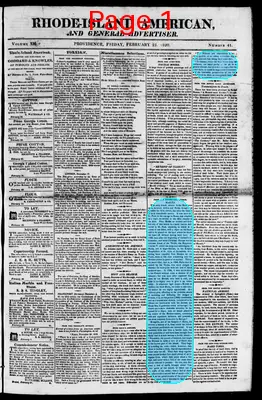
The Rhode Island American, And General Advertiser
Providence, Providence County, Rhode Island
What is this article about?
Historical overview of Malta: biblical site, ceded to Knights Hospitallers in 1530, repelled Turkish siege in 1565 with 30,000 losses, captured from French by British in 1798; valued for military and commercial importance in 1805; details on fertility, diet, and climate.
Clipping
OCR Quality
Full Text
MALTA.
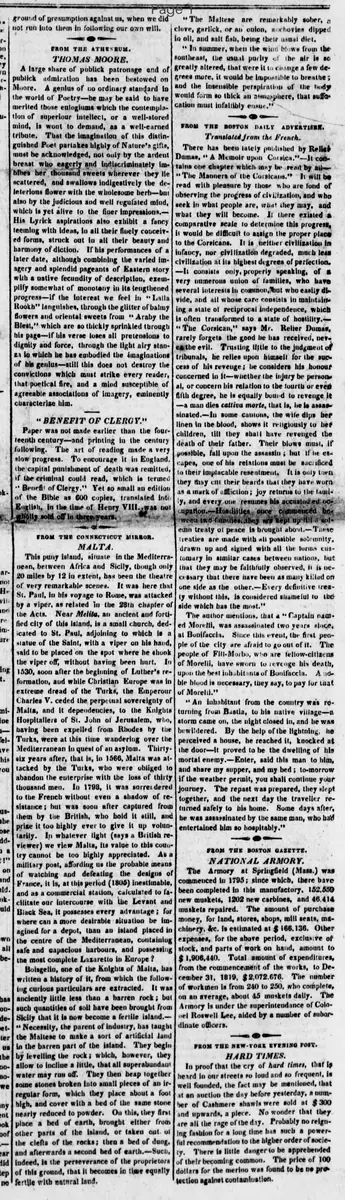
This puny island, situate in the Mediterranean, between Africa and Sicily, though only 20 miles by 12 in extent, has been the theatre of very remarkable scenes. It was here that St. Paul, in his voyage to Rome, was attacked by a viper, as related in the 28th chapter of the Acts. Near Melite, an ancient and fortified city of this island, is a small church, dedicated to St. Paul, adjoining to which is a statue of the Saint, with a viper on his hand, said to be placed on the spot where he shook the viper off, without having been hurt. In 1530, soon after the beginning of Luther's reformation, and while Christian Europe was in extreme dread of the Turks, the Emperor Charles V. ceded the perpetual sovereignty of Malta, and its dependencies, to the Knights Hospitallers of St. John of Jerusalem, who, having been expelled from Rhodes by the Turks, were at this time wandering over the Mediterranean in quest of an asylum. Thirty-six years after, that is, in 1565, Malta was attacked by the Turks, who were obliged to abandon the enterprise with the loss of thirty thousand men. In 1798, it was surrendered to the French without even a shadow of resistance; but was soon after captured from them by the British, who hold it still, and prize it too highly ever to give it up voluntarily. In whatever light (says a British reviewer) we view Malta, its value to this country cannot be too highly appreciated. As a military post, affording us the probable means of watching and defeating the designs of France, it is, at this period (1805) inestimable, and as a commercial station, calculated to facilitate our intercourse with the Levant and Black Sea, it possesses every advantage; for where can a more desirable situation be imagined for a depot, than an island placed in the centre of the Mediterranean, containing safe and capacious harbours, and possessing the most complete Lazaretto in Europe?
Boisgelin, one of the Knights of Malta, has written a history of it, from which the following curious particulars are extracted. It was anciently little less than a barren rock; but such quantities of soil have been brought from Sicily that it is now become a fertile island.— "Necessity, the parent of industry, has taught the Maltese to make a sort of artificial land in the barren part of the island. They begin by levelling the rock; which, however, they allow to incline a little, that all superabundant water may run off. They then heap together some stones broken into small pieces of an irregular form, which they place about a foot high, and cover with a bed of the same stone nearly reduced to powder. On this, they first place a bed of earth, brought either from other parts of the island, or taken out of the clefts of the rocks; then a bed of dung, and afterwards a second bed of earth.—Such, indeed, is the perseverance of the proprietors of this ground, that it becomes in time equally fertile with natural land."
"The Maltese are remarkably sober, a clove, garlick, or an onion, anchovies dipped in oil, and salt fish, being their usual diet.
"In summer, when the wind blows from the southeast, the usual purity of the air is so greatly altered, that were it to change a few degrees more, it would be impossible to breathe; and the insensible perspiration of the body would form so thick an atmosphere, that suffocation must infallibly ensue."
What sub-type of article is it?
What keywords are associated?
What entities or persons were involved?
Where did it happen?
Foreign News Details
Primary Location
Malta
Event Date
Historical Overview From Ancient Times To 1805
Key Persons
Outcome
in 1565, turks abandoned the enterprise with the loss of thirty thousand men; in 1798, surrendered to the french without resistance, then captured by the british who hold it still
Event Details
Malta, a small island in the Mediterranean, has biblical associations with St. Paul; in 1530, ceded by Emperor Charles V. to the Knights Hospitallers of St. John after their expulsion from Rhodes; in 1565, attacked by Turks who failed with heavy losses; in 1798, surrendered to French and soon captured by British, valued as military post and commercial station; anciently barren but made fertile through artificial soil; Maltese diet and air conditions described