Thank you for visiting SNEWPapers!
Sign up free
Letter to Editor
March 5, 1847
The Liberator
Boston, Suffolk County, Massachusetts
What is this article about?
Jonathan Walker writes to William Lloyd Garrison seeking his views on abstaining from slave-labor products, prompted by Lea H. Gause's query in The Liberator. He reflects on his own efforts and the pervasive difficulties in completely avoiding such products in daily life, while reaffirming his commitment to abolition.
Clipping
OCR Quality
95%
Excellent
Full Text
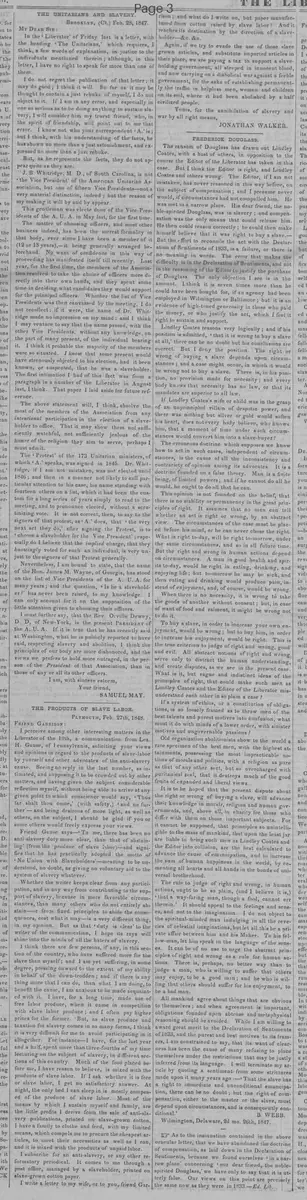
THE PRODUCTS OF SLAVE LABOR.
PLYMOUTH, Feb. 27th, 1847.
FRIEND GARRISON:
I perceive among other interesting matters in the Liberator of the 19th, a communication from Lea. H. Gause, of Pennsylvania, soliciting your views and opinions in regard to the products of slave-labor by yourself and other advocates of the anti-slavery cause. Seeing no reply in the last number, as intimated, and supposing it to be crowded out by other matters, and having given the subject considerable reflection myself, without being able to arrive at any given point to which conscience would say, Thus far shalt thou come,' (with safety,) and no further'—and being desirous of more light, as well as others, on the subject, I should be glad if you or some others would freely express your views.
Friend Gause says— To me, there has been no anti-slavery duty more clear, than that of abstaining'(from the produce of slave labor)—and signifies that he has practically adopted the motto of No Union with Slaveholders'—meaning to be understood, no doubt, as giving no voluntary aid to the system of slavery whatever.
Whether the writer keeps clear from any participation, and in any way from contributing to the support of slavery, because in more favorable circumstances, than many others who do not entirely abstain—or from fixed principles to abide the consequences, cost what it may—is a very different thing, in my opinion. But as that 'duty is clear' to the writer of the communication, I hope its rays will shine into the minds of all the haters of slavery.
I think there are few persons, if any, in this section of the country, who have suffered more for the slave than myself; and I am yet suffering, in some degree, pressing onward to the extent of my ability in behalf of the down-trodden; and if there is anything more that I can do, than what I am doing, to benefit the cause, I am anxious to be made acquainted with it. I have, for a long time, made use of free labor produce, when it came in competition with slave labor produce; and I often pay higher prices for the former. But, as slave produce and taxation for slavery comes in so many forms, I think it is very difficult for me to avoid participating in it altogether. For instance—I have, for the last year and a half, spent more than three-fourths of my time lecturing on the subject of slavery, in different sections of this country. Much of the food placed before me, I have reason to believe, is mixed with the products of slave labor. If I ask whether it is free or slave labor, I get no satisfactory answer. At night, the only bed I can sleep in is mostly composed of the produce of slave labor. Most of the means by which I sustain myself and family, are the little profits I derive from the sale of anti-slavery publications, printed on slave-grown cotton. I have a family to clothe and feed, with my limited means, which compels me to procure the cheapest articles, to meet their necessities as well as I can, and it is mixed with the products of unpaid labor.
I subscribe for an anti-slavery, or any other reformatory periodical. It comes to me through a post office, managed by a slaveholder, printed on slave-grown cotton paper.
I write a letter to my wife, or to you, friend Garrison; and what do I write on, but paper manufactured from cotton raised by slave labor? And it reaches its destination by the direction of a slaveholder—&c. &c.
Again, if we try to evade the use of those slave grown articles, and substitute imported articles in their place, we are paying a tax to support a slaveholding government, all steeped in innocent blood, and now carrying on a diabolical war against a feeble government, for the sake of establishing permanently the traffic in helpless men, women and children on its soil, where it had been abolished by a half civilized people.
Yours, for the annihilation of slavery and war by all right means,
JONATHAN WALKER.
PLYMOUTH, Feb. 27th, 1847.
FRIEND GARRISON:
I perceive among other interesting matters in the Liberator of the 19th, a communication from Lea. H. Gause, of Pennsylvania, soliciting your views and opinions in regard to the products of slave-labor by yourself and other advocates of the anti-slavery cause. Seeing no reply in the last number, as intimated, and supposing it to be crowded out by other matters, and having given the subject considerable reflection myself, without being able to arrive at any given point to which conscience would say, Thus far shalt thou come,' (with safety,) and no further'—and being desirous of more light, as well as others, on the subject, I should be glad if you or some others would freely express your views.
Friend Gause says— To me, there has been no anti-slavery duty more clear, than that of abstaining'(from the produce of slave labor)—and signifies that he has practically adopted the motto of No Union with Slaveholders'—meaning to be understood, no doubt, as giving no voluntary aid to the system of slavery whatever.
Whether the writer keeps clear from any participation, and in any way from contributing to the support of slavery, because in more favorable circumstances, than many others who do not entirely abstain—or from fixed principles to abide the consequences, cost what it may—is a very different thing, in my opinion. But as that 'duty is clear' to the writer of the communication, I hope its rays will shine into the minds of all the haters of slavery.
I think there are few persons, if any, in this section of the country, who have suffered more for the slave than myself; and I am yet suffering, in some degree, pressing onward to the extent of my ability in behalf of the down-trodden; and if there is anything more that I can do, than what I am doing, to benefit the cause, I am anxious to be made acquainted with it. I have, for a long time, made use of free labor produce, when it came in competition with slave labor produce; and I often pay higher prices for the former. But, as slave produce and taxation for slavery comes in so many forms, I think it is very difficult for me to avoid participating in it altogether. For instance—I have, for the last year and a half, spent more than three-fourths of my time lecturing on the subject of slavery, in different sections of this country. Much of the food placed before me, I have reason to believe, is mixed with the products of slave labor. If I ask whether it is free or slave labor, I get no satisfactory answer. At night, the only bed I can sleep in is mostly composed of the produce of slave labor. Most of the means by which I sustain myself and family, are the little profits I derive from the sale of anti-slavery publications, printed on slave-grown cotton. I have a family to clothe and feed, with my limited means, which compels me to procure the cheapest articles, to meet their necessities as well as I can, and it is mixed with the products of unpaid labor.
I subscribe for an anti-slavery, or any other reformatory periodical. It comes to me through a post office, managed by a slaveholder, printed on slave-grown cotton paper.
I write a letter to my wife, or to you, friend Garrison; and what do I write on, but paper manufactured from cotton raised by slave labor? And it reaches its destination by the direction of a slaveholder—&c. &c.
Again, if we try to evade the use of those slave grown articles, and substitute imported articles in their place, we are paying a tax to support a slaveholding government, all steeped in innocent blood, and now carrying on a diabolical war against a feeble government, for the sake of establishing permanently the traffic in helpless men, women and children on its soil, where it had been abolished by a half civilized people.
Yours, for the annihilation of slavery and war by all right means,
JONATHAN WALKER.
What sub-type of article is it?
Ethical Moral
Persuasive
Reflective
What themes does it cover?
Slavery Abolition
Morality
What keywords are associated?
Slave Labor Products
Abstention Duty
Anti Slavery Cause
Jonathan Walker
William Garrison
Liberator
No Union With Slaveholders
What entities or persons were involved?
Jonathan Walker
Friend Garrison
Letter to Editor Details
Author
Jonathan Walker
Recipient
Friend Garrison
Main Argument
the writer seeks garrison's and others' views on abstaining from slave-labor products, as prompted by gause's query, and shares his personal challenges in fully avoiding them due to their ubiquity in daily life while committing to do more for the cause if possible.
Notable Details
References Lea H. Gause's Communication In The Liberator
Personal Suffering And Lecturing On Slavery
Examples Of Unavoidable Slave Products: Food, Beds, Publications, Paper, Postal System
Criticism Of Slaveholding Government And Mexican War