Thank you for visiting SNEWPapers!
Sign up free
Editorial
September 23, 1801
The Providence Journal, And Town And Country Advertiser
Providence, Providence County, Rhode Island
What is this article about?
An editorial from the Salem Gazette argues against capital punishment, advocating for humane alternatives that reform criminals while ensuring public safety. It critiques the assumption that death deters crime and calls for experiments in penal reform, drawing on European examples.
Merged-components note: Continuation of the same argumentative article on capital punishments across pages; labeled as editorial due to opinionated content.
Clippings
1 of 2
OCR Quality
95%
Excellent
Full Text
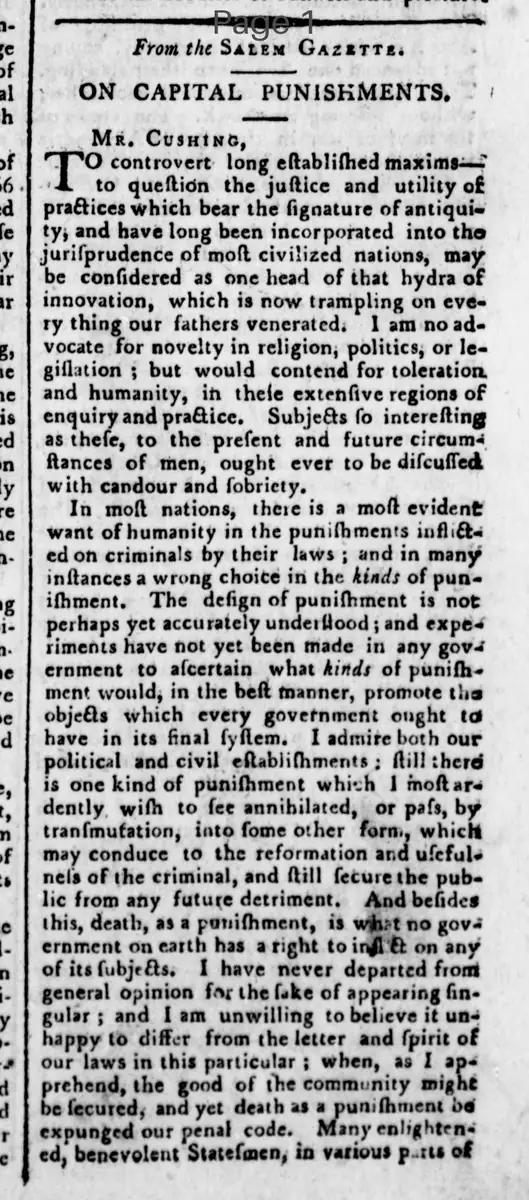
From the Salem Gazette:
ON CAPITAL PUNISHMENTS.
To controvert long established maxims: Mr. Cushing, to question the justice and utility of practices which bear the signature of antiquity, and have long been incorporated into the jurisprudence of most civilized nations, may be considered as one head of that hydra of innovation, which is now trampling on every thing our fathers venerated: I am no advocate for novelty in religion, politics, or legislation; but would contend for toleration and humanity, in these extensive regions of enquiry and practice. Subjects so interesting as these, to the present and future circumstances of men, ought ever to be discussed with candour and sobriety.
In most nations, there is a most evident want of humanity in the punishments inflicted on criminals by their laws; and in many instances a wrong choice in the kinds of punishment. The design of punishment is not perhaps yet accurately understood; and experiments have not yet been made in any government to ascertain what kinds of punishment would, in the best manner, promote the objects which every government ought to have in its final system. I admire both our political and civil establishments: still there is one kind of punishment which I most ardently wish to see annihilated, or pass, by transmutation, into some other form, which may conduce to the reformation and usefulness of the criminal, and still secure the public from any future detriment. And besides this, death, as a punishment, is what no government on earth has a right to inflict on any of its subjects. I have never departed from general opinion for the sake of appearing singular; and I am unwilling to believe it unhappy to differ from the letter and spirit of our laws in this particular; when, as I apprehend, the good of the community might be secured, and yet death as a punishment be expunged our penal code. Many enlightened, benevolent Statesmen, in various parts of
Europe, who were devoted friends to a well organized, energetic government, have written against capital punishments; and some governments have so far listened to the voice of reason and humanity, as to make the experiment, and have happily found, that the multiplication of crimes was not the consequence of abolishing death as a civil punishment.
Legislators have proceeded upon this principle, that death, in the view of all characters, is the greatest evil, and therefore most likely to deter men from the commission of crimes.
But this position is not true; for it is a fact, that many men consider other events productive of much greater evil than death; hence, in the expectation of those events, death is resorted to—as a happy asylum from their approach.
The suppression of crimes is certainly the first object in the formation of laws; and it is the voice of reason and humanity, that such penalties should be annexed to these laws, as would render them the most influential on the conduct of the subjects.
And if it be possible (as I think it is) to invent such sanctions as provide for the emendation and usefulness of the offender, and yet secure the public, a very important object would be obtained.
Human existence has been sported with in every age, and almost in every country. Those sanguinary and infernal wars, which the folly and wickedness of men have perpetuated from age to age, have largely contributed to destroy that inviolability which ever ought to be attached to human life.
This sacred gift of heaven has been ravished from men, under pretence of laws, called military, civil, or ecclesiastical, according to the pride, caprice, or ignorance of men in power.
To meliorate the penal systems of nations, and if possible provide for the reformation and usefulness of the culprit, consistently with public safety, are objects worthy the regard of the humane and enlightened in every country.
It is certainly contrary to every known principle of human nature, to believe that a man becomes, by the commission of one crime, absolutely incorrigible; and that no hope can be indulged of his reformation, and future usefulness to society, in any possible way; and it yet wants actual experiments to prove that his life, in every respect, and in every place, is wholly incompatible with the good of society.
I will conclude this number by expressing a wish to see a rational vindication of death as a civil punishment: for if this position rests on the basis of humanity, of public necessity, or of divine revelation, when rightly interpreted, I will not contend.
In some future numbers we may see how far death inflicted as a punishment by civil government, is agreeable to these sources of authority.
Humanity.
ON CAPITAL PUNISHMENTS.
To controvert long established maxims: Mr. Cushing, to question the justice and utility of practices which bear the signature of antiquity, and have long been incorporated into the jurisprudence of most civilized nations, may be considered as one head of that hydra of innovation, which is now trampling on every thing our fathers venerated: I am no advocate for novelty in religion, politics, or legislation; but would contend for toleration and humanity, in these extensive regions of enquiry and practice. Subjects so interesting as these, to the present and future circumstances of men, ought ever to be discussed with candour and sobriety.
In most nations, there is a most evident want of humanity in the punishments inflicted on criminals by their laws; and in many instances a wrong choice in the kinds of punishment. The design of punishment is not perhaps yet accurately understood; and experiments have not yet been made in any government to ascertain what kinds of punishment would, in the best manner, promote the objects which every government ought to have in its final system. I admire both our political and civil establishments: still there is one kind of punishment which I most ardently wish to see annihilated, or pass, by transmutation, into some other form, which may conduce to the reformation and usefulness of the criminal, and still secure the public from any future detriment. And besides this, death, as a punishment, is what no government on earth has a right to inflict on any of its subjects. I have never departed from general opinion for the sake of appearing singular; and I am unwilling to believe it unhappy to differ from the letter and spirit of our laws in this particular; when, as I apprehend, the good of the community might be secured, and yet death as a punishment be expunged our penal code. Many enlightened, benevolent Statesmen, in various parts of
Europe, who were devoted friends to a well organized, energetic government, have written against capital punishments; and some governments have so far listened to the voice of reason and humanity, as to make the experiment, and have happily found, that the multiplication of crimes was not the consequence of abolishing death as a civil punishment.
Legislators have proceeded upon this principle, that death, in the view of all characters, is the greatest evil, and therefore most likely to deter men from the commission of crimes.
But this position is not true; for it is a fact, that many men consider other events productive of much greater evil than death; hence, in the expectation of those events, death is resorted to—as a happy asylum from their approach.
The suppression of crimes is certainly the first object in the formation of laws; and it is the voice of reason and humanity, that such penalties should be annexed to these laws, as would render them the most influential on the conduct of the subjects.
And if it be possible (as I think it is) to invent such sanctions as provide for the emendation and usefulness of the offender, and yet secure the public, a very important object would be obtained.
Human existence has been sported with in every age, and almost in every country. Those sanguinary and infernal wars, which the folly and wickedness of men have perpetuated from age to age, have largely contributed to destroy that inviolability which ever ought to be attached to human life.
This sacred gift of heaven has been ravished from men, under pretence of laws, called military, civil, or ecclesiastical, according to the pride, caprice, or ignorance of men in power.
To meliorate the penal systems of nations, and if possible provide for the reformation and usefulness of the culprit, consistently with public safety, are objects worthy the regard of the humane and enlightened in every country.
It is certainly contrary to every known principle of human nature, to believe that a man becomes, by the commission of one crime, absolutely incorrigible; and that no hope can be indulged of his reformation, and future usefulness to society, in any possible way; and it yet wants actual experiments to prove that his life, in every respect, and in every place, is wholly incompatible with the good of society.
I will conclude this number by expressing a wish to see a rational vindication of death as a civil punishment: for if this position rests on the basis of humanity, of public necessity, or of divine revelation, when rightly interpreted, I will not contend.
In some future numbers we may see how far death inflicted as a punishment by civil government, is agreeable to these sources of authority.
Humanity.
What sub-type of article is it?
Crime Or Punishment
Legal Reform
Moral Or Religious
What keywords are associated?
Capital Punishment
Penal Reform
Humanity In Law
Death Penalty Abolition
Criminal Reformation
Public Safety
What entities or persons were involved?
Mr. Cushing
European Statesmen
Editorial Details
Primary Topic
Opposition To Capital Punishment
Stance / Tone
Advocacy For Humane Penal Reform And Abolition Of Death Penalty
Key Figures
Mr. Cushing
European Statesmen
Key Arguments
Punishments Lack Humanity And Proper Design For Reformation.
No Government Has The Right To Inflict Death On Subjects.
Death Does Not Deter All Criminals, As Some See It As Relief From Worse Evils.
Alternatives Can Reform Offenders While Securing Public Safety.
European Examples Show Abolition Does Not Increase Crime.
Human Life Is Sacred And Should Not Be Taken Under Civil Law.
One Crime Does Not Make A Person Incorrigible.
Calls For Experiments In Non Capital Punishments.