Thank you for visiting SNEWPapers!
Sign up free
Literary
November 20, 1868
New Hampshire Statesman
Concord, Merrimack County, New Hampshire
What is this article about?
Reflective essay on the unseen beginnings of natural processes, illustrated by the winter life of the crocus bulb, emphasizing divine love, gratitude, and the value of observing nature's subtle wonders to appreciate the grand.
Clipping
OCR Quality
98%
Excellent
Full Text
PLANTS IN WINTER.
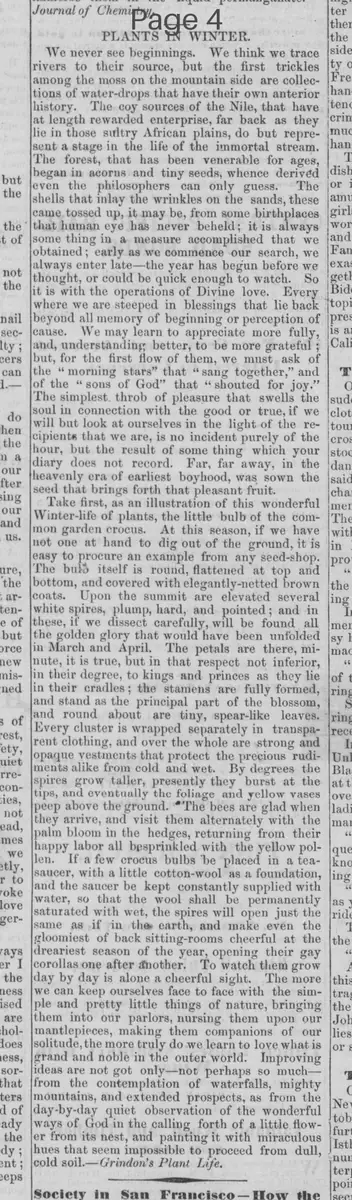
We never see beginnings. We think we trace rivers to their source, but the first trickles among the moss on the mountain side are collections of water-drops that have their own anterior history. The coy sources of the Nile, that have at length rewarded enterprise, far back as they lie in those sultry African plains, do but represent a stage in the life of the immortal stream. The forest, that has been venerable for ages, began in acorns and tiny seeds, whence derived even the philosophers can only guess. The shells that inlay the wrinkles on the sands, these came tossed up, it may be, from some birthplaces that human eye has never beheld; it is always something in a measure accomplished that we obtained; early as we commence our search, we always enter late—the year has begun before we thought, or could be quick enough to watch. So it is with the operations of Divine love. Everywhere we are steeped in blessings that lie back beyond all memory of beginning or perception of cause. We may learn to appreciate more fully, and, understanding, better, to be more grateful; but, for the first flow of them, we must ask of the "morning stars" that "sang together," and of the "sons of God" that "shouted for joy."
The simplest throb of pleasure that swells the soul in connection with the good or true, if we will but look at ourselves in the light of the recipients that we are, is no incident purely of the hour, but the result of something which your diary does not record. Far, far away, in the heavenly era of earliest boyhood, was sown the seed that brings forth that pleasant fruit.
Take first, as an illustration of this wonderful Winter-life of plants, the little bulb of the common garden crocus. At this season, if we have not one at hand to dig out of the ground, it is easy to procure an example from any seed-shop. The bulb itself is round, flattened at top and bottom, and covered with elegantly-netted brown coats. Upon the summit are elevated several white spires, plump, hard, and pointed; and in these, if we dissect carefully, will be found all the golden glory that would have been unfolded in March and April. The petals are there, minute, it is true, but in that respect not inferior in their degree, to kings and princes as they lie in their cradles; the stamens are fully formed, and stand as the principal part of the blossom, and round about are tiny, spear-like leaves. Every cluster is wrapped separately in transparent clothing, and over the whole are strong and opaque vestments that protect the precious rudiments alike from cold and wet. By degrees the spires grow taller, presently they burst at the tips, and eventually the foliage and yellow vases peep above the ground. The bees are glad when they arrive, and visit them alternately with the palm bloom in the hedges, returning from their happy labor all besprinkled with the yellow pollen. If a few crocus bulbs be placed in a tea saucer, with a little cotton-wool as a foundation, and the saucer be kept constantly supplied with water, so that the wool shall be permanently saturated with wet, the spires will open just the same as if in the earth, and make even the gloomiest of back sitting-rooms cheerful at the dreariest season of the year, opening their gay corollas one after another. To watch them grow day by day is alone a cheerful sight. The more we can keep ourselves face to face with the simple and pretty little things of nature, bringing them into our parlors, nursing them upon our mantlepieces, making them companions of our solitude, the more truly do we learn to love what is grand and noble in the outer world. Improving ideas are not got only—not perhaps so much—from the contemplation of waterfalls, mighty mountains, and extended prospects, as from the day-by-day quiet observation of the wonderful ways of God in the calling forth of a little flower from its nest, and painting it with miraculous hues that seem impossible to proceed from dull, cold soil.—Grindon's Plant Life.
We never see beginnings. We think we trace rivers to their source, but the first trickles among the moss on the mountain side are collections of water-drops that have their own anterior history. The coy sources of the Nile, that have at length rewarded enterprise, far back as they lie in those sultry African plains, do but represent a stage in the life of the immortal stream. The forest, that has been venerable for ages, began in acorns and tiny seeds, whence derived even the philosophers can only guess. The shells that inlay the wrinkles on the sands, these came tossed up, it may be, from some birthplaces that human eye has never beheld; it is always something in a measure accomplished that we obtained; early as we commence our search, we always enter late—the year has begun before we thought, or could be quick enough to watch. So it is with the operations of Divine love. Everywhere we are steeped in blessings that lie back beyond all memory of beginning or perception of cause. We may learn to appreciate more fully, and, understanding, better, to be more grateful; but, for the first flow of them, we must ask of the "morning stars" that "sang together," and of the "sons of God" that "shouted for joy."
The simplest throb of pleasure that swells the soul in connection with the good or true, if we will but look at ourselves in the light of the recipients that we are, is no incident purely of the hour, but the result of something which your diary does not record. Far, far away, in the heavenly era of earliest boyhood, was sown the seed that brings forth that pleasant fruit.
Take first, as an illustration of this wonderful Winter-life of plants, the little bulb of the common garden crocus. At this season, if we have not one at hand to dig out of the ground, it is easy to procure an example from any seed-shop. The bulb itself is round, flattened at top and bottom, and covered with elegantly-netted brown coats. Upon the summit are elevated several white spires, plump, hard, and pointed; and in these, if we dissect carefully, will be found all the golden glory that would have been unfolded in March and April. The petals are there, minute, it is true, but in that respect not inferior in their degree, to kings and princes as they lie in their cradles; the stamens are fully formed, and stand as the principal part of the blossom, and round about are tiny, spear-like leaves. Every cluster is wrapped separately in transparent clothing, and over the whole are strong and opaque vestments that protect the precious rudiments alike from cold and wet. By degrees the spires grow taller, presently they burst at the tips, and eventually the foliage and yellow vases peep above the ground. The bees are glad when they arrive, and visit them alternately with the palm bloom in the hedges, returning from their happy labor all besprinkled with the yellow pollen. If a few crocus bulbs be placed in a tea saucer, with a little cotton-wool as a foundation, and the saucer be kept constantly supplied with water, so that the wool shall be permanently saturated with wet, the spires will open just the same as if in the earth, and make even the gloomiest of back sitting-rooms cheerful at the dreariest season of the year, opening their gay corollas one after another. To watch them grow day by day is alone a cheerful sight. The more we can keep ourselves face to face with the simple and pretty little things of nature, bringing them into our parlors, nursing them upon our mantlepieces, making them companions of our solitude, the more truly do we learn to love what is grand and noble in the outer world. Improving ideas are not got only—not perhaps so much—from the contemplation of waterfalls, mighty mountains, and extended prospects, as from the day-by-day quiet observation of the wonderful ways of God in the calling forth of a little flower from its nest, and painting it with miraculous hues that seem impossible to proceed from dull, cold soil.—Grindon's Plant Life.
What sub-type of article is it?
Essay
What themes does it cover?
Nature
Religious
Moral Virtue
What keywords are associated?
Winter Plants
Crocus Bulb
Divine Love
Nature Observation
Gratitude
Beginnings
Botany
Spiritual Reflection
What entities or persons were involved?
Grindon's Plant Life
Literary Details
Title
Plants In Winter.
Author
Grindon's Plant Life
Subject
Winter Life Of Plants, Illustrated By The Crocus
Key Lines
We Never See Beginnings.
So It Is With The Operations Of Divine Love.
Take First, As An Illustration Of This Wonderful Winter Life Of Plants, The Little Bulb Of The Common Garden Crocus.
The More We Can Keep Ourselves Face To Face With The Simple And Pretty Little Things Of Nature... The More Truly Do We Learn To Love What Is Grand And Noble In The Outer World.
Improving Ideas Are Not Got Only—Not Perhaps So Much—From The Contemplation Of Waterfalls, Mighty Mountains, And Extended Prospects, As From The Day By Day Quiet Observation Of The Wonderful Ways Of God In The Calling Forth Of A Little Flower From Its Nest...