Thank you for visiting SNEWPapers!
Sign up free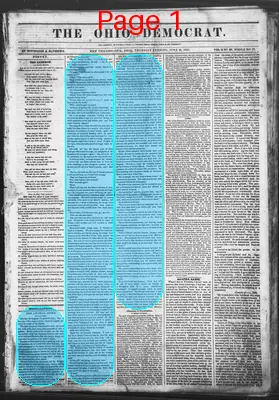
Literary
June 24, 1841
The Ohio Democrat
New Philadelphia, Tuscarawas County, Ohio
What is this article about?
In the reign of Emperor Akbar, Ada, daughter of a rajah, falls in love with Selim, a young Moor. She tests his constancy by making him ride and swim the Jumma daily for a year on an Arabian steed. At the next festival, they elope on the horse, escaping pursuers by crossing the river.
Merged-components note: Continuation of the story 'The Arabian Steed' split across components on the same page.
Clipping
OCR Quality
95%
Excellent
Full Text
MISCELLANEOUS.
THE ARABIAN STEED.
BY T. H. BAILY.
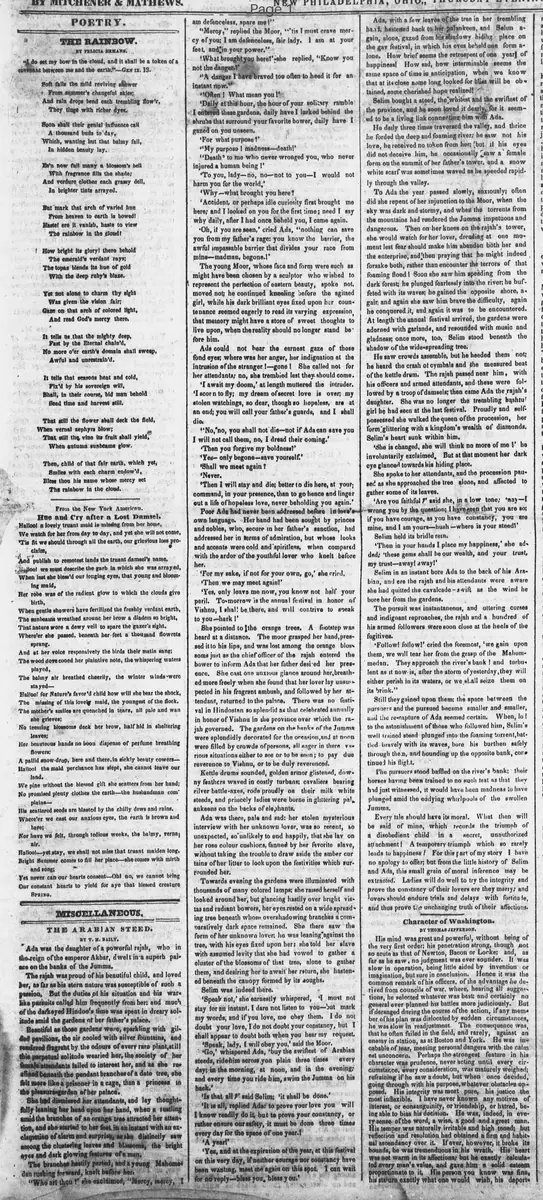
Ada was the daughter of a powerful rajah, who in the reign of the emperor Akbar, dwelt in a superb palace on the banks of the Jumma.
The rajah was proud of his beautiful child, and loved her, as far as his stern nature was susceptible of such a passion. But the duties of his situation and his warlike pursuits called him frequently from her: and much of the dark-eyed Hindoo's time was spent in dreary solitude amid the gardens of her father's palace.
Beautiful as those gardens were, sparkling with gilded pavilions, the air cooled with silver fountains, and rendered fragrant by the odours of every rare plant, still this perpetual solitude wearied her, the society of her female attendants failed to interest her, and as she reclined beneath the pendent branches of a date tree, she felt more like a prisoner in a cage, than a princess in the pleasure-garden of her palace.
She had dismissed her attendants, and lay thoughtfully leaning her head upon her hand, when a rustling amid the branches of an orange tree attracted her attention, and she started to her feet in an instant with an exclamation of alarm and surprise, as she distinctly saw among the clustering leaves and blossoms, the bright eyes and dark glowing features of a man.
The branches hastily parted, and a young Mahomedan rushing forward, knelt before her.
"Who art thou?" she exclaimed, "Mercy, mercy, I am defenceless, spare me!"
"Mercy," replied the Moor, "'tis I must crave mercy of you; I am defenceless, fair lady. I am at your feet, and in your power."
"What brought you here?"—she replied, "Know you not the danger?"
"A danger I have braved too often to heed it for an instant now."
"Often! What mean you!"
"Daily at this hour, the hour of your solitary ramble I entered these gardens, daily have I lurked behind the shrubs that surround your favorite bower, daily have I gazed on you unseen."
"For what purpose?"
"My purpose—madness—death!"
"Death to me who never wronged you, who never injured a human being!"
"To you, lady—no, no—not to you—I would not harm you for the world."
"Why—what brought you here?"
"Accident, or perhaps idle curiosity first brought me here; and I looked on you for the first time; need I say why daily, after I had once beheld you, I came again. Oh, if you are seen," cried Ada, "nothing can save you from my father's rage: you know the barrier, the awful impassable barrier that divides your race from mine—madman, begone!"
The young Moor, whose face and form were such as might have been chosen by a sculptor who wished to represent the perfection of eastern beauty, spoke not, moved not; he continued kneeling before the agitated girl, while his dark brilliant eyes fixed upon her countenance seemed eagerly to read its varying expression that memory might have a store of sweet thoughts to live upon, when the reality should no longer stand before him.
Ada could not bear the earnest gaze of those fond eyes; where was her anger, her indignation at the intrusion of the stranger—I—gone! She called not for her attendants; no, she trembled lest they should come.
"I await my doom," at length muttered the intruder. "I scorn to fly; my dream of secret love is over; my stolen watchings, so dear, though so hopeless, are at an end; you will call your father's guards, and I shall die."
"No," no, you shall not die—not if Ada can save you I will not call them, no, I dread their coming."
"Then you forgive my boldness?"
"Yes—only begone—save yourself."
"Shall we meet again?"
"Never."
"Then I will stay and die; better to die here, at your command, in your presence, than to go hence and linger out a life of hopeless love, never beholding you again."
Poor Ada had never been addressed before in love's own language. Her hand had been sought by princes and nobles, who, secure in her father's sanction, had addressed her in terms of admiration, but whose looks and accents were cold and spiritless, when compared with the ardor of the youthful lover who knelt before her.
"For my sake, if not for your own, go," she cried.
"Then, we may meet again?"
"Yes, only leave me now, you know not half your peril. To-morrow is the annual festival in honor of Vishnu, I shall be there, and will contrive to speak to you—hark!"
She pointed to the orange trees. A footstep was heard at a distance. The moor grasped her hand, pressed it to his lips, and was lost among the orange blossoms just as the chief officer of the rajah entered the bower to inform Ada that her father desired her presence. She cast one anxious glance around her, breathed more freely when she found that her lover lay unsuspected in his fragrant ambush, and followed by her attendant, returned to the palace. There was no festival in Hindostan so splendid as that celebrated annually in honor of Vishnu in the province over which the rajah governed. The gardens on the banks of the Jumma were splendidly decorated for the occasion, and at noon were filled by crowds of persons, all eager in their various situations either to see or to be seen; to pay due reverence to Vishnu, or to be duly reverenced.
Kettle drums sounded, golden armor glistened, downy feathers waved in costly turbans; cavaliers bearing silver battle-axes, rode proudly on their milk white steeds, and princely ladies were borne in glittering palankeen on the backs of elephants.
Ada was there, pale and sad: her stolen mysterious interview with her unknown lover, was so recent, so unexpected, so unlikely to end happily, that she lay on her rose colour cushions, fanned by her favorite slave, without taking the trouble to draw aside the amber curtains of her litter to look upon the festivities which surrounded her.
Towards evening the gardens were illuminated with thousands of many colored lamps; she raised herself and looked around her, but glancing hastily over bright vistas and radiant bowers, her eyes rested on a wide spreading tree beneath whose overshadowing branches a comparatively dark space remained. She there saw the form of her unknown lover; he was leaning against the tree, with his eyes fixed upon her; she told her slave with assumed levity that she had vowed to gather a cluster of the blossoms of that tree, alone to gather them, and desiring her to await her return, she hastened beneath the canopy formed by its boughs.
Selim was indeed there.
"Speak not," she earnestly whispered, "I must not stay for an instant. I dare not listen to you—but mark my words, and if you love me obey them. I do not doubt your love, I do not doubt your constancy, but I shall appear to doubt both when you hear my request."
"Speak, lady, I will obey you," said the Moor.
"Go," whispered Ada, "buy the swiftest of Arabian steeds, ride him across yon plain three times every day; in the morning, at noon, and in the evening; and every time you ride him, swim the Jumma on his back."
"Is that all?" said Selim: "it shall be done."
"It is all," replied Ada: "to prove your love you will I know readily do it, but to prove your constancy, or rather ensure our safety, it must be done three times every day for the space of one year."
"A year!"
"Yes, and at the expiration of the year, at this festival on this very day, if neither courage nor constancy have been wanting, meet me again on this spot. I can wait for no reply—bless you! bless you."
Ada, with a few leaves of the tree in her trembling hand, hastened back to her palankeen, and Selim again, alone, gazed from his shadowy hiding place on the gay festival, in which his eyes beheld one form alone. How brief seems the retrospect of one year of happiness! How sad, how interminable seems the same space of time in anticipation, when we know that at its close some long looked for bliss will be obtained, some cherished hope realized!
Selim bought a steed, the whitest and the swiftest of the province, and he soon loved it dearly, for it seemed to be a living link connecting him with Ada.
He daily three times traversed the valley, and thrice he forded the deep and foaming river; he saw not his love, he received no token from her; but if his eyes did not deceive him, he occasionally saw a female form on the summit of her father's tower, and a snow white scarf was sometimes waved as he speeded rapidly through the valley.
To Ada the year passed slowly, anxiously; often did she repent of her injunction to the Moor, when the sky was dark and stormy, and when the torrents from the mountains had rendered the Jumma impetuous and dangerous. Then on her knees on the rajah's tower, she would watch for her lover, dreading at one moment lest fear should make him abandon both her and the enterprise, and then praying that he might indeed forsake both, rather than encounter the terrors of that foaming flood! Soon she saw him speeding from the dark forest; he plunged fearlessly into the river; he buffeted with its waves; he gained the opposite shore, again and again she saw him brave the difficulty, again he conquered it, and again it was to be encountered.
At length the annual festival arrived, the gardens were adorned with garlands, and resounded with music and gladness; once more, too, Selim stood beneath the shadow of the wide-spreading tree.
He saw crowds assemble, but he heeded them not; he heard the crash of cymbals and the measured beat of the kettle drum. The rajah passed near him, with his officers and armed attendants, and these were followed by a troop of damsels; then came Ada the rajah's daughter. She was no longer the trembling bashful girl he had seen at the last festival. Proudly and self-possessed she walked the queen of the procession, her form glittering with a kingdom's wealth of diamonds.
Selim's heart sunk within him.
"She is changed, she will think no more of me!" he involuntarily exclaimed. But at that moment her dark eye glanced towards his hiding place.
She spoke to her attendants, and the procession paused as she approached the tree alone, and affected to gather some of its leaves.
"Are you faithful?" said she, in a low tone; "nay—I wrong you by the question; I know that you are so; if you have courage, as you have constancy, you are mine, and I am yours—hush—where is your steed!"
Selim held its bridle rein.
"Then in your hands I place my happiness," she added; "these gems shall be our wealth, and your trust, my trust—away! away!"
Selim in an instant bore Ada to the back of his Arabian, and ere the rajah and his attendants were aware she had quitted the cavalcade—swift as the wind he bore her from the gardens.
The pursuit was instantaneous, and uttering curses and indignant reproaches, the rajah and a hundred of his armed followers were soon close at the heels of the fugitives.
"Follow! follow!" cried the foremost, "we gain upon them, we will tear her from the grasp of the Mahomedan. They approach the river's bank! and turbulent as it now is, after the storm of yesterday, they will either perish in its waters, or we shall seize them on its brink."
Still they gained upon them; the space between the pursuers and the pursued became smaller and smaller, and the re-capture of Ada seemed certain. When, lo! to the astonishment of those who followed him, Selim's well trained steed plunged into the foaming torrent, battled bravely with its waves, bore his burthen safely through them, and bounding up the opposite bank, continued his flight.
The pursuers stood baffled on the river's bank; their horses having been trained to no such feat as that they had just witnessed, it would have been madness to have plunged amid the eddying whirlpools of the swollen Jumma.
Every tale should have its moral. What then will be said of mine, which records the triumph of a disobedient child in a secret, unauthorized attachment! A temporary triumph which so rarely leads to happiness! For this part of my story I have no apology to offer; but from the little history of Selim and Ada, this small grain of moral inference may be extracted. Ladies will do well to try the integrity and prove the constancy of their lovers ere they marry; and lovers should endure trials and delays with fortitude, and thus prove the unchanging truth of their affections.
THE ARABIAN STEED.
BY T. H. BAILY.
Ada was the daughter of a powerful rajah, who in the reign of the emperor Akbar, dwelt in a superb palace on the banks of the Jumma.
The rajah was proud of his beautiful child, and loved her, as far as his stern nature was susceptible of such a passion. But the duties of his situation and his warlike pursuits called him frequently from her: and much of the dark-eyed Hindoo's time was spent in dreary solitude amid the gardens of her father's palace.
Beautiful as those gardens were, sparkling with gilded pavilions, the air cooled with silver fountains, and rendered fragrant by the odours of every rare plant, still this perpetual solitude wearied her, the society of her female attendants failed to interest her, and as she reclined beneath the pendent branches of a date tree, she felt more like a prisoner in a cage, than a princess in the pleasure-garden of her palace.
She had dismissed her attendants, and lay thoughtfully leaning her head upon her hand, when a rustling amid the branches of an orange tree attracted her attention, and she started to her feet in an instant with an exclamation of alarm and surprise, as she distinctly saw among the clustering leaves and blossoms, the bright eyes and dark glowing features of a man.
The branches hastily parted, and a young Mahomedan rushing forward, knelt before her.
"Who art thou?" she exclaimed, "Mercy, mercy, I am defenceless, spare me!"
"Mercy," replied the Moor, "'tis I must crave mercy of you; I am defenceless, fair lady. I am at your feet, and in your power."
"What brought you here?"—she replied, "Know you not the danger?"
"A danger I have braved too often to heed it for an instant now."
"Often! What mean you!"
"Daily at this hour, the hour of your solitary ramble I entered these gardens, daily have I lurked behind the shrubs that surround your favorite bower, daily have I gazed on you unseen."
"For what purpose?"
"My purpose—madness—death!"
"Death to me who never wronged you, who never injured a human being!"
"To you, lady—no, no—not to you—I would not harm you for the world."
"Why—what brought you here?"
"Accident, or perhaps idle curiosity first brought me here; and I looked on you for the first time; need I say why daily, after I had once beheld you, I came again. Oh, if you are seen," cried Ada, "nothing can save you from my father's rage: you know the barrier, the awful impassable barrier that divides your race from mine—madman, begone!"
The young Moor, whose face and form were such as might have been chosen by a sculptor who wished to represent the perfection of eastern beauty, spoke not, moved not; he continued kneeling before the agitated girl, while his dark brilliant eyes fixed upon her countenance seemed eagerly to read its varying expression that memory might have a store of sweet thoughts to live upon, when the reality should no longer stand before him.
Ada could not bear the earnest gaze of those fond eyes; where was her anger, her indignation at the intrusion of the stranger—I—gone! She called not for her attendants; no, she trembled lest they should come.
"I await my doom," at length muttered the intruder. "I scorn to fly; my dream of secret love is over; my stolen watchings, so dear, though so hopeless, are at an end; you will call your father's guards, and I shall die."
"No," no, you shall not die—not if Ada can save you I will not call them, no, I dread their coming."
"Then you forgive my boldness?"
"Yes—only begone—save yourself."
"Shall we meet again?"
"Never."
"Then I will stay and die; better to die here, at your command, in your presence, than to go hence and linger out a life of hopeless love, never beholding you again."
Poor Ada had never been addressed before in love's own language. Her hand had been sought by princes and nobles, who, secure in her father's sanction, had addressed her in terms of admiration, but whose looks and accents were cold and spiritless, when compared with the ardor of the youthful lover who knelt before her.
"For my sake, if not for your own, go," she cried.
"Then, we may meet again?"
"Yes, only leave me now, you know not half your peril. To-morrow is the annual festival in honor of Vishnu, I shall be there, and will contrive to speak to you—hark!"
She pointed to the orange trees. A footstep was heard at a distance. The moor grasped her hand, pressed it to his lips, and was lost among the orange blossoms just as the chief officer of the rajah entered the bower to inform Ada that her father desired her presence. She cast one anxious glance around her, breathed more freely when she found that her lover lay unsuspected in his fragrant ambush, and followed by her attendant, returned to the palace. There was no festival in Hindostan so splendid as that celebrated annually in honor of Vishnu in the province over which the rajah governed. The gardens on the banks of the Jumma were splendidly decorated for the occasion, and at noon were filled by crowds of persons, all eager in their various situations either to see or to be seen; to pay due reverence to Vishnu, or to be duly reverenced.
Kettle drums sounded, golden armor glistened, downy feathers waved in costly turbans; cavaliers bearing silver battle-axes, rode proudly on their milk white steeds, and princely ladies were borne in glittering palankeen on the backs of elephants.
Ada was there, pale and sad: her stolen mysterious interview with her unknown lover, was so recent, so unexpected, so unlikely to end happily, that she lay on her rose colour cushions, fanned by her favorite slave, without taking the trouble to draw aside the amber curtains of her litter to look upon the festivities which surrounded her.
Towards evening the gardens were illuminated with thousands of many colored lamps; she raised herself and looked around her, but glancing hastily over bright vistas and radiant bowers, her eyes rested on a wide spreading tree beneath whose overshadowing branches a comparatively dark space remained. She there saw the form of her unknown lover; he was leaning against the tree, with his eyes fixed upon her; she told her slave with assumed levity that she had vowed to gather a cluster of the blossoms of that tree, alone to gather them, and desiring her to await her return, she hastened beneath the canopy formed by its boughs.
Selim was indeed there.
"Speak not," she earnestly whispered, "I must not stay for an instant. I dare not listen to you—but mark my words, and if you love me obey them. I do not doubt your love, I do not doubt your constancy, but I shall appear to doubt both when you hear my request."
"Speak, lady, I will obey you," said the Moor.
"Go," whispered Ada, "buy the swiftest of Arabian steeds, ride him across yon plain three times every day; in the morning, at noon, and in the evening; and every time you ride him, swim the Jumma on his back."
"Is that all?" said Selim: "it shall be done."
"It is all," replied Ada: "to prove your love you will I know readily do it, but to prove your constancy, or rather ensure our safety, it must be done three times every day for the space of one year."
"A year!"
"Yes, and at the expiration of the year, at this festival on this very day, if neither courage nor constancy have been wanting, meet me again on this spot. I can wait for no reply—bless you! bless you."
Ada, with a few leaves of the tree in her trembling hand, hastened back to her palankeen, and Selim again, alone, gazed from his shadowy hiding place on the gay festival, in which his eyes beheld one form alone. How brief seems the retrospect of one year of happiness! How sad, how interminable seems the same space of time in anticipation, when we know that at its close some long looked for bliss will be obtained, some cherished hope realized!
Selim bought a steed, the whitest and the swiftest of the province, and he soon loved it dearly, for it seemed to be a living link connecting him with Ada.
He daily three times traversed the valley, and thrice he forded the deep and foaming river; he saw not his love, he received no token from her; but if his eyes did not deceive him, he occasionally saw a female form on the summit of her father's tower, and a snow white scarf was sometimes waved as he speeded rapidly through the valley.
To Ada the year passed slowly, anxiously; often did she repent of her injunction to the Moor, when the sky was dark and stormy, and when the torrents from the mountains had rendered the Jumma impetuous and dangerous. Then on her knees on the rajah's tower, she would watch for her lover, dreading at one moment lest fear should make him abandon both her and the enterprise, and then praying that he might indeed forsake both, rather than encounter the terrors of that foaming flood! Soon she saw him speeding from the dark forest; he plunged fearlessly into the river; he buffeted with its waves; he gained the opposite shore, again and again she saw him brave the difficulty, again he conquered it, and again it was to be encountered.
At length the annual festival arrived, the gardens were adorned with garlands, and resounded with music and gladness; once more, too, Selim stood beneath the shadow of the wide-spreading tree.
He saw crowds assemble, but he heeded them not; he heard the crash of cymbals and the measured beat of the kettle drum. The rajah passed near him, with his officers and armed attendants, and these were followed by a troop of damsels; then came Ada the rajah's daughter. She was no longer the trembling bashful girl he had seen at the last festival. Proudly and self-possessed she walked the queen of the procession, her form glittering with a kingdom's wealth of diamonds.
Selim's heart sunk within him.
"She is changed, she will think no more of me!" he involuntarily exclaimed. But at that moment her dark eye glanced towards his hiding place.
She spoke to her attendants, and the procession paused as she approached the tree alone, and affected to gather some of its leaves.
"Are you faithful?" said she, in a low tone; "nay—I wrong you by the question; I know that you are so; if you have courage, as you have constancy, you are mine, and I am yours—hush—where is your steed!"
Selim held its bridle rein.
"Then in your hands I place my happiness," she added; "these gems shall be our wealth, and your trust, my trust—away! away!"
Selim in an instant bore Ada to the back of his Arabian, and ere the rajah and his attendants were aware she had quitted the cavalcade—swift as the wind he bore her from the gardens.
The pursuit was instantaneous, and uttering curses and indignant reproaches, the rajah and a hundred of his armed followers were soon close at the heels of the fugitives.
"Follow! follow!" cried the foremost, "we gain upon them, we will tear her from the grasp of the Mahomedan. They approach the river's bank! and turbulent as it now is, after the storm of yesterday, they will either perish in its waters, or we shall seize them on its brink."
Still they gained upon them; the space between the pursuers and the pursued became smaller and smaller, and the re-capture of Ada seemed certain. When, lo! to the astonishment of those who followed him, Selim's well trained steed plunged into the foaming torrent, battled bravely with its waves, bore his burthen safely through them, and bounding up the opposite bank, continued his flight.
The pursuers stood baffled on the river's bank; their horses having been trained to no such feat as that they had just witnessed, it would have been madness to have plunged amid the eddying whirlpools of the swollen Jumma.
Every tale should have its moral. What then will be said of mine, which records the triumph of a disobedient child in a secret, unauthorized attachment! A temporary triumph which so rarely leads to happiness! For this part of my story I have no apology to offer; but from the little history of Selim and Ada, this small grain of moral inference may be extracted. Ladies will do well to try the integrity and prove the constancy of their lovers ere they marry; and lovers should endure trials and delays with fortitude, and thus prove the unchanging truth of their affections.
What sub-type of article is it?
Prose Fiction
What themes does it cover?
Love Romance
Moral Virtue
What keywords are associated?
Forbidden Love
Arabian Steed
Hindu Princess
Moor Lover
Test Of Constancy
Festival Of Vishnu
Escape On Horseback
What entities or persons were involved?
By T. H. Baily.
Literary Details
Title
The Arabian Steed.
Author
By T. H. Baily.
Key Lines
"Mercy," Replied The Moor, "'Tis I Must Crave Mercy Of You; I Am Defenceless, Fair Lady. I Am At Your Feet, And In Your Power."
"Go," Whispered Ada, "Buy The Swiftest Of Arabian Steeds, Ride Him Across Yon Plain Three Times Every Day; In The Morning, At Noon, And In The Evening; And Every Time You Ride Him, Swim The Jumma On His Back."
Every Tale Should Have Its Moral. What Then Will Be Said Of Mine, Which Records The Triumph Of A Disobedient Child In A Secret, Unauthorized Attachment! A Temporary Triumph Which So Rarely Leads To Happiness!
Ladies Will Do Well To Try The Integrity And Prove The Constancy Of Their Lovers Ere They Marry; And Lovers Should Endure Trials And Delays With Fortitude, And Thus Prove The Unchanging Truth Of Their Affections.