Thank you for visiting SNEWPapers!
Sign up free
The Sumter Banner
Sumter, Sumter County, South Carolina
What is this article about?
Detailed sketch of the royal family at the Court of Sardinia, describing the King Victor Emanuel's preferences and demeanor, the Queen's beauty and virtues, the Duke of Genoa's charm, the Duchess's grace, and the Queen Dowager's pious retirement.
Clipping
OCR Quality
Full Text
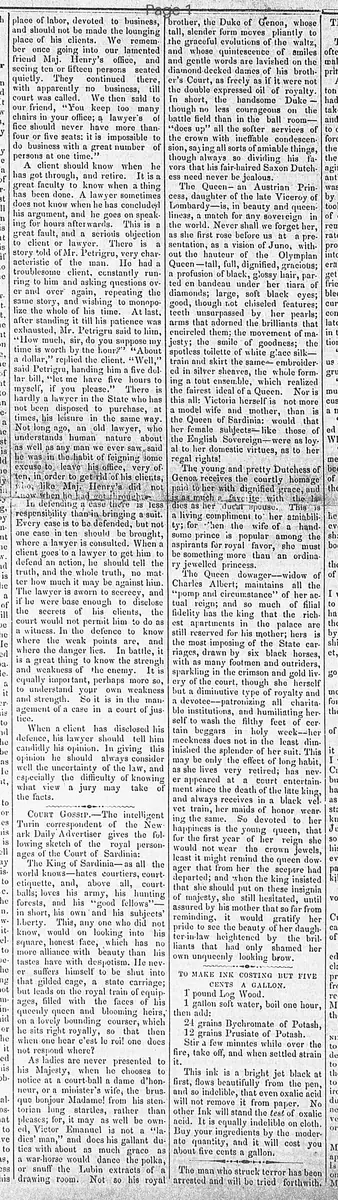
The King of Sardinia-as all the world knows-hates courtiers, court-etiquette, and, above all, court-balls; loves his army, his hunting forests, and his "good fellows" in short, his own and his subjects' liberty. This, any one who did not know, would on looking into his square, honest face, which has no more alliance with beauty than his tastes have with despotism. He never suffers himself to be shut into that gilded cage, a state carriage; but leads on the royal train of equipages, filled with the aces of his queenly queen and blooming heirs, on a lovely bounding courser; which he sits right royally, so that then when one hears c'est le roi! one does not respond where?
As ladies are never presented to his Majesty, when he chooses to notice at a court-ball a dame d'honneur, or a minister's wife; the brusque bonjour Madame! from his stentorian lungs startles, rather than pleases; for, it may as well be owned, Victor Emanuel is not a "ladies' man," and does his gallant duties with about as much grace as a war-horse would dance the polka; or snuff the Lubin extracts of a drawing room..
Not so his royal brother, the Duke of Genoa, whose tall, slender form moves pliantly to the graceful evolutions of the waltz, and whose quintessence of smiles and gentle words are lavished on the diamond-decked dames of his brother's Court, as freely as if it were not the double expressed oil of royalty.
In short, the handsome Duke - though no less courageous on the battle field than in the ball room "does up" all the softer services of the crown with ineffable condescension, saying all sorts of amiable things, though always so dividing his favors that his fair-haired Saxon Duchess need never be jealous.
The Queen- an Austrian Princess, daughter of the late Viceroy of Lombardy-is, in beauty and queenliness, a match for any sovereign in the world. Never shall we forget her, as she first rose before us at a presentation, as a vision of Juno; without the hauteur of the Olympian Queen--tall, full, dignified, gracious; a profusion of black, glossy hair, parted en bandeau under her tiara of diamonds; large, soft black eyes; good, though not chiseled features; teeth unsurpassed by her pearls; arms that adorned the brilliants that encircled them: the movement of majesty; the smile of goodness; the spotless toilette of white glace silk-- train and skirt the same=embroidered in silver sheaves, the whole forming a tout ensemble, which realized the fairest ideal of a Queen. Nor is this all: Victoria herself is not more a model wife and mother, than is the Queen of Sardinia: would that her female subjects= like those of the English Sovereign--were as loyal to her domestic virtues, as to her regal rights!
The young and pretty Duchess of Genoa receives the courtly homage paid to her with dignified grace, and is as much a favorite with the ladies as her ducal spouse.. This is a living compliment to her amiability; for. when the wife of a handsome prince is popular among the aspirants for royal favor, she must be something more than an ordinary jewelled princess.
The Queen dowager--widow of Charles Albert; maintains all the "pomp and circumstance" of her actual reign; and so much of filial fidelity has the king that the richest apartments in the palace are still reserved for his mother; hers is the most imposing of the State carriages, drawn by six black horses, with as many footmen and outriders, sparkling in the crimson and gold livery of the court. though she herself but a diminutive type of royalty and a devotee--patronizing all charitable institutions, and humiliating herself to wash the filthy feet of certain beggars in holy week--her meekness does not in the least diminished the splendor of her suit. This may be only the effect of long habit, as she lives very retired; has never appeared at a court entertainment since the death of the late king, and always receives in a black velvet train, her maids of honor wearing the same. So devoted to her happiness is the young queen, that for the first year of her reign she would not wear the crown jewels, least it might remind the queen dowager that from her the sceptre had departed; and when the king insisted that she should put on these insignia of majesty, she still hesitated, until assured by his mother that so far from reminding. it would gratify her pride to see the beauty of her daughter-in-law heightened by the brilliants that had only shamed her own unqueenly looking brow.
What sub-type of article is it?
What keywords are associated?
What entities or persons were involved?
Where did it happen?
Foreign News Details
Primary Location
Sardinia
Key Persons
Event Details
The Turin correspondent sketches the King of Sardinia's aversion to court formalities and preference for liberty and army; his awkward interactions with ladies; the Duke of Genoa's charm at balls; the Queen's beauty, grace, and model domestic virtues; the Duchess of Genoa's amiability; and the Queen Dowager's pious retirement and retained pomp, with the young Queen's deference to her.