Thank you for visiting SNEWPapers!
Sign up free
The New Hampshire Gazette And General Advertiser
Portsmouth, Exeter, Rockingham County, New Hampshire
What is this article about?
In a letter to the New-Hampshire Gazette, 'Watchman' rebuts 'the Monitor's' arguments on constitutional issues, including venue of criminal trials, treatment of absentees' estates via escheat, and the Bill of Rights, emphasizing common law principles and laws of nations in post-Revolutionary New Hampshire.
Merged-components note: This is a single continuous letter to the editor spanning pages 1 and 2, with the image merged due to spatial overlap with the text (bboxes overlap in x and y coordinates) and sequential reading order indicating it belongs to the same component.
Clippings
1 of 2
OCR Quality
Full Text
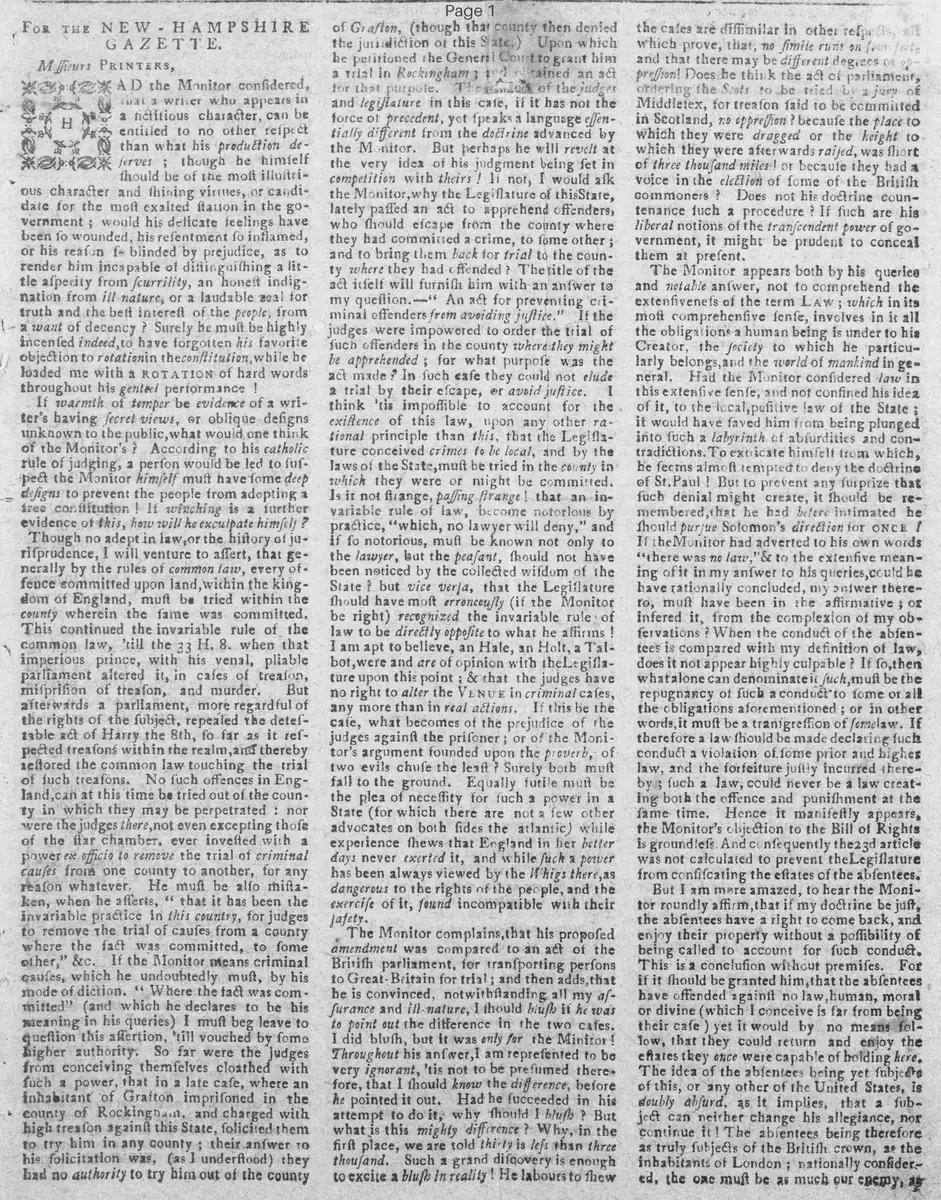
Messrs. Printers,
The Monitor considered.
Has a writer who appears in a fictitious character, can be entitled to no other respect than what his production deserves; though he himself should be of the most illustrious character and shining virtues, or candidate for the most exalted station in the government: would his delicate feelings have been so wounded, his resentment so inflamed, or his reason blinded by prejudice, as to render him incapable of distinguishing a little asperity from currility, an honest indignation from ill nature, or a laudable zeal for truth and the best interest of the people, from a want of decency? Surely he must be highly incensed indeed, to have forgotten his favorite objection to rotation in the constitution, while he loaded me with a rotation of hard words throughout his genteel performance!
If warmth of temper be evidence of a writer's having secret views, or oblique designs unknown to the public, what would one think of the Monitor's? According to his catholic rule of judging, a person would be led to suspect the Monitor himself must have some deep designs to prevent the people from adopting a free constitution! If switching is a further evidence of this, how will he exculpate himself?
Though no adept in law, or the history of jurisprudence, I will venture to assert, that generally by the rules of common law, every offence committed upon land, within the kingdom of England, must be tried within the county wherein the same was committed.
This continued the invariable rule of the common law, till the 33 H. 8. when that imperious prince, with his venal, pliable parliament altered it, in cases of treason, misprision of treason, and murder. But afterwards a parliament, more regardful of the rights of the subject, repealed the detestable act of Harry the 8th, so far as it respected treasons within the realm, and thereby restored the common law touching the trial of such treasons. No such offences in England, can at this time be tried out of the county in which they may be perpetrated: nor were the judges there, not even excepting those of the star chamber, ever invested with a power ex officio to remove the trial of criminal causes from one county to another, for any reason whatever. He must be also mistaken, when he asserts, "that it has been the invariable practice in this country, for judges to remove the trial of causes from a county where the fact was committed, to some other," &c. If the Monitor means criminal causes, which he undoubtedly must, by his mode of diction. "Where the fact was committed" (and which he declares to be his meaning in his queries) I must beg leave to question this assertion, till vouched by some higher authority. So far were the judges from conceiving themselves clothed with such a power, that in a late case, where an inhabitant of Grafton imprisoned in the county of Rockingham, and charged with high treason against this State, solicited them to try him in any county; their answer to his solicitation was, (as I understood) they had no authority to try him out of the county of Grafton. (though that county then denied the jurisdiction of this State.) Upon which he petitioned the General Court to grant him a trial in Rockingham; and obtained an act for that purpose. The conduct of the judges and legislature in this case, if it has not the force of precedent, yet speaks a language essentially different from the doctrine advanced by the Monitor. But perhaps he will revolt at the very idea of his judgment being set in competition with theirs! If not, I would ask the Monitor, why the Legislature of this State, lately passed an act to apprehend offenders, who should escape from the county where they had committed a crime, to some other: and to bring them back for trial to the county where they had offended? The title of the act itself will furnish him with an answer to my question - "An act for preventing criminal offenders from avoiding justice." If the judges were empowered to order the trial of such offenders in the county where they might be apprehended: for what purpose was the act made? In such case they could not elude a trial by their escape, or avoid justice. I think it is impossible to account for the existence of this law, upon any other rational principle than this, that the Legislature conceived crimes to be local, and by the laws of the State, must be tried in the county in which they were or might be committed.
Is it not strange, passing strange! that an invariable rule of law, become notorious by practice, "which no lawyer will deny," and if so notorious, must be known not only to the lawyer, but the peasant, should not have been noticed by the collected wisdom of the State? but vice versa, that the Legislature should have most erroneously (if the Monitor be right) recognized the invariable rule of law to be directly opposite to what he affirms! I am apt to believe, an Hale, an Holt, a Talbot, were and are of opinion with the Legislature upon this point: & that the judges have no right to alter the Venue in criminal cases, any more than in real actions. If this be the case, what becomes of the prejudice of the judges against the prisoner: or of the Monitor's argument founded upon the proverb, of two evils choose the least? Surely both must fall to the ground. Equally futile must be the plea of necessity for such a power in a State (for which there are not a few other advocates on both sides the atlantic) while experience shows that England in her better days never exerted it, and while such a power has been always viewed by the Whigs there, as dangerous to the rights of the people, and the exercise of it, found incompatible with their safety.
The Monitor complains, that his proposed amendment was compared to an act of the British parliament, for transporting persons to Great-Britain for trial; and then adds, that he is convinced, notwithstanding all my assurance and ill-nature, I should blush if he was to point out the difference in the two cases. I did blush, but it was only for the Monitor! Throughout his answer, I am represented to be very ignorant, 'tis not to be presumed therefore, that I should know the difference, before he pointed it out. Had he succeeded in his attempt to do it, why should I blush? But what is this mighty difference? Why, in the first place, we are told thirty is less than three thousand. Such a grand discovery is enough to excite a blush in reality! He labours to show the cases are dissimilar in other respects, all which prove, that no simile runs on four feet - and that there may be different degrees of oppression! Does he think the act of parliament, ordering the Scots to be tried by a jury of Middlesex, for treason said to be committed in Scotland, no oppression? because the place to which they were dragged or the height to which they were afterwards raised, was short of three thousand miles! or because they had a voice in the election of some of the British commoners? Does not his doctrine countenance such a procedure? If such are his liberal notions of the transcendent power of government, it might be prudent to conceal them at present.
The Monitor appears both by his queries and notable answer: not to comprehend the extensiveness of the term Law: which in its most comprehensive sense, involves in it all the obligations a human being is under to his Creator, the society to which he particularly belongs, and the world of mankind in general. Had the Monitor considered law in this extensive sense: and not confined his ideas of it, to the local, positive law of the State; it would have saved him from being plunged into such a labyrinth of absurdities and contradictions. To extricate himself from which, he seems almost tempted to deny the doctrine of St. Paul! But to prevent any surprise that such denial might create, it should be remembered, that he had before intimated he should pursue Solomon's direction for once! If the Monitor had adverted to his own words "there was no law." & to the extensive meaning of it in my answer to his queries, could he have rationally concluded, my answer thereto, must have been in the affirmative: or inferred it, from the complexion of my observations? When the conduct of the absentees is compared with my definition of law, does it not appear highly culpable? If so, then what alone can denominate it such, must be the repugnancy of such a conduct to some or all the obligations aforementioned: or in other words, it must be a transgression of some law. If therefore a law should be made declaring such conduct a violation of some prior and higher law, and the forfeiture justly incurred thereby; such a law, could never be a law creating both the offence and punishment at the same time. Hence it manifestly appears, the Monitor's objection to the Bill of Rights is groundless. And consequently the 22d article was not calculated to prevent the Legislature from confiscating the estates of the absentees. But I am more amazed, to hear the Monitor roundly affirm, that if my doctrine be just, the absentees have a right to come back, and enjoy their property without a possibility of being called to account for such conduct. This is a conclusion without premises. For if it should be granted him, that the absentees have offended against no law, human, moral or divine (which I conceive is far from being their case) yet it would by no means follow, that they could return and enjoy the estates they once were capable of holding here. The idea of the absentees being yet subjects of this, or any other of the United States, is doubly absurd, as it implies, that a subject can neither change his allegiance, nor continue it! The absentees being therefore as truly subjects of the British crown, as the inhabitants of London: nationally considered, the one must be as much our enemy, as
the other, both being made equally foreigners to the Commonwealth of America, by the declaration of Independence. This being the case, I would ask the Monitor, if an alien-enemy should enter the territory of his foe without safe conduct, whether by such temerity, he would not be liable to be made prisoner of war, or punished as a spy? If by the laws of nations, this must be his fate, how should the absentees return without subjecting themselves to the like punishment? If it should be replied, they may return at the end of the war--I answer, that peace one would neither give them a right to return nor hold property here. By the laws of nations in general, an alien-friend is incapable of holding real property in a foreign country; nor can he become a subject of another nation or state, 'till he be made such by the supreme power thereof. This double incapacity in the absentees, must therefore be a perpetual impediment to their return or holding estates here.--
If so, the estates they left here, when they absented must of course ESCHEAT to this State: the absentees being incapable of holding or transferring the same, in any manner whatever. If the cause of the escheat arises from such incapacity, all that is necessary to be done in order to reap the fruit of the escheat is to ascertain what persons are thus incapacitated. The only difference between doing this, by act, office-found, or otherwise, must consist in the mode of enquiry; as neither creates, but only ascertains, the incapacity. Having thus pointed out how such estates may be taken and applied to public uses, (notwithstanding the 23d article in the Bill of Rights) I shall submit the equity and policy of such a procedure, to those, whose province it is, to determine such matters.
The Monitor having assumed the name, at the same time exercises the right of admonishing generally, accordingly he faults the General Court for not going through in the business of confiscation; but thinking this a little assuming, he palliates the matter, by laying the blame to a violent opposition from a certain quarter--but whether in or out of the General Court, he will not tell! Did he think it would have been an over-strained compliment to them, to have ascribed the cause of such delay to their moderation, humanity and compassion for the helpless, distressed families the absentees left behind, and past experience of the fruitless pursuit?
Let the Monitor should think, I designedly left some part of his observations unanswered, because they were really unanswerable (as I conceive he did some of mine) I will answer his questions--Whether there was any law in 1775, against corresponding with the enemy, &c.? Yes, the law of common honesty, common sense, common safety & of war.
I would give the same answer to the case of Dr. Church and to that, of the inhabitants of these States, then enlisting in the British army. I am not insensible, that in time of war, the laws of war must take place between the belligerous powers; but what reason is his story establishing an arbitrary constitution both in peace and war? But I am incapable of conceiving why cases, which occur in time of peace, should not be determined by the rules of reason, and in such a manner as will best promote the interest of the Commonwealth, as well as in time of revolutions, and even in time of war, which the Monitor impliedly says, ought not to be the case.
Though I agree with the Monitor, that the example of the Massachusetts cannot sanction error, or be a reason for our adopting of it: yet, I think, there is a wide difference between alleging, and proving them to be in an error: and that some deference is due to the opinion of the framers of their Constitution (who were perhaps gentlemen of equal abilities and patriotism with the Monitor): But I must confess, the Monitor being hard pressed, had a strong inducement, not to spare them or their Legislature, when both conceived their Bill of Rights did not militate with their act for confiscation: and consequently, that their act was not retrospective?
Many have hastily concluded from the Monitor's saying, the other objections had been laid before the public with fairness and candor, and with a spirit of moderation, to which I am a perfect stranger; that the TRUE REPUBLICAN and MONITOR, were the same. But to convince such of their gross mistake, I need only point out to them, the essential difference in the manner of the compositions and nature of the objections. The stile, elegance and politeness of the first, compared with the last, differ as widely, as any two extremes in nature! Besides, the True Republican, proposed but Four alterations, to be made in the Constitution itself, one of which he afterwards ingenuously gave up, but made no objection to the Bill of Rights. These, to me, are convincing proofs, that such different productions and objections, ought not to be ascribed to the same writer.
I trust the Freemen of New-Hampshire, have too much discernment, not to see the difference between an address to their passions, and their reason; and too much virtue, to be influenced, by motives unworthy of themselves. I assure the Monitor, I reprobate the idea of figuring in a News-Paper; merely for the sake of victory without opposition: nor do I wish to obtain it with, unless my sentiments are supported by truth, and the principles of a free government. I am happy in the reflection, that the impartial public are his Tribunal and mine. to them I chearfully submit the decision of these merit, or demerit, of his performance & mine.
Only reminding the Monitor, that, the importance of obtaining a free, and well-organized constitution, ought to banish forever, every popular prejudice from our minds, and become the supreme object of our attention. Should we dare to be traitorously wanting to so great a duty, we might, perhaps, flatter the generation which passeth away; but truth and justice, which are ETERNAL, would impeach us to future generations, who would read us with contempt, and pronounce our name with Execration.
WATCHMAN.
What sub-type of article is it?
What themes does it cover?
What keywords are associated?
What entities or persons were involved?
Letter to Editor Details
Author
Watchman.
Recipient
Messrs. Printers
Main Argument
watchman defends his positions against the monitor, arguing that criminal trials must occur in the county of the offense per common law, absentees' estates escheat to the state as alien enemies, and the bill of rights does not prevent confiscation, while criticizing the monitor's legal misunderstandings and inflammatory tone.
Notable Details