Thank you for visiting SNEWPapers!
Sign up free
Editorial
September 18, 1928
The Bismarck Tribune
Bismarck, Mandan, Burleigh County, Morton County, North Dakota
What is this article about?
Editorial discusses accusations by British labor leaders of mistreatment of 10,000 unemployed British miners sent to Canada's wheat fields to address harvest labor shortage. Notes challenges for miners but highlights past success of similar 1923 program where most stayed.
Clipping
OCR Quality
100%
Excellent
Full Text
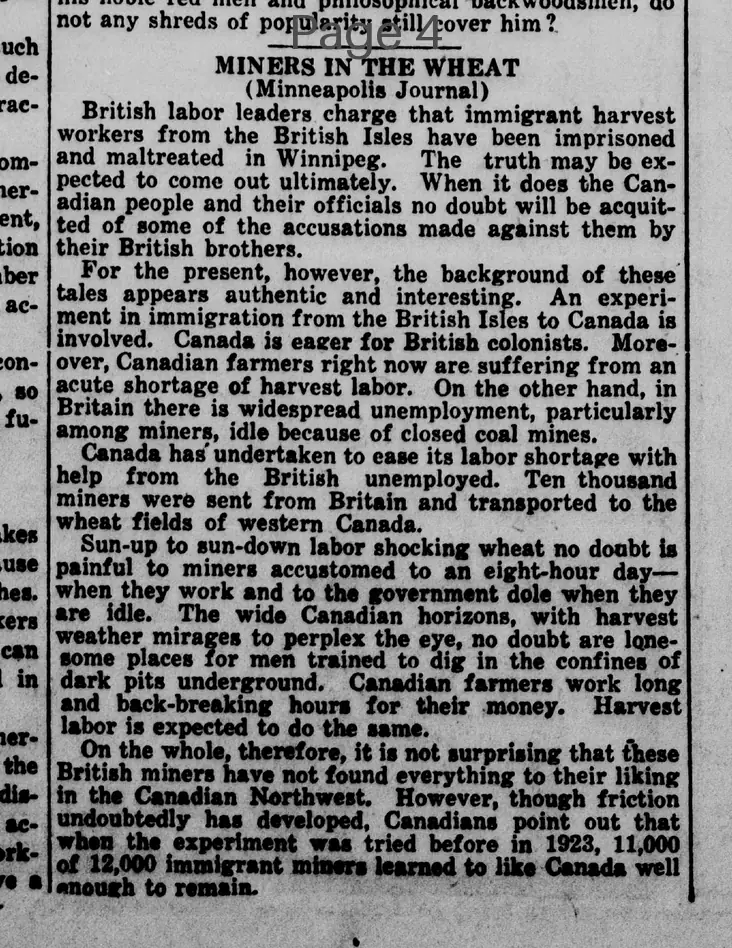
MINERS IN THE WHEAT
(Minneapolis Journal)
British labor leaders charge that immigrant harvest workers from the British Isles have been imprisoned and maltreated in Winnipeg. The truth may be expected to come out ultimately. When it does the Canadian people and their officials no doubt will be acquitted of some of the accusations made against them by their British brothers.
For the present, however, the background of these tales appears authentic and interesting. An experiment in immigration from the British Isles to Canada is involved. Canada is eager for British colonists. Moreover, Canadian farmers right now are suffering from an acute shortage of harvest labor. On the other hand, in Britain there is widespread unemployment, particularly among miners, idle because of closed coal mines.
Canada has undertaken to ease its labor shortage with help from the British unemployed. Ten thousand miners were sent from Britain and transported to the wheat fields of western Canada.
Sun-up to sun-down labor shocking wheat no doubt is painful to miners accustomed to an eight-hour day when they work and to the government dole when they are idle. The wide Canadian horizons, with harvest weather mirages to perplex the eye, no doubt are lonesome places for men trained to dig in the confines of dark pits underground. Canadian farmers work long and back-breaking hours for their money. Harvest labor is expected to do the same.
On the whole, therefore, it is not surprising that these British miners have not found everything to their liking in the Canadian Northwest. However, though friction undoubtedly has developed, Canadians point out that when the experiment was tried before in 1923, 11,000 of 12,000 immigrant miners learned to like Canada well enough to remain.
(Minneapolis Journal)
British labor leaders charge that immigrant harvest workers from the British Isles have been imprisoned and maltreated in Winnipeg. The truth may be expected to come out ultimately. When it does the Canadian people and their officials no doubt will be acquitted of some of the accusations made against them by their British brothers.
For the present, however, the background of these tales appears authentic and interesting. An experiment in immigration from the British Isles to Canada is involved. Canada is eager for British colonists. Moreover, Canadian farmers right now are suffering from an acute shortage of harvest labor. On the other hand, in Britain there is widespread unemployment, particularly among miners, idle because of closed coal mines.
Canada has undertaken to ease its labor shortage with help from the British unemployed. Ten thousand miners were sent from Britain and transported to the wheat fields of western Canada.
Sun-up to sun-down labor shocking wheat no doubt is painful to miners accustomed to an eight-hour day when they work and to the government dole when they are idle. The wide Canadian horizons, with harvest weather mirages to perplex the eye, no doubt are lonesome places for men trained to dig in the confines of dark pits underground. Canadian farmers work long and back-breaking hours for their money. Harvest labor is expected to do the same.
On the whole, therefore, it is not surprising that these British miners have not found everything to their liking in the Canadian Northwest. However, though friction undoubtedly has developed, Canadians point out that when the experiment was tried before in 1923, 11,000 of 12,000 immigrant miners learned to like Canada well enough to remain.
What sub-type of article is it?
Immigration
Labor
What keywords are associated?
British Miners
Canadian Harvest
Immigration Experiment
Labor Shortage
Winnipeg Maltreatment
Unemployment Relief
What entities or persons were involved?
British Labor Leaders
Immigrant Harvest Workers
Canadian Farmers
British Miners
Editorial Details
Primary Topic
British Miners Sent To Canadian Wheat Fields
Stance / Tone
Neutral Observational With Mild Defense Of Canadians
Key Figures
British Labor Leaders
Immigrant Harvest Workers
Canadian Farmers
British Miners
Key Arguments
British Labor Leaders Charge Imprisonment And Maltreatment Of Immigrant Workers In Winnipeg
Canada Faces Acute Harvest Labor Shortage And Seeks British Colonists
Britain Has Widespread Unemployment Among Miners Due To Closed Coal Mines
Ten Thousand Miners Transported From Britain To Western Canadian Wheat Fields
Miners Unaccustomed To Long Harvest Hours And Conditions Find It Challenging
Friction Has Developed But Previous 1923 Experiment Saw Most Miners Stay