Thank you for visiting SNEWPapers!
Sign up free
Story
January 15, 1844
The Madisonian
Washington, District Of Columbia
What is this article about?
Detailed account of Adam Horn's public execution in Baltimore for murder, attended by 30,000 spectators; includes preparations, religious consolations, the hanging at noon, post-mortem galvanic experiments, and phrenological examination.
Clipping
OCR Quality
98%
Excellent
Full Text
From the Baltimore Sun.
EXECUTION OF HORN.
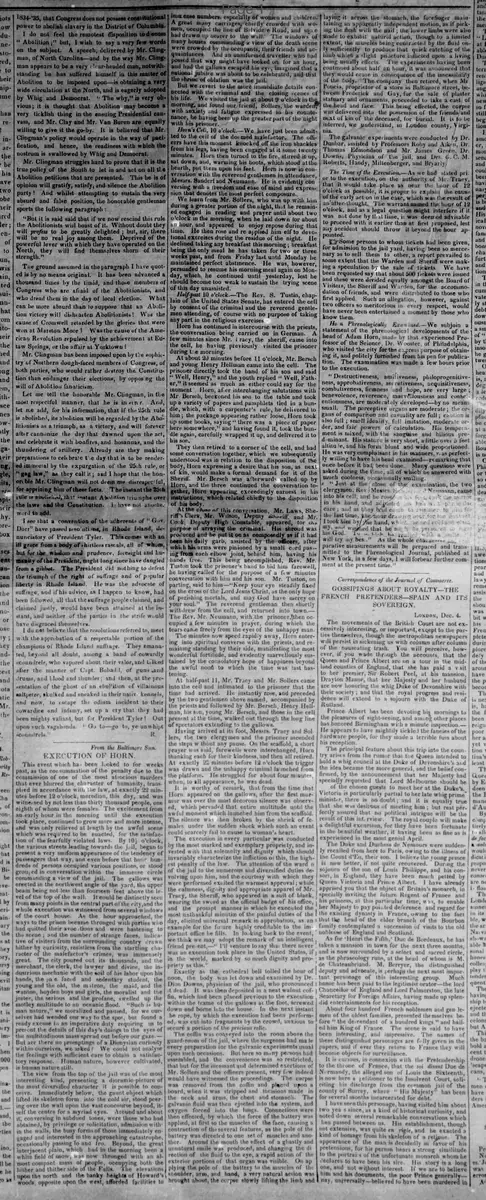
This event which has been looked to for weeks past, as the consummation of the penalty due to the commission of one of the most atrocious murders that ever blurred the character of humanity, transpired in accordance with the law, at exactly 22 minutes before 12 o'clock, meridian, this day, and was witnessed by not less than thirty thousand people, one eighth of whom were females. The excitement from an early hour in the morning until the execution took place, continued to grow more and more intense, and was only relieved at length by the awful scene which was required to be enacted, for the satisfaction of the fearfully violated laws. By 10 o'clock, the various streets leading towards the jail, began to present a very uniform appearance of the tendency of passengers that way, and even before that hour hundreds of persons occupied various positions, or stood grouped in conversation within the immense circle commanding a view of the jail. The gallows was erected in the northwest angle of the yard, the upper beam being not less than fourteen feet above the level of the top of the wall. It could be distinctly seen from many points in the central part of the city, and the whole execution was witnessed from several windows of the court house. As the hour approached, the ways to the prison became thronged with parties who had quitted their avocations and were hastening to the scene; and the number of strange faces, indicative of visitors from the surrounding country drawn hither by curiosity, resistless from the startling character of the malefactor's crimes, was immensely great. The city poured out its thousands, and the merchant, the clerk, the lawyer and divine, the industrious mechanic with the soil of his labor upon his hands, the pale faced and sedentary student, the young and the old, the matron, the maid, and the wanton, hoyden boys and girls, the moralist and the jester, the serious and the profane, swelled up the motley multitude to an oceanic flood. "Such is human nature," we moralized and paused, for we ourselves had wended our way to the spot, but found a ready excuse in an imperative duty requiring us to present the details of this day's doings to the eyes of the multitudinous mass spread out before our gaze. But are there no promptings of a Dionysian curiosity within ourselves, we asked? We could not analyse the feelings with sufficient care to obtain a satisfactory response. Human nature, however cultivated, is human nature still.
The view from the top of the jail was of the most interesting kind, presenting a dioramic picture of the most diversified character it is possible to conceive. Immediately below, the gaunt object which lifted its skeleton form into the cold air, stood peering over the wall upon the vast concourse beyond, itself the centre for a myriad eyes. Around and about it, conversing in subdued tones, were those who had obtained, by privilege or solicitation, admission within the walls, the busy forms of those immediately engaged and interested in the approaching catastrophe, occasionally passing to and fro. Beyond, the great interjacent plain, which had in the morning been a white field of snow, was now thronged with an almost compact mass of people, occupying both the hither and thither side of the Falls. The elevations upon the north and the banky heights of Howard's woods, opposite upon the west, afforded facilities to immense numbers, especially of women and children. A great many carriages, chiefly crowded with women, occupied the line of Belvidere Road, and some had drawn up nearer to the wall. The windows of many houses commanding a view of the death scene were crowded by the occupants, their friends and acquaintances. And an uninformed traveller who had passed that way might have looked on for an hour, and had the gallows escaped his eye, imagined that a national jubilee was about to be celebrated, and that the shrine of oblation was the jail.
But we revert to the more immediate details connected with the criminal and the closing scenes of his life. We visited the jail at about 9 o'clock in the morning, and found our friend, Sollers, the warden, with anxiety and fatigue expressed in his countenance, he having been up the greater part of the night with his prisoner.
Horn's Cell, 10 o'clock.—We have just been admitted to the cell of the doomed malefactor. The officers have this moment knocked off the iron shackles from his legs, having been engaged at it some twenty minutes. Horn then turned to the fire, stirred it up, sat down, and, warming his boots, which stood at the hearth, put them upon his feet. Horn is now in conversation with the reverend gentlemen in attendance, Messrs. Sandel and Neumann. He is evidently conversing with a freedom and ease of mind and expression that denotes the most perfect composure.
We learn from Mr. Sollers, who was up with him during a greater portion of the night, that he remained engaged in reading and prayer until about two o'clock in the morning, when he laid down for about an hour, and appeared to enjoy repose during that time. He then rose and re-applied himself to devotional exercises during the residue of the night. He declined taking any breakfast this morning; breakfast being the only meal he has taken for two or three weeks past, and from Friday last until Monday he maintained perfect abstinence. He was, however, persuaded to resume his morning meal again on Monday, which, he continued until yesterday, lest he should become too weak to sustain the trying scene of this day unassisted.
Half-past 10 o'clock.—The Rev. S. Tustin, chaplain of the United States Senate, has entered the cell by consent of the criminal and the reverend gentlemen attending, of course with no purpose of taking any part in the religious exercises
Horn has continued in intercourse with the priests, the conversation being carried on in German. A few minutes since Mr. Tracy, the sheriff, came into the cell, he having previously visited the prisoner during the morning.
At about 20 minutes before 11 o'clock, Mr. Bersch and young Henry Hellman came into the cell. The prisoner directly took the hand of his son and said "Well, Henry" and the youth replied "Well, Father." it seemed as much as either could say for the moment, Horn, after interchanging salutations with Mr. Bersch, beckoned his son to the table and took up a variety of papers and pamphlets tied in a bundle, which, with a carpenter's rule, he delivered to him; the package appearing rather loose, Horn took up some books, saying "there was a piece of paper here somewhere," and having found it, took the bundle again, carefully wrapped it up, and delivered it to his son.
They then retired to a corner of the cell, and had some conversation together, which we subsequently understood was in relation to the disposition of the body, Horn expressing a desire that his son, as next of kin, would make a formal demand for it of the Sheriff. Mr. Bersch was afterwards called up by Horn, and the three continued the conversation together, Horn appearing exceedingly earnest in his instructions, which related chiefly to the disposition of his body.
At the close of this conversation, Mr. Laws, Sheriff's Clerk, Mr. Wilson, Deputy Sheriff, and Mr. Cook, Deputy High Constable, appeared, for the purpose of arraying the criminal. His shroud was produced and he put it on as composedly as if it had been his daily garb, assisted by the officers, after which his arms were pinioned by a small cord passing from each elbow joint, behind him, having his hands free. This being accomplished, Rev. Mr. Tustin took the prisoner's hand to bid him farewell, he having called for the purpose of a few minutes conversation with him and his son. Mr. Tustin, on parting, said to him—“Keep your eye steadily fixed on the cross of the Lord Jesus Christ, as the only hope of perishing mortals, and may God have mercy on your soul." The reverend gentleman then shortly withdrew from the cell, and returned into town.—
The Rev. Mr. Neumann, with the prisoner, then occupied a few minutes in prayer, during which the tears came freely from the eyes of the unhappy man. The minutes now speed rapidly away, Horn entering into spiritual converse with the priests, and remaining standing by their side, manifesting the most wonderful fortitude, and evidently marvellously sustained by the consolatory hope of happiness beyond the awful noon to which the time was fast hastening.
At half-past 11, Mr. Tracy and Mr. Sollers came into the cell and intimated to the prisoner that the time had arrived. He instantly rose, and preceded by the two gentlemen above named, accompanied by the priests and followed by Mr. Bersch, Henry Hellman, his son, young Mr. Bersch, and those in the cell present at the time, walked out through the long line of spectators extending to the gallows.
Having arrived at its foot, Messrs. Tracy and Sollers, the two clergymen and the prisoner ascended the steps without any pause. On the scaffold, a short prayer was said, farewells were interchanged, Horn thanking each for their kindness, and then all retired.
At exactly 2 minutes before 12 o'clock the trigger was drawn and the unhappy criminal launched from the platform. He struggled for about four minutes, when, to all appearance, he was dead.
It is worthy of remark, that from the time that Horn appeared on the gallows, after the first murmur was over the most decorous silence was observed, which pervaded that entire multitude until the awful moment which launched him from the scaffold. The silence was then broken by the shriek of females under the sudden shock which such an event could scarcely fail to cause to woman's heart.
The execution in every particular was conducted by the most marked and exemplary propriety, and invested with that solemnity and dignity which should invariably characterize the infliction of this, the highest penalty of the law. The attention of the warden of the jail to the numerous and diversified duties devolving upon him, and the courtesy with which they were performed excited the warmest approval; while the calmness, dignity and appropriate apparel of Mr. Tracy, the Sheriff, who appeared in a suit of black, wearing the sword as the official badge of his office, and the prompt manner in which he executed the most unthankful minutiae of the painful duties of the day, elicited universal remark in approbation, as an example for the future highly creditable to the important office he fills. In looking back to the event, we think we may adopt the remark of an intelligent friend present,—"I'll venture to say that there never was an execution took place in the United States, if in the world, marked by so much dignity and propriety as this."
Exactly as the cathedral bell tolled the hour of noon, the body was let down and examined by Dr. Dion Downs, physician of the jail, who pronounced it dead. It was then deposited in a neat walnut coffin, which had been placed previous to the execution within the frame of the gallows at the foot, screwed down and borne into the house. In the next instant the rope, by which the execution had been performed, was cut into fragments by the crowd, anxious to secure a portion of the precious relic.
The coffin was conveyed into the room above the guard-room of the jail, where the surgeons had made every preparation for the galvanic experiments usual upon such occasions. But here so many persons had assembled, and the convenience was so restricted, that but for the incessant and determined exertions of Mr. Sollers and the officers present, very few indeed would have witnessed the proceedings. The corpse was removed from the coffin and placed upon a board, when it was stripped and Incisions made in the neck and arms, the chest and stomach. The galvanic fluid was then ejected into the system, and oxygen forced into the lungs. Connections were then effected, by which the force of the battery was applied, at first to the muscles of the face, causing a contraction of the several features, as the pole of the battery was directed to one set of muscles and another. Around the mouth the effect of a ghastly and unnatural smile was produced, and changing the direction of the fluid to the eye, a rapid action of the exterior portions of that organ was visible. On applying the pole of the battery to the muscles of the shoulder, arm, and hand, a very natural action was brought about, the corpse slowly lifting the limb and laying it across the stomach, the forefinger maintaining an apparently independent motion, as if picking the flesh with the nail; the lower limbs were also made to exhibit natural action, though to a limited extent, the muscles being contracted by the fluid only sufficiently to produce that quick catching of the limb which a slight puncture inflicted upon a living being usually effects. The experiments having been continued about half an hour, it was announced that they would cease in consequence of the insensibility of the body. The company then retired, when Mr. Poncia, proprietor of a store in Baltimore street, between Frederick and Gay, for the sale of plaster statuary and ornaments, proceeded to take a cast of the head and face. This being effected, the corpse was delivered into the possession of the friends, and next of kin of the deceased, for burial. It is to be interred, we understand, in Loudon county, Virginia.
The galvanic experiments were conducted by Dr. Dunbar, assisted by Professors Roby and Aikyn, Dr. Thomas Edmondson and Mr. James Green, Dr. Downs, Physician of the jail, and Drs. C. C. M. Roberts, Handy, Miltenberger, and Bryarly.
The Time of the Execution.—As we had stated prior to the execution, on the authority of Mr. Tracy, that it would take place as near the hour of 12 o'clock as possible, it is proper to explain the cause of the early action in the case, which was the result of an after-thought. The warrant named the hour of 12 o'clock, and as a legal question might interfere if it was not done by that time, it was deemed advisable to proceed with it earlier than at first proposed, lest any accident should throw it beyond the hour appointed.
Some persons to whom tickets had been given, for admission to the jail yard, having been so mercenary as to sell them to others, a report prevailed to some extent that the Warden and Sheriff were making a speculation by the sale of tickets. We have been requested say that about 500 tickets were issued and these were divided equally amongst the Board of Visitors, the Sheriff and Warden, for the accommodation of friends, and were distributed to those who first applied. Such an allegation, however, against two officers so meritorious in every respect, would have never been entertained a moment by those who know them.
Horn Phrenologically Examined.—We subjoin a statement of the phrenological developments of the head of Adam Horn, made by that experienced Professor of the Science, Dr. Wooster, of Philadelphia, who visited the city for the express purpose of obtaining it, and politely furnished from his pen or publication. The examination was made a few hours prior to the execution.
"Destructiveness, amativeness, philoprogenitiveness, approbativeness, secretiveness, acquisitiveness, combativeness, firmness and hope, are very large; benevolence, reverence, marvellousness and conscientiousness, are moderately developed—by no means small. The perceptive organs are moderate; the organs of comparison and causality are full; caution is also full; self esteem, full imitation, moderate order, and fair powers of calculation. His temperament is mixed, with the sanguine and bilious predominant. His stature is very short, a little over 5 feet altitude, and his form blunt and wide proportioned. He was very complaisant in his manners, was perfectly willing to have his head examined—remarking that once before it had been done. Many questions were asked during the time, all of which he answered with much coolness, occasionally smiling.
"Just at the close of the examination, the two clergymen, Rev. Messrs. Sandel and Neumann, came into his cell, and he rose up, took the mirror in his hand, and adjusted his hair with great care; and as they had come to minister to his soul for the last time, the hour drawing near for the execution, I took him by the hand, which seemed cold and clammy, and wished that he might be prepared to meet his God. To which he replied with a smile, "I will try my best." As the whole character on comparative measurements will be prepared and transmitted to the Phrenological Journal, published at New York, in a few days, I will forbear further comment at the present time."
EXECUTION OF HORN.
This event which has been looked to for weeks past, as the consummation of the penalty due to the commission of one of the most atrocious murders that ever blurred the character of humanity, transpired in accordance with the law, at exactly 22 minutes before 12 o'clock, meridian, this day, and was witnessed by not less than thirty thousand people, one eighth of whom were females. The excitement from an early hour in the morning until the execution took place, continued to grow more and more intense, and was only relieved at length by the awful scene which was required to be enacted, for the satisfaction of the fearfully violated laws. By 10 o'clock, the various streets leading towards the jail, began to present a very uniform appearance of the tendency of passengers that way, and even before that hour hundreds of persons occupied various positions, or stood grouped in conversation within the immense circle commanding a view of the jail. The gallows was erected in the northwest angle of the yard, the upper beam being not less than fourteen feet above the level of the top of the wall. It could be distinctly seen from many points in the central part of the city, and the whole execution was witnessed from several windows of the court house. As the hour approached, the ways to the prison became thronged with parties who had quitted their avocations and were hastening to the scene; and the number of strange faces, indicative of visitors from the surrounding country drawn hither by curiosity, resistless from the startling character of the malefactor's crimes, was immensely great. The city poured out its thousands, and the merchant, the clerk, the lawyer and divine, the industrious mechanic with the soil of his labor upon his hands, the pale faced and sedentary student, the young and the old, the matron, the maid, and the wanton, hoyden boys and girls, the moralist and the jester, the serious and the profane, swelled up the motley multitude to an oceanic flood. "Such is human nature," we moralized and paused, for we ourselves had wended our way to the spot, but found a ready excuse in an imperative duty requiring us to present the details of this day's doings to the eyes of the multitudinous mass spread out before our gaze. But are there no promptings of a Dionysian curiosity within ourselves, we asked? We could not analyse the feelings with sufficient care to obtain a satisfactory response. Human nature, however cultivated, is human nature still.
The view from the top of the jail was of the most interesting kind, presenting a dioramic picture of the most diversified character it is possible to conceive. Immediately below, the gaunt object which lifted its skeleton form into the cold air, stood peering over the wall upon the vast concourse beyond, itself the centre for a myriad eyes. Around and about it, conversing in subdued tones, were those who had obtained, by privilege or solicitation, admission within the walls, the busy forms of those immediately engaged and interested in the approaching catastrophe, occasionally passing to and fro. Beyond, the great interjacent plain, which had in the morning been a white field of snow, was now thronged with an almost compact mass of people, occupying both the hither and thither side of the Falls. The elevations upon the north and the banky heights of Howard's woods, opposite upon the west, afforded facilities to immense numbers, especially of women and children. A great many carriages, chiefly crowded with women, occupied the line of Belvidere Road, and some had drawn up nearer to the wall. The windows of many houses commanding a view of the death scene were crowded by the occupants, their friends and acquaintances. And an uninformed traveller who had passed that way might have looked on for an hour, and had the gallows escaped his eye, imagined that a national jubilee was about to be celebrated, and that the shrine of oblation was the jail.
But we revert to the more immediate details connected with the criminal and the closing scenes of his life. We visited the jail at about 9 o'clock in the morning, and found our friend, Sollers, the warden, with anxiety and fatigue expressed in his countenance, he having been up the greater part of the night with his prisoner.
Horn's Cell, 10 o'clock.—We have just been admitted to the cell of the doomed malefactor. The officers have this moment knocked off the iron shackles from his legs, having been engaged at it some twenty minutes. Horn then turned to the fire, stirred it up, sat down, and, warming his boots, which stood at the hearth, put them upon his feet. Horn is now in conversation with the reverend gentlemen in attendance, Messrs. Sandel and Neumann. He is evidently conversing with a freedom and ease of mind and expression that denotes the most perfect composure.
We learn from Mr. Sollers, who was up with him during a greater portion of the night, that he remained engaged in reading and prayer until about two o'clock in the morning, when he laid down for about an hour, and appeared to enjoy repose during that time. He then rose and re-applied himself to devotional exercises during the residue of the night. He declined taking any breakfast this morning; breakfast being the only meal he has taken for two or three weeks past, and from Friday last until Monday he maintained perfect abstinence. He was, however, persuaded to resume his morning meal again on Monday, which, he continued until yesterday, lest he should become too weak to sustain the trying scene of this day unassisted.
Half-past 10 o'clock.—The Rev. S. Tustin, chaplain of the United States Senate, has entered the cell by consent of the criminal and the reverend gentlemen attending, of course with no purpose of taking any part in the religious exercises
Horn has continued in intercourse with the priests, the conversation being carried on in German. A few minutes since Mr. Tracy, the sheriff, came into the cell, he having previously visited the prisoner during the morning.
At about 20 minutes before 11 o'clock, Mr. Bersch and young Henry Hellman came into the cell. The prisoner directly took the hand of his son and said "Well, Henry" and the youth replied "Well, Father." it seemed as much as either could say for the moment, Horn, after interchanging salutations with Mr. Bersch, beckoned his son to the table and took up a variety of papers and pamphlets tied in a bundle, which, with a carpenter's rule, he delivered to him; the package appearing rather loose, Horn took up some books, saying "there was a piece of paper here somewhere," and having found it, took the bundle again, carefully wrapped it up, and delivered it to his son.
They then retired to a corner of the cell, and had some conversation together, which we subsequently understood was in relation to the disposition of the body, Horn expressing a desire that his son, as next of kin, would make a formal demand for it of the Sheriff. Mr. Bersch was afterwards called up by Horn, and the three continued the conversation together, Horn appearing exceedingly earnest in his instructions, which related chiefly to the disposition of his body.
At the close of this conversation, Mr. Laws, Sheriff's Clerk, Mr. Wilson, Deputy Sheriff, and Mr. Cook, Deputy High Constable, appeared, for the purpose of arraying the criminal. His shroud was produced and he put it on as composedly as if it had been his daily garb, assisted by the officers, after which his arms were pinioned by a small cord passing from each elbow joint, behind him, having his hands free. This being accomplished, Rev. Mr. Tustin took the prisoner's hand to bid him farewell, he having called for the purpose of a few minutes conversation with him and his son. Mr. Tustin, on parting, said to him—“Keep your eye steadily fixed on the cross of the Lord Jesus Christ, as the only hope of perishing mortals, and may God have mercy on your soul." The reverend gentleman then shortly withdrew from the cell, and returned into town.—
The Rev. Mr. Neumann, with the prisoner, then occupied a few minutes in prayer, during which the tears came freely from the eyes of the unhappy man. The minutes now speed rapidly away, Horn entering into spiritual converse with the priests, and remaining standing by their side, manifesting the most wonderful fortitude, and evidently marvellously sustained by the consolatory hope of happiness beyond the awful noon to which the time was fast hastening.
At half-past 11, Mr. Tracy and Mr. Sollers came into the cell and intimated to the prisoner that the time had arrived. He instantly rose, and preceded by the two gentlemen above named, accompanied by the priests and followed by Mr. Bersch, Henry Hellman, his son, young Mr. Bersch, and those in the cell present at the time, walked out through the long line of spectators extending to the gallows.
Having arrived at its foot, Messrs. Tracy and Sollers, the two clergymen and the prisoner ascended the steps without any pause. On the scaffold, a short prayer was said, farewells were interchanged, Horn thanking each for their kindness, and then all retired.
At exactly 2 minutes before 12 o'clock the trigger was drawn and the unhappy criminal launched from the platform. He struggled for about four minutes, when, to all appearance, he was dead.
It is worthy of remark, that from the time that Horn appeared on the gallows, after the first murmur was over the most decorous silence was observed, which pervaded that entire multitude until the awful moment which launched him from the scaffold. The silence was then broken by the shriek of females under the sudden shock which such an event could scarcely fail to cause to woman's heart.
The execution in every particular was conducted by the most marked and exemplary propriety, and invested with that solemnity and dignity which should invariably characterize the infliction of this, the highest penalty of the law. The attention of the warden of the jail to the numerous and diversified duties devolving upon him, and the courtesy with which they were performed excited the warmest approval; while the calmness, dignity and appropriate apparel of Mr. Tracy, the Sheriff, who appeared in a suit of black, wearing the sword as the official badge of his office, and the prompt manner in which he executed the most unthankful minutiae of the painful duties of the day, elicited universal remark in approbation, as an example for the future highly creditable to the important office he fills. In looking back to the event, we think we may adopt the remark of an intelligent friend present,—"I'll venture to say that there never was an execution took place in the United States, if in the world, marked by so much dignity and propriety as this."
Exactly as the cathedral bell tolled the hour of noon, the body was let down and examined by Dr. Dion Downs, physician of the jail, who pronounced it dead. It was then deposited in a neat walnut coffin, which had been placed previous to the execution within the frame of the gallows at the foot, screwed down and borne into the house. In the next instant the rope, by which the execution had been performed, was cut into fragments by the crowd, anxious to secure a portion of the precious relic.
The coffin was conveyed into the room above the guard-room of the jail, where the surgeons had made every preparation for the galvanic experiments usual upon such occasions. But here so many persons had assembled, and the convenience was so restricted, that but for the incessant and determined exertions of Mr. Sollers and the officers present, very few indeed would have witnessed the proceedings. The corpse was removed from the coffin and placed upon a board, when it was stripped and Incisions made in the neck and arms, the chest and stomach. The galvanic fluid was then ejected into the system, and oxygen forced into the lungs. Connections were then effected, by which the force of the battery was applied, at first to the muscles of the face, causing a contraction of the several features, as the pole of the battery was directed to one set of muscles and another. Around the mouth the effect of a ghastly and unnatural smile was produced, and changing the direction of the fluid to the eye, a rapid action of the exterior portions of that organ was visible. On applying the pole of the battery to the muscles of the shoulder, arm, and hand, a very natural action was brought about, the corpse slowly lifting the limb and laying it across the stomach, the forefinger maintaining an apparently independent motion, as if picking the flesh with the nail; the lower limbs were also made to exhibit natural action, though to a limited extent, the muscles being contracted by the fluid only sufficiently to produce that quick catching of the limb which a slight puncture inflicted upon a living being usually effects. The experiments having been continued about half an hour, it was announced that they would cease in consequence of the insensibility of the body. The company then retired, when Mr. Poncia, proprietor of a store in Baltimore street, between Frederick and Gay, for the sale of plaster statuary and ornaments, proceeded to take a cast of the head and face. This being effected, the corpse was delivered into the possession of the friends, and next of kin of the deceased, for burial. It is to be interred, we understand, in Loudon county, Virginia.
The galvanic experiments were conducted by Dr. Dunbar, assisted by Professors Roby and Aikyn, Dr. Thomas Edmondson and Mr. James Green, Dr. Downs, Physician of the jail, and Drs. C. C. M. Roberts, Handy, Miltenberger, and Bryarly.
The Time of the Execution.—As we had stated prior to the execution, on the authority of Mr. Tracy, that it would take place as near the hour of 12 o'clock as possible, it is proper to explain the cause of the early action in the case, which was the result of an after-thought. The warrant named the hour of 12 o'clock, and as a legal question might interfere if it was not done by that time, it was deemed advisable to proceed with it earlier than at first proposed, lest any accident should throw it beyond the hour appointed.
Some persons to whom tickets had been given, for admission to the jail yard, having been so mercenary as to sell them to others, a report prevailed to some extent that the Warden and Sheriff were making a speculation by the sale of tickets. We have been requested say that about 500 tickets were issued and these were divided equally amongst the Board of Visitors, the Sheriff and Warden, for the accommodation of friends, and were distributed to those who first applied. Such an allegation, however, against two officers so meritorious in every respect, would have never been entertained a moment by those who know them.
Horn Phrenologically Examined.—We subjoin a statement of the phrenological developments of the head of Adam Horn, made by that experienced Professor of the Science, Dr. Wooster, of Philadelphia, who visited the city for the express purpose of obtaining it, and politely furnished from his pen or publication. The examination was made a few hours prior to the execution.
"Destructiveness, amativeness, philoprogenitiveness, approbativeness, secretiveness, acquisitiveness, combativeness, firmness and hope, are very large; benevolence, reverence, marvellousness and conscientiousness, are moderately developed—by no means small. The perceptive organs are moderate; the organs of comparison and causality are full; caution is also full; self esteem, full imitation, moderate order, and fair powers of calculation. His temperament is mixed, with the sanguine and bilious predominant. His stature is very short, a little over 5 feet altitude, and his form blunt and wide proportioned. He was very complaisant in his manners, was perfectly willing to have his head examined—remarking that once before it had been done. Many questions were asked during the time, all of which he answered with much coolness, occasionally smiling.
"Just at the close of the examination, the two clergymen, Rev. Messrs. Sandel and Neumann, came into his cell, and he rose up, took the mirror in his hand, and adjusted his hair with great care; and as they had come to minister to his soul for the last time, the hour drawing near for the execution, I took him by the hand, which seemed cold and clammy, and wished that he might be prepared to meet his God. To which he replied with a smile, "I will try my best." As the whole character on comparative measurements will be prepared and transmitted to the Phrenological Journal, published at New York, in a few days, I will forbear further comment at the present time."
What sub-type of article is it?
Crime Story
Historical Event
Tragedy
What themes does it cover?
Crime Punishment
Justice
Tragedy
What keywords are associated?
Execution
Hanging
Murder
Baltimore
Galvanic Experiments
Crowd
Phrenology
What entities or persons were involved?
Adam Horn
Mr. Tracy
Mr. Sollers
Henry Hellman
Rev. Sandel
Rev. Neumann
Rev. Tustin
Where did it happen?
Baltimore Jail
Story Details
Key Persons
Adam Horn
Mr. Tracy
Mr. Sollers
Henry Hellman
Rev. Sandel
Rev. Neumann
Rev. Tustin
Location
Baltimore Jail
Story Details
Adam Horn is executed by hanging at noon in Baltimore for an atrocious murder, witnessed by 30,000 people; preparations include removing shackles, prayers, farewells to son; post-execution galvanic experiments on body; body to be buried in Loudon county, Virginia.