Thank you for visiting SNEWPapers!
Sign up free
Story
November 20, 1839
Vermont Telegraph
Brandon, Rutland County, Vermont
What is this article about?
Collection of 18th-19th century medical quotes warning against alcohol's health and social harms, promoting water as the ideal beverage, plus anecdotes on financial ruin from liquor in Connecticut and a humorous Boston druggist label cautioning against rum ingestion.
Clipping
OCR Quality
95%
Excellent
Full Text
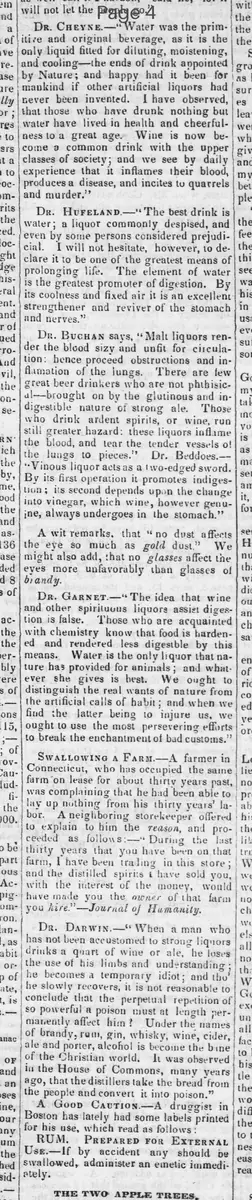
Dr. Cheyne.—"Water was the primitive and original beverage, as it is the only liquid fitted for diluting, moistening, and cooling—the ends of drink appointed by Nature; and happy had it been for mankind if other artificial liquors had never been invented. I have observed, that those who have drunk nothing but water have lived in health and cheerfulness to a great age. Wine is now become a common drink with the upper classes of society; and we see by daily experience that it inflames their blood, produces a disease, and incites to quarrels and murder."
DR. Hufeland.—"The best drink is water; a liquor commonly despised, and even by some persons considered prejudicial. I will not hesitate, however, to declare it to be one of the greatest means of prolonging life. The element of water is the greatest promoter of digestion. By its coolness and fixed air it is an excellent strengthener and reviver of the stomach and nerves."
Dr. Buchan says, "Malt liquors render the blood sizy and unfit for circulation: hence proceed obstructions and inflammation of the lungs. There are few great beer drinkers who are not phthisical—brought on by the glutinous and indigestible nature of strong ale. Those who drink ardent spirits, or wine, run still greater hazard: these liquors inflame the blood, and tear the tender vessels of the lungs to pieces." Dr. Beddoes.—"Vinous liquor acts as a two-edged sword. By its first operation it promotes indigestion; its second depends upon the change into vinegar, which wine, however genuine, always undergoes in the stomach."
A wit remarks, that "no dust affects the eye so much as gold dust." We might also add, that no glasses affect the eyes more unfavorably than glasses of brandy.
Dr. Garnert.—"The idea that wine and other spirituous liquors assist digestion is false. Those who are acquainted with chemistry know that food is hardened and rendered less digestible by this means. Water is the only liquor that nature has provided for animals; and whatever she gives is best. We ought to distinguish the real wants of nature from the artificial calls of habit; and when we find the latter beginning to injure us, we ought to use the most persevering efforts to break the enchantment of bad customs."
Swallowing A Farm.—A farmer in Connecticut, who has occupied the same farm on lease for about thirty years past, was complaining that he had been able to lay up nothing from his thirty years' labor. A neighboring storekeeper offered to explain to him the reason, and proceeded as follows:—"During the last thirty years that you have been on that farm, I have been trading in this store; and the distilled spirits I have sold you, with the interest of the money, would have made you the owner of that farm you hire."—Journal of Humanity.
Dr. Darwin.—"When a man who has not been accustomed to strong liquors drinks a quart of wine or ale, he loses the use of his limbs and understanding; he becomes a temporary idiot; and though he slowly recovers, it is not reasonable to conclude that the perpetual repetition of so powerful a poison must at length permanently affect him? Under the names of brandy, rum, gin, whisky, wine, cider, ale and porter, alcohol is become the bane of the Christian world. It was observed in the House of Commons, many years ago, that the distillers take the bread from the people and convert it into poison."
A Good Caution.—A druggist in Boston has lately had some labels printed for his use, which read as follows:
Rum. Prepared for External Use.—If by accident any should be swallowed, administer an emetic immediately.
DR. Hufeland.—"The best drink is water; a liquor commonly despised, and even by some persons considered prejudicial. I will not hesitate, however, to declare it to be one of the greatest means of prolonging life. The element of water is the greatest promoter of digestion. By its coolness and fixed air it is an excellent strengthener and reviver of the stomach and nerves."
Dr. Buchan says, "Malt liquors render the blood sizy and unfit for circulation: hence proceed obstructions and inflammation of the lungs. There are few great beer drinkers who are not phthisical—brought on by the glutinous and indigestible nature of strong ale. Those who drink ardent spirits, or wine, run still greater hazard: these liquors inflame the blood, and tear the tender vessels of the lungs to pieces." Dr. Beddoes.—"Vinous liquor acts as a two-edged sword. By its first operation it promotes indigestion; its second depends upon the change into vinegar, which wine, however genuine, always undergoes in the stomach."
A wit remarks, that "no dust affects the eye so much as gold dust." We might also add, that no glasses affect the eyes more unfavorably than glasses of brandy.
Dr. Garnert.—"The idea that wine and other spirituous liquors assist digestion is false. Those who are acquainted with chemistry know that food is hardened and rendered less digestible by this means. Water is the only liquor that nature has provided for animals; and whatever she gives is best. We ought to distinguish the real wants of nature from the artificial calls of habit; and when we find the latter beginning to injure us, we ought to use the most persevering efforts to break the enchantment of bad customs."
Swallowing A Farm.—A farmer in Connecticut, who has occupied the same farm on lease for about thirty years past, was complaining that he had been able to lay up nothing from his thirty years' labor. A neighboring storekeeper offered to explain to him the reason, and proceeded as follows:—"During the last thirty years that you have been on that farm, I have been trading in this store; and the distilled spirits I have sold you, with the interest of the money, would have made you the owner of that farm you hire."—Journal of Humanity.
Dr. Darwin.—"When a man who has not been accustomed to strong liquors drinks a quart of wine or ale, he loses the use of his limbs and understanding; he becomes a temporary idiot; and though he slowly recovers, it is not reasonable to conclude that the perpetual repetition of so powerful a poison must at length permanently affect him? Under the names of brandy, rum, gin, whisky, wine, cider, ale and porter, alcohol is become the bane of the Christian world. It was observed in the House of Commons, many years ago, that the distillers take the bread from the people and convert it into poison."
A Good Caution.—A druggist in Boston has lately had some labels printed for his use, which read as follows:
Rum. Prepared for External Use.—If by accident any should be swallowed, administer an emetic immediately.
What sub-type of article is it?
Medical Curiosity
Curiosity
What themes does it cover?
Moral Virtue
Misfortune
What keywords are associated?
Temperance
Alcohol Dangers
Water Benefits
Medical Warnings
Liquor Anecdotes
Health Effects
What entities or persons were involved?
Dr. Cheyne
Dr. Hufeland
Dr. Buchan
Dr. Beddoes
Dr. Garnert
Dr. Darwin
Where did it happen?
Connecticut; Boston
Story Details
Key Persons
Dr. Cheyne
Dr. Hufeland
Dr. Buchan
Dr. Beddoes
Dr. Garnert
Dr. Darwin
Location
Connecticut; Boston
Story Details
Quotes from doctors extolling water's benefits and decrying alcohol's harms to health, digestion, and society; anecdote of farmer losing farm equivalent to liquor costs; humorous druggist label warning against ingesting rum.