Thank you for visiting SNEWPapers!
Sign up free
The Morning Star And Catholic Messenger
New Orleans, Orleans County, Louisiana
What is this article about?
Lady Herbert describes Monsignor Claret, confessor to the Queen of Spain and Archbishop of Cuba, highlighting his personal holiness, humility amid unjust accusations, ascetic lifestyle, and dedication to preaching and devotion. Anecdotes include his silent endurance of criticism and preference for a simple crucifix symbolizing victory over suffering.
Clipping
OCR Quality
Full Text
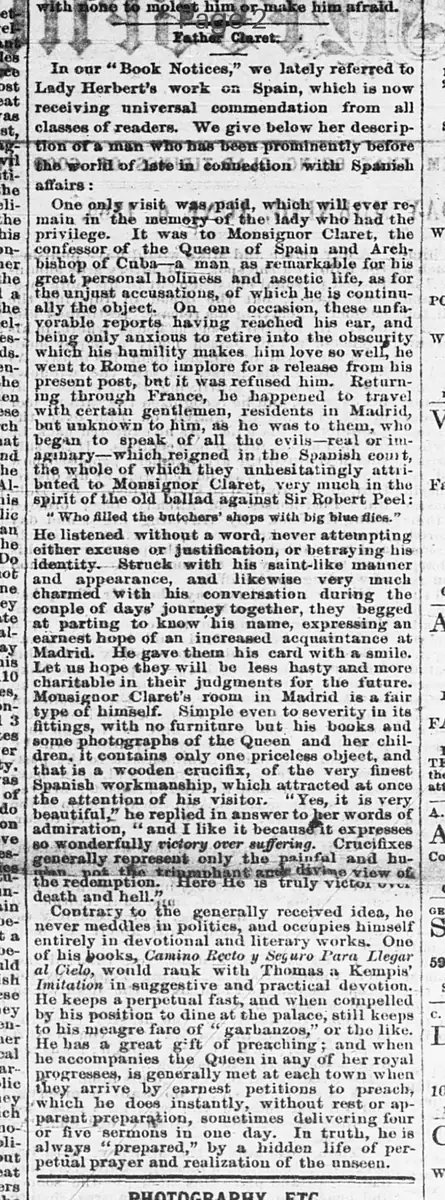
In our "Book Notices," we lately referred to Lady Herbert's work on Spain, which is now receiving universal commendation from all classes of readers. We give below her description of a man who has been prominently before the world of late in connection with Spanish affairs:
One only visit was paid, which will ever remain in the memory of the lady who had the privilege. It was to Monsignor Claret, the confessor of the Queen of Spain and Archbishop of Cuba--a man, as remarkable for his great personal holiness and ascetic life, as for the unjust accusations, of which he is continually the object. On one occasion, these unfavorable reports having reached his ear, and being only anxious to retire into the obscurity which his humility makes him love so well, he went to Rome to implore for a release from his present post, but it was refused him. Returning through France, he happened to travel with certain gentlemen, residents in Madrid, but unknown to him, as he was to them, who began to speak of all the evils--real or imaginary--which reigned in the Spanish court, the whole of which they unhesitatingly attributed to Monsignor Claret, very much in the spirit of the old ballad against Sir Robert Peel:
"Who filled the butchers' shops with big blue flies."
He listened without a word, never attempting either excuse or justification, or betraying his identity. Struck with his saint-like manner and appearance, and likewise very much charmed with his conversation during the couple of days' journey together, they begged at parting to know his name, expressing an earnest hope of an increased acquaintance at Madrid. He gave them his card with a smile. Let us hope they will be less hasty and more charitable in their judgments for the future.
Monsignor Claret's room in Madrid is a fair type of himself. Simple even to severity in its fittings, with no furniture but his books and some photographs of the Queen and her children, it contains only one priceless object, and that is a wooden crucifix, of the very finest Spanish workmanship, which attracted at once the attention of his visitor. "Yes, it is very beautiful," he replied in answer to her words of admiration, "and I like it because it expresses so wonderfully victory over suffering. Crucifixes generally represent only the painful and human part of the redemption. Here He is truly victorious over death and hell."
Contrary to the generally received idea, he never meddles in politics, and occupies himself entirely in devotional and literary works. One of his books, Camino Recto y Seguro Para Llegar al Cielo, would rank with Thomas a Kempis' Imitation in suggestive and practical devotion.
He keeps a perpetual fast, and when compelled by his position to dine at the palace, still keeps to his meagre fare of "garbanzos," or the like.
He has a great gift of preaching; and when he accompanies the Queen in any of her royal progresses, is generally met at each town when they arrive by earnest petitions to preach, which he does instantly, without rest or apparent preparation, sometimes delivering four or five sermons in one day. In truth, he is always "prepared," by a hidden life of perpetual prayer and realization of the unseen.
What sub-type of article is it?
What themes does it cover?
What keywords are associated?
What entities or persons were involved?
Where did it happen?
Story Details
Key Persons
Location
Madrid, Spain
Story Details
Lady Herbert recounts her visit to Monsignor Claret, emphasizing his holiness, humility during unjust accusations, including an anecdote of traveling incognito through France where critics unknowingly praised him; his simple room with a symbolic crucifix; avoidance of politics for devotional works; perpetual fast; and prolific preaching during royal travels.