Thank you for visiting SNEWPapers!
Sign up free
The Herald
Savannah, Chatham County, Georgia
What is this article about?
Report on the August 14, 1960s-era NAACP mass meeting at Bethel AME Church in Savannah, featuring prayers, speeches by W. W. Law and Amos C. Brown on desegregating lunch counters via boycotts, calls for persistence against segregation, a satirical play, and picnic announcements. (248 characters)
Merged-components note: Merged continuation of the mass meeting story across pages
Clippings
1 of 2
OCR Quality
Full Text
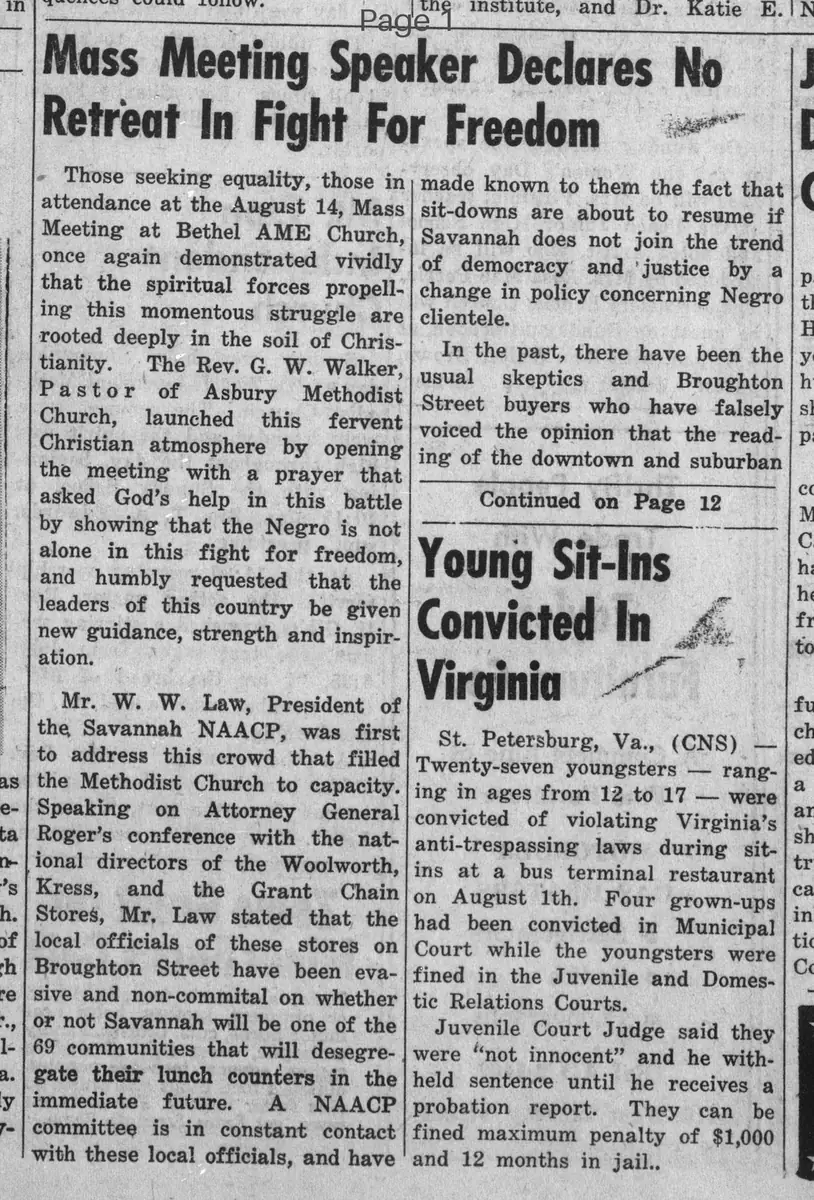
Those seeking equality, those in attendance at the August 14, Mass Meeting at Bethel AME Church, once again demonstrated vividly that the spiritual forces propelling this momentous struggle are rooted deeply in the soil of Christianity. The Rev. G. W. Walker, Pastor of Asbury Methodist Church, launched this fervent Christian atmosphere by opening the meeting with a prayer that asked God's help in this battle by showing that the Negro is not alone in this fight for freedom, and humbly requested that the leaders of this country be given new guidance, strength and inspiration. Mr. W. W. Law, President of the Savannah NAACP, was first to address this crowd that filled the Methodist Church to capacity. Speaking on Attorney General Rogers' conference with the national directors of the Woolworth, Kress, and the Grant Chain Stores, Mr, Law stated that the local officials of these stores on Broughton Street have been evasive and non-commital on whether or not Savannah will be one of the 69 communities that will desegregate their lunch counters in the immediate future. A NAACP committee is in constant contact with these local officials, and have made known to them the fact that sit-downs are about to resume if Savannah does not join the trend of democracy' and 'justice by a change in policy concerning Negro clientele. In the past, there have been the usual skeptics and Broughton Street buyers who have falsely voiced the opinion that the reading of the downtown and suburban Continued on Page 12
23RD MASS MEETING
(Continued from Page 1)
shoppers does no good and is therefore not effective. The fallacy in this approach was forcefully demonstrated by the announcement that the owner of a Negro Super Market adjoining Carver Village had now given full support of all NAACP activities, and was in complete agreement that Negroes should not patronize Broughton Street merchants. This was a complete turn around in attitude as reported in last Sunday's Mass Meeting. Another business leader voluntarily contacted the NAACP office this week and offered to fire two of his employees whose names were read for shopping, and who had created so much ill will that his business was about to be boycotted. These emphatic announcements show that Negro business people must be particularly careful and must not try and block those of his own race who place the desire for freedom, first class citizenship, and human dignity above these modest establishments.
The NAACP president once again made known his deep dislike and harsh suspicion of these Uncle Toms in the Negro community whose entire income is derived from colored people and yet continually voice opinions and take actions that are designed to please their "white friends." The withholding of patronage from any store that continues to support the philosophy of the white supremacists and politicians will continue.
Mr. W. W. Law introduced the speaker of the day, Mr. Amos C. Brown, 19 year old NAACP freedom speaker from Jackson, Mississippi. Mr. Brown, who is now employed as a Field Director for the youth division of the NAACP, began his address to the audience at Bethel by describing the emergence of segregation in the 1890's as a result of the Supreme Court decision which initially established the old doctrine of "separate but equal." "This spirit of separateness prevailed for 50 years until the majestic rising of today's New Negro and until the May 17, 1954 Court decision that declared segregation legally dead," stated this inspiring young man from the tyrannical and ancient state of Mississippi. The speaker described how the forces of segregation continue to march on in the disguise of segregated facilities and poor job opportunities.
Mr. Brown stated that the spotlight of world opinion is focused upon America, Land of the Free, for the uncommitted nations on this sphere realize that there exists today a large discrepancy in what is preached here in this country and what is actually practiced. He requested that the youth of today must stand up and kill the remaining spiritual forces of this undemocratic segregation, and added that any Negro in Savannah who is not concerned about freedom is committing an Act of Moral Suicide. The sympathetic and understanding audience roared in approval for this youth who is characteristic of the new and indestructible driving force, and who best symbolizes the Negro's "Angry Young Men." The youth leader reaffirmed that Negroes are not seeking to dominate this country or to be rabble rousers, but there will be no peace until love replaces hate and until the Negro achieves his full rights guaranteed by the U. S. Constitution. Mr. Brown is truly an angry young man in a hurry.
In conclusion the influential speaker asked the audience not to be discouraged merely because there are no lunch counters desegregated here in Savannah, and because school integration has not yet come to Georgia. "Do not turn back, for there is no retreat in this fight for freedom," stated this disciplined fighter. He quoted the teachings of Christ in saying that he who puts his hand to the plough and turns back is not worthy of Me. "... Will Go, Must Go, See What The End Will Be," goes the old time Negro spiritual, and upon these ringing notes Mr. Brown closed his address at Bethel AME Church.
The audience was next entertained by the humorous play, "The Colonel Comes Back Home:" the cast was composed of NAACP workers, many of whom are battle tested veterans from the Broughton Street picket lines. The satire dealt upon the change in the Negro, his desires and aspirations. It demonstrated that complacency and other stereotype Negro is being replaced by a desire for full equality and participation, a longing for human dignity and a better life for the new generation.
Final announcement was given by Mrs. Clyde Esther Garrison who stated that a NAACP picnic will be held August 27 at Dorchester Center in Liberty County. Buses will leave the NAACP office, Henry Street and West Broad, at 8:30 A.M. No food preparation is necessary as a large "Freedom" type menu is being prepared. Tickets are now on sale at the NAACP office.
Next Sunday, August 21 the 24th Mass Meeting will be held at Asbury Methodist Church, Duffy and Abercorn, the Rev. G. D. Walker, pastor.
What sub-type of article is it?
What themes does it cover?
What keywords are associated?
What entities or persons were involved?
Where did it happen?
Story Details
Key Persons
Location
Bethel Ame Church, Savannah
Event Date
August 14
Story Details
At the August 14 mass meeting at Bethel AME Church in Savannah, Rev. G. W. Walker opened with prayer, W. W. Law discussed NAACP efforts to desegregate lunch counters and boycott support, and young speaker Amos C. Brown urged persistence in the fight against segregation, emphasizing no retreat for freedom. The meeting included a satirical play and announcements for a picnic.