Thank you for visiting SNEWPapers!
Sign up free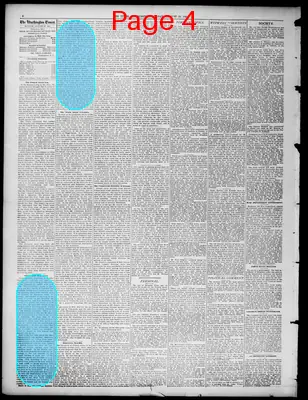
Editorial
August 26, 1901
The Washington Times
Washington, District Of Columbia
What is this article about?
Editorial critiques Representative Grosvenor's protectionist tariff arguments, highlighting how American manufacturers compete successfully in British markets despite costs, implying tariffs enable domestic price gouging rather than necessary protection.
Clipping
OCR Quality
95%
Excellent
Full Text
Some Tariff Absurdities.
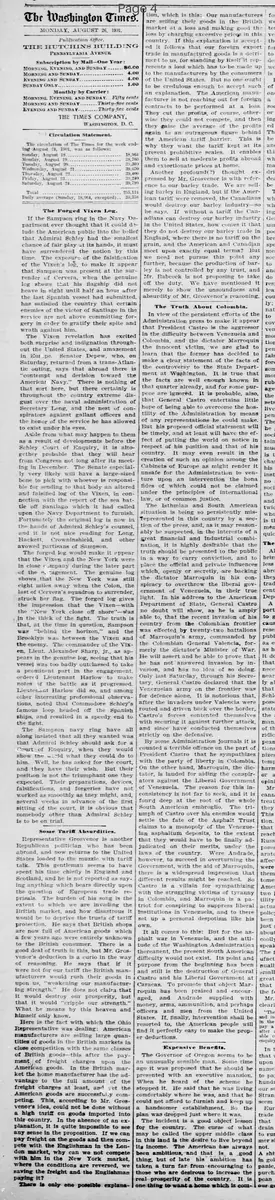
Representative Grosvenor is another Republican politician who has been abroad, and now returns to the United States loaded to the muzzle with tariff talk. This gentleman seems to have spent his time chiefly in England and Scotland, and he is not reported as saying anything which bears directly upon the question of European trade reprisals. The burden of his song is the extent to which we are invading the British market, and how disastrous it would be to deprive the trusts of tariff protection. He says that British shops are now full of American goods which a few years ago were entirely unknown to the British consumer. There is a good deal of truth in this, but Mr. Grosvenor's deduction is a curio in the way of reasoning. He says that if it were not for our tariff the British manufacturers would rush their goods in upon us, "weakening our manufacturing strength." He does not claim that it would destroy our prosperity, but that it would "cripple our strength." What he means by this heaven and himself only know.
Here is the fact with which the Ohio Representative was dealing: American manufacturers are selling large quantities of goods in the British markets in close competition with the same classes of British goods—this after the payment of freight charges upon the American goods. In the British market the home manufacturer has the advantage to the full amount of the freight charges at least, and yet the American goods are successfully competing. This, according to Mr. Grosvenor's idea, could not be done without a high tariff on goods imported into this country. In the absence of an explanation, it is quite impossible to see any sense in the proposition. If we can pay freight on the goods and then compete with the Englishman in the London market, why can we not compete with him in the New York market, where the conditions are reversed, we saving the freight and the Englishman paying it?
There is only one possible explanation, which is this: Our manufacturers are selling their goods in the British market at a loss and making good the loss by charging excessive prices in this country. If this explanation is accepted it follows that our foreign export trade in manufactured goods is a detriment to us, for standing by itself it represents a loss which has to be made up to the manufacturers by the consumers of the United States. But no one ought to be credulous enough to accept such an explanation. The American manufacturer is not reaching out for foreign contracts to be performed at a loss. They cut the profits, of course, otherwise they could not compete, and then they raise the average of the profits again to an outrageous figure behind the American tariff barrier. This is why they want the tariff kept at its present prohibitive scales. It enables them to sell at moderate profits abroad and extortionate prices at home.
Another profound(? thought expressed by Mr. Grosvenor is with reference to our barley trade. We are selling barley in England, but if the American tariff were removed, the Canadians would destroy our barley industry—so he says. If without a tariff the Canadians can destroy our barley industry in the United States, how comes it that they do not destroy our barley trade in England, where there is no tariff on the grain, and the American and Canadian meet upon exactly equal terms? But we need not pursue this point any further, because the production of barley is not controlled by any trust, and Mr. Babcock is not proposing to take off the duty. We have mentioned it merely to show the unsoundness and absurdity of Mr. Grosvenor's reasoning.
Representative Grosvenor is another Republican politician who has been abroad, and now returns to the United States loaded to the muzzle with tariff talk. This gentleman seems to have spent his time chiefly in England and Scotland, and he is not reported as saying anything which bears directly upon the question of European trade reprisals. The burden of his song is the extent to which we are invading the British market, and how disastrous it would be to deprive the trusts of tariff protection. He says that British shops are now full of American goods which a few years ago were entirely unknown to the British consumer. There is a good deal of truth in this, but Mr. Grosvenor's deduction is a curio in the way of reasoning. He says that if it were not for our tariff the British manufacturers would rush their goods in upon us, "weakening our manufacturing strength." He does not claim that it would destroy our prosperity, but that it would "cripple our strength." What he means by this heaven and himself only know.
Here is the fact with which the Ohio Representative was dealing: American manufacturers are selling large quantities of goods in the British markets in close competition with the same classes of British goods—this after the payment of freight charges upon the American goods. In the British market the home manufacturer has the advantage to the full amount of the freight charges at least, and yet the American goods are successfully competing. This, according to Mr. Grosvenor's idea, could not be done without a high tariff on goods imported into this country. In the absence of an explanation, it is quite impossible to see any sense in the proposition. If we can pay freight on the goods and then compete with the Englishman in the London market, why can we not compete with him in the New York market, where the conditions are reversed, we saving the freight and the Englishman paying it?
There is only one possible explanation, which is this: Our manufacturers are selling their goods in the British market at a loss and making good the loss by charging excessive prices in this country. If this explanation is accepted it follows that our foreign export trade in manufactured goods is a detriment to us, for standing by itself it represents a loss which has to be made up to the manufacturers by the consumers of the United States. But no one ought to be credulous enough to accept such an explanation. The American manufacturer is not reaching out for foreign contracts to be performed at a loss. They cut the profits, of course, otherwise they could not compete, and then they raise the average of the profits again to an outrageous figure behind the American tariff barrier. This is why they want the tariff kept at its present prohibitive scales. It enables them to sell at moderate profits abroad and extortionate prices at home.
Another profound(? thought expressed by Mr. Grosvenor is with reference to our barley trade. We are selling barley in England, but if the American tariff were removed, the Canadians would destroy our barley industry—so he says. If without a tariff the Canadians can destroy our barley industry in the United States, how comes it that they do not destroy our barley trade in England, where there is no tariff on the grain, and the American and Canadian meet upon exactly equal terms? But we need not pursue this point any further, because the production of barley is not controlled by any trust, and Mr. Babcock is not proposing to take off the duty. We have mentioned it merely to show the unsoundness and absurdity of Mr. Grosvenor's reasoning.
What sub-type of article is it?
Economic Policy
Trade Or Commerce
What keywords are associated?
Tariff Protection
American Exports
British Market
Manufacturing Competition
Barley Trade
Republican Politicians
What entities or persons were involved?
Representative Grosvenor
British Manufacturers
American Manufacturers
Trusts
Editorial Details
Primary Topic
Critique Of Tariff Protection For American Manufacturers
Stance / Tone
Critical Of Protectionist Tariff Arguments
Key Figures
Representative Grosvenor
British Manufacturers
American Manufacturers
Trusts
Key Arguments
American Goods Successfully Compete In British Markets Despite Freight Costs, Suggesting No Need For High Tariffs
High Tariffs Allow Manufacturers To Charge Extortionate Prices Domestically While Selling Abroad At Moderate Profits
Grosvenor's Claim That Removing Tariffs Would Let British Goods Weaken Us Manufacturing Is Illogical Given Export Success
Argument About Canadian Barley Destroying Us Industry Without Tariffs Is Absurd Since They Don't In Open British Market