Thank you for visiting SNEWPapers!
Sign up free
Editorial
August 18, 1802
Alexandria Advertiser And Commercial Intelligencer
Alexandria, Virginia
What is this article about?
This editorial denounces President Jefferson for rewarding journalist James Callender with $50 for slandering George Washington in his work 'The Prospect Before Us,' quoting Callender's attacks on Washington's character, neutrality proclamation, and death, while highlighting Jefferson's hypocritical public grief at Washington's tomb.
Clipping
OCR Quality
95%
Excellent
Full Text
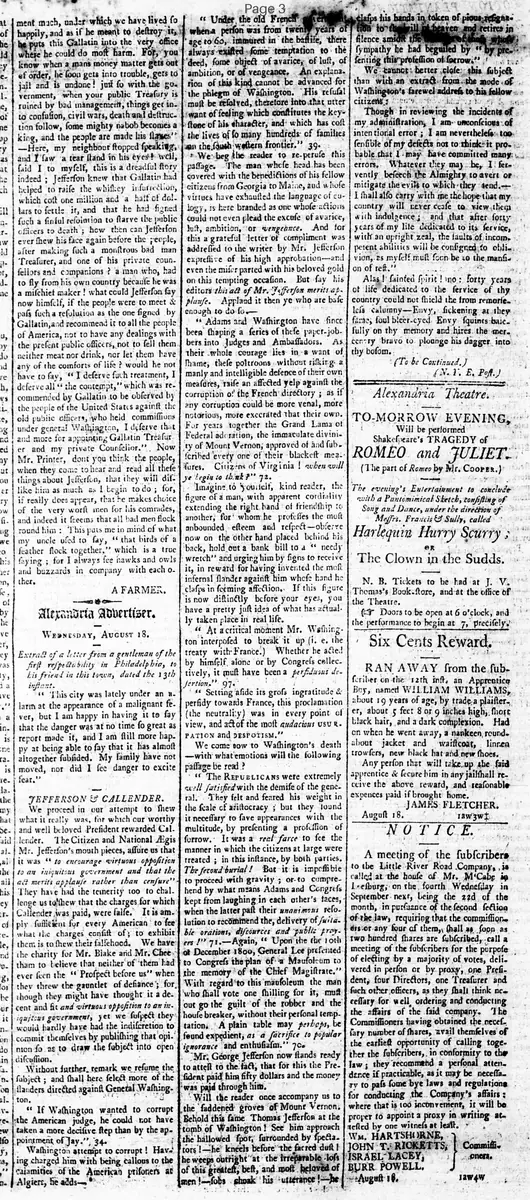
JEFFERSON & CALLENDER.
We proceed in our attempt to shew what it really was, for which our worthy and well beloved President rewarded Callender. The Citizen and National Aegis, Mr. Jefferson's mouth pieces, assure us that it was "to encourage virtuous opposition to an iniquitous government and that the act merits applause rather than censure"
They have had the temerity too to challenge us to shew that the charges for which Callender was paid, were false. It is amply sufficient for every American to see what the charges consist of; to exhibit them is to shew their falsehood. We have the charity for Mr. Duane and Mr. Cheetham to believe that neither of them had ever seen the "Prospect before us" when they threw the gauntlet of defiance; for though they might have thought it a decent and stand virtuous opposition to an iniquitous government, yet we suspect they would hardly have had the indiscretion to commit themselves by publishing that opinion so as to draw the subject into open discussion.
Without further remark we resume the object: and shall here select more of the slanders directed against General Washington.
"If Washington wanted to corrupt the American judge, he could not have taken a more decisive step than by the appointment of Jay." 34.
Washington attempt to corrupt! Having charged him with being callous to the calamities of the American prisoners at Algiers, he adds—
"Under the old French when a person was from twenty years of age to 60, immured in the bastile, there always existed some temptation to the deed, some object of avarice, of lust, of ambition, or of vengeance. An explanation of this kind cannot be advanced for the phlegm of Washington. His refusal must be resolved, therefore into that utter want of feeling which constitutes the key-stone of his character, and which has cost the lives of so many hundreds of families from the southwestern frontier." 39.
We beg the reader to re-peruse this passage. The man whose head has been covered with the benedictions of his fellow citizens from Georgia to Maine, and whose virtues have exhausted the language of eulogy, is here branded as one whose actions could not even plead the excuse of avarice, lust, ambition, "or vengeance. And for this a grateful letter of compliment was addressed to the writer by Mr. Jefferson expressive of his high approbation—and even the miser parted with his beloved gold on this tempting occasion. But say his editors this act of Mr. Jefferson merits applause. Applaud it then ye who are base enough to do so.—
"Adams and Washington have incessantly been shaping a series of these paper-jobbers into Judges and Ambassadors. As their whole courage lies in a want of shame; these poltroons without risking a manly and intelligible defence of their own measures, raise an affected yelp against the corruption of the French directory; as if any corruption could be more venal, more notorious, more execrated than their own. For years together the Grand Lama of Federal adoration, the immaculate divinity of Mount Vernon; approved of and Subscribed every one of their blackest measures. Citizens of Virginia! when will ye begin to think?" 72.
Imagine to yourself, kind reader, the figure of a man, with apparent cordiality extending the right hand of friendship to another; for whom he professes the most unbounded esteem and respect—observe now on the other hand placed behind his back, hold out a bank bill to a "needy wretch" and urging him by signs to receive it, in reward for having invented the most infernal slander against him whose hand he clasps in seeming affection. If this figure is now distinctly before your eyes, you have a pretty just idea of what has actually taken place in real life.
At a critical moment Mr. Washington interposed to break it up (i.e. the treaty with France.) Whether he acted by himself alone or by Congress collectively, it must have been a perfidious desertion. 97.
Setting aside its gross ingratitude & perfidy towards France, this proclamation (the neutrality) was in every point of view, an act of the most audacious USURPATION and DESPOTISM."
We come now to Washington's death—with what emotions will the following passage be read?
The Republicans were extremely well satisfied with the demise of the general. They felt and feared his weight in the scale of aristocracy; but they found it necessary to save appearances with the multitude, by presenting a profusion of sorrow.—It was a real farce to see the manner in which the citizens at large were treated; in this instance, by both parties. The second burial! But it is impossible to proceed with gravity; or to comprehend by what means Adams and Congress kept from laughing in each other's faces, when the latter past their unanimous resolution to recommend the delivery of suitable orations, discourses and public prayers!" 71.—Again, "Upon the 10th of December 1800, General Lee presented to Congress the plan of a Mausoleum to the memory of the Chief Magistrate."
With regard to this mausoleum the man who shall vote one shilling for it; must out go the guilt of the robber and the house breaker, without their personal temptation. A plain table may perhaps, be found expedient; as a sacrifice to popular ignorance and enthusiasm." 70.
Mr. George Jefferson now stands ready to attest to the fact; that for this the President paid him fifty dollars and the money was paid through him.
Will the reader once accompany us to the saddened groves of Mount Vernon. Behold this same Thomas Jefferson at the tomb of Washington! See him approach the hallowed spot; surrounded by spectators!—he kneels before the sacred dust! he weeps outright at the irreparable loss of this greatest, best, and most beloved of men!—sobs shoak his utterance! he clasps his hands in token of pious resignation to the will of heaven and retires in silence amidst the sympathy he had beguiled by presenting this profusion of sorrow!"
We cannot better close this subject than with an extract from the anecdote of Washington's farewell address to his fellow citizens:
"Though in reviewing the incidents of my administration. I am unconscious of intentional error; I am nevertheless too sensible of my defects not to think it probable that I may have committed many errors. Whatever they may be, I fervently beseech the Almighty to avert or mitigate the evils to which they may tend. I shall also carry with me the hope that my country will never cease to view them with indulgence; and that after forty years of my life dedicated to its service, with an upright zeal, the faults of incompetent abilities will be consigned to oblivion,—as myself must soon be to the mansions of rest."
Alas! sainted spirit! no: forty years of life dedicated to the service of thy country could not shield thee from remorseless calumny—Envy, sickening at thy fame; foul bleer-eyed. Envy squints basely on thy memory and hires the mercenary bravo to plounge his dagger into thy bosom.
(To be Continued.)
We proceed in our attempt to shew what it really was, for which our worthy and well beloved President rewarded Callender. The Citizen and National Aegis, Mr. Jefferson's mouth pieces, assure us that it was "to encourage virtuous opposition to an iniquitous government and that the act merits applause rather than censure"
They have had the temerity too to challenge us to shew that the charges for which Callender was paid, were false. It is amply sufficient for every American to see what the charges consist of; to exhibit them is to shew their falsehood. We have the charity for Mr. Duane and Mr. Cheetham to believe that neither of them had ever seen the "Prospect before us" when they threw the gauntlet of defiance; for though they might have thought it a decent and stand virtuous opposition to an iniquitous government, yet we suspect they would hardly have had the indiscretion to commit themselves by publishing that opinion so as to draw the subject into open discussion.
Without further remark we resume the object: and shall here select more of the slanders directed against General Washington.
"If Washington wanted to corrupt the American judge, he could not have taken a more decisive step than by the appointment of Jay." 34.
Washington attempt to corrupt! Having charged him with being callous to the calamities of the American prisoners at Algiers, he adds—
"Under the old French when a person was from twenty years of age to 60, immured in the bastile, there always existed some temptation to the deed, some object of avarice, of lust, of ambition, or of vengeance. An explanation of this kind cannot be advanced for the phlegm of Washington. His refusal must be resolved, therefore into that utter want of feeling which constitutes the key-stone of his character, and which has cost the lives of so many hundreds of families from the southwestern frontier." 39.
We beg the reader to re-peruse this passage. The man whose head has been covered with the benedictions of his fellow citizens from Georgia to Maine, and whose virtues have exhausted the language of eulogy, is here branded as one whose actions could not even plead the excuse of avarice, lust, ambition, "or vengeance. And for this a grateful letter of compliment was addressed to the writer by Mr. Jefferson expressive of his high approbation—and even the miser parted with his beloved gold on this tempting occasion. But say his editors this act of Mr. Jefferson merits applause. Applaud it then ye who are base enough to do so.—
"Adams and Washington have incessantly been shaping a series of these paper-jobbers into Judges and Ambassadors. As their whole courage lies in a want of shame; these poltroons without risking a manly and intelligible defence of their own measures, raise an affected yelp against the corruption of the French directory; as if any corruption could be more venal, more notorious, more execrated than their own. For years together the Grand Lama of Federal adoration, the immaculate divinity of Mount Vernon; approved of and Subscribed every one of their blackest measures. Citizens of Virginia! when will ye begin to think?" 72.
Imagine to yourself, kind reader, the figure of a man, with apparent cordiality extending the right hand of friendship to another; for whom he professes the most unbounded esteem and respect—observe now on the other hand placed behind his back, hold out a bank bill to a "needy wretch" and urging him by signs to receive it, in reward for having invented the most infernal slander against him whose hand he clasps in seeming affection. If this figure is now distinctly before your eyes, you have a pretty just idea of what has actually taken place in real life.
At a critical moment Mr. Washington interposed to break it up (i.e. the treaty with France.) Whether he acted by himself alone or by Congress collectively, it must have been a perfidious desertion. 97.
Setting aside its gross ingratitude & perfidy towards France, this proclamation (the neutrality) was in every point of view, an act of the most audacious USURPATION and DESPOTISM."
We come now to Washington's death—with what emotions will the following passage be read?
The Republicans were extremely well satisfied with the demise of the general. They felt and feared his weight in the scale of aristocracy; but they found it necessary to save appearances with the multitude, by presenting a profusion of sorrow.—It was a real farce to see the manner in which the citizens at large were treated; in this instance, by both parties. The second burial! But it is impossible to proceed with gravity; or to comprehend by what means Adams and Congress kept from laughing in each other's faces, when the latter past their unanimous resolution to recommend the delivery of suitable orations, discourses and public prayers!" 71.—Again, "Upon the 10th of December 1800, General Lee presented to Congress the plan of a Mausoleum to the memory of the Chief Magistrate."
With regard to this mausoleum the man who shall vote one shilling for it; must out go the guilt of the robber and the house breaker, without their personal temptation. A plain table may perhaps, be found expedient; as a sacrifice to popular ignorance and enthusiasm." 70.
Mr. George Jefferson now stands ready to attest to the fact; that for this the President paid him fifty dollars and the money was paid through him.
Will the reader once accompany us to the saddened groves of Mount Vernon. Behold this same Thomas Jefferson at the tomb of Washington! See him approach the hallowed spot; surrounded by spectators!—he kneels before the sacred dust! he weeps outright at the irreparable loss of this greatest, best, and most beloved of men!—sobs shoak his utterance! he clasps his hands in token of pious resignation to the will of heaven and retires in silence amidst the sympathy he had beguiled by presenting this profusion of sorrow!"
We cannot better close this subject than with an extract from the anecdote of Washington's farewell address to his fellow citizens:
"Though in reviewing the incidents of my administration. I am unconscious of intentional error; I am nevertheless too sensible of my defects not to think it probable that I may have committed many errors. Whatever they may be, I fervently beseech the Almighty to avert or mitigate the evils to which they may tend. I shall also carry with me the hope that my country will never cease to view them with indulgence; and that after forty years of my life dedicated to its service, with an upright zeal, the faults of incompetent abilities will be consigned to oblivion,—as myself must soon be to the mansions of rest."
Alas! sainted spirit! no: forty years of life dedicated to the service of thy country could not shield thee from remorseless calumny—Envy, sickening at thy fame; foul bleer-eyed. Envy squints basely on thy memory and hires the mercenary bravo to plounge his dagger into thy bosom.
(To be Continued.)
What sub-type of article is it?
Partisan Politics
Moral Or Religious
What keywords are associated?
Jefferson Callender
Washington Slander
Political Corruption
Republican Hypocrisy
Federalist Defense
Partisan Attacks
What entities or persons were involved?
Thomas Jefferson
James Callender
George Washington
John Adams
William Duane
James Cheetham
Editorial Details
Primary Topic
Jefferson's Payment To Callender For Slandering Washington
Stance / Tone
Indignant Defense Of Washington And Condemnation Of Jefferson's Hypocrisy
Key Figures
Thomas Jefferson
James Callender
George Washington
John Adams
William Duane
James Cheetham
Key Arguments
Jefferson Paid Callender $50 For Slanders Against Washington In 'The Prospect Before Us'
Callender Accused Washington Of Corruption In Appointing Jay
Callender Portrayed Washington As Callous And Lacking Feeling Toward American Prisoners
Callender Criticized Washington And Adams For Corruption And Supporting French Directory Attacks
Callender Called Washington's Neutrality Proclamation Usurpation And Despotism
Callender Mocked Republican Grief Over Washington's Death As Farce
Jefferson Hypocritically Mourned Washington Publicly While Funding His Slander Privately