Thank you for visiting SNEWPapers!
Sign up free
Story
January 13, 1806
Alexandria Daily Advertiser
Alexandria, Virginia
What is this article about?
US Senate debate on December 20: Gen. S. Smith opposes Dr. Logan's bill to suspend trade with St. Domingo, emphasizing its value to US economy, risks of benefiting Britain, and potential Haitian retaliation, without French urging.
Clipping
OCR Quality
95%
Excellent
Full Text
CONGRESS.
Senate of the United States.
Friday, December 20.
Debate on the motion of Dr. Logan, for leave to bring in a bill to suspend the commercial intercourse between the United States and St. Domingo—Concluded.
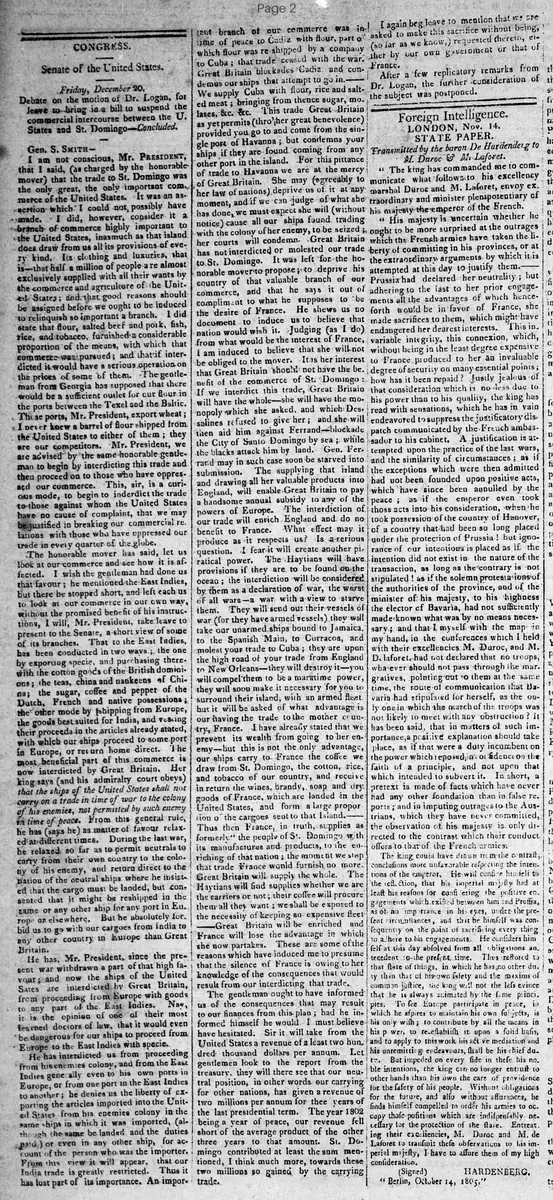
Gen. S. SMITH—I am not conscious, Mr. President, that I said, (as charged by the honorable mover) that the trade to St. Domingo was the only great, the only important commerce of the United States. It was an assertion which I could not possibly have made. I did, however, consider it a branch of commerce highly important to the United States, inasmuch as that island does draw from us all its provisions of every kind. Its clothing and luxuries, that is—that half a million of people are almost exclusively supplied with all their wants by the commerce and agriculture of the United States; and that good reasons should be assigned before we ought to be induced to relinquish so important a branch: I did state that flour, salted beef and pork, fish, rice, and tobacco, furnished a considerable proportion of the means, with which that commerce was pursued; and that if interdicted it would have a serious operation on the prices of some of them. The gentleman from Georgia has supposed that there would be a sufficient outlet for our flour in the ports between the Texel and the Baltic. These ports, Mr. President, export wheat; I never knew a barrel of flour shipped from the United States to either of them; they are our competitors. Mr. President, we are advised by the same honorable gentleman to begin by interdicting this trade and then proceed on to those who have oppressed our commerce. This, sir, is a curious mode, to begin to interdict the trade to those against whom the United States have no cause of complaint, that we may be justified in breaking our commercial relations with those who have oppressed our trade in every quarter of the globe. The honorable mover has said, let us look at our commerce and see how it is affected. I wish the gentleman had done us that favour; he mentioned the East Indies, but there he stopped short, and left us to look at our commerce in our own way, without the promised benefit of his instructions, I will, Mr. President, take leave to present to the Senate, a short view of some of its branches. That to the East Indies, has been conducted in two ways; the one by exporting specie, and purchasing therewith the cotton goods of the British dominions; the teas, china and nankeens of China; the sugar, coffee and pepper of the Dutch, French and native possessions; the other mode by shipping from Europe, the goods best suited for India, and vesting their proceeds in the articles already stated, with which our ships proceed to some port in Europe, or return home direct. The most beneficial part of this commerce is now interdicted by Great Britain. Her king says (and his admiralty court obeys) that the ships of the United States shall not carry on a trade in time of war to the colony of his enemies, not permitted by such enemy in time of peace. From this general rule, he has (says he) as matter of favour relaxed at different times. During the last war, he relaxed so far as to permit neutrals to carry from their own country to the colony of his enemy, and return direct to the nation of the neutral ships. where he insisted that the cargo must be landed, but consented that it might be reshipped in the same or any other ship for any port in Europe. But he absolutely forbids us to go with our cargoes from India to Europe or elsewhere. But he absolutely forbids us to go with our cargoes from India to any other country in Europe than Great Britain. He has, Mr. President, since the present war withdrawn a part of that high favour; and now the ships of the United States are interdicted by Great Britain, to any part of the East Indies. Nay, from proceeding from Europe with goods to the East Indies, it is the opinion of one of their most learned doctors of law, that it would even be dangerous for our ships to proceed from Europe to the East Indies with specie. He has interdicted us from proceeding from his enemies colony, and from the East Indies generally even to his own ports in Europe, or from one port in the East Indies to another; he denies us the liberty of exporting the articles imported into the United States from his enemies colony in the same ships in which it was imported, (although the same be landed and the duties paid,) or even in any other ship, or on account of the person who was the importer. From this view it will appear, that our India trade is greatly restricted. Thus it has lost part of its importance. An important branch of our commerce was in time of peace to Cadiz with flour, part of which flour was re-shipped by a company to Cuba; that trade ceased with the war. Great Britain blockades Cadiz, and condemns our ships that attempt to go in. We supply Cuba with flour, rice and salted meat; bringing from thence sugar, molasses, &c. &c. This trade Great Britain as yet permits (thro' her great benevolence) provided you go to and come from the single port of Havanna; but condemns your ships if they are found coming from any other port in the island. For this pittance of trade to Havanna we are at the mercy of Great Britain. She may (agreeably to her law of nations) deprive us of it at any moment, and if we can judge of what she has done, we must expect she will (without notice) cause all our ships found trading with the colony of her enemy, to be seized; her courts will condemn. Great Britain has not interdicted or molested our trade to St. Domingo. It was left for the honorable mover to propose; to deprive his country of that valuable branch of our commerce, and that he says it out of compliment to what he supposes to be the desire of France. He shews us no document to induce us to believe that nation would wish it. Judging (as I do) from what would be the interest of France, I am induced to believe that she will not be obliged to the mover. It is her interest that Great Britain should not have the benefit of the commerce of St. Domingo: If we interdict this trade, Great Britain will have the whole—she will have the monopoly which she asked, and which Dessalines refused to give her; and she will then aid him against Ferrand—blockade the City of Santo Domingo by sea; while the blacks attack him by land. Gen. Ferrand may in such case soon be starved into submission. The supplying that island and drawing all her valuable products into England, will enable Great Britain to pay a handsome annual subsidy to any of the powers of Europe— The interdiction of our trade will enrich England and do no benefit to France. What effect may it produce as it respects us? Is a serious question. I fear it will create another piratical power. The Haytians will have provisions if they are to be found on the ocean: the interdiction will be considered by them as a declaration of war, the worst of all wars—a war with a view to starve them. They will send out their vessels of war (for they have armed vessels) they will take our unarmed ships bound to Jamaica, to the Spanish Main, to Curacao, and molest your trade to Cuba.; they are upon the high road of your trade from England to New Orleans—they will destroy it—you will compel them to be a maritime power, they will soon make it necessary for you to surround their island; with an armed fleet. but it will be asked of what advantage is our having the trade to the mother country, France. I have already stated that we prevent its wealth from going to her enemy—but this is not the only advantage, our ships carry to France the coffee we draw from St. Domingo, the cotton, rice, and tobacco of our country, and receive in return the wines, brandy, soap and dry goods of France, which are landed in the United States, and form a large proportion of the cargoes sent to that Island. Thus then France, in truth, supplies as formerly the people of St. Domingo with its manufactures and products, to the enriching of that nation; the moment we stop that trade France would furnish no more. Great Britain will supply the whole. The Haytians will send supplies whether we are the carriers or not; their coffee will procure them all they want; we shall be exposed to the necessity of keeping an expensive fleet—Great Britain will be enriched and France will lose the advantage in which she now partakes. These are some of the reasons which have induced me to presume that the silence of France is owing to her knowledge of the consequences that would result from our interdicting that trade. The gentleman ought to have informed us of the consequences that may result to our finances from this plan; had he informed himself he would, I must believe, have hesitated: Sir it will take from the United States a revenue of at least two hundred thousand dollars per annum. Let gentlemen look to the report from the treasury. they will there see that our neutral position, in other words our carrying for other nations, has given a revenue of two millions per annum for three years of the last presidential term. The year 1802 being a year of peace, our revenue fell short of the average product of the other three years to that amount. St. Domingo contributed at least the sum mentioned, I think much more, towards these two millions so gained by the carrying trade. I again beg leave to mention that we are asked to make this sacrifice without being requested thereto by our own government or that of France. (so far as we know,) After a few replicatory remarks from Dr. Logan, the further consideration of the subject was postponed.
Senate of the United States.
Friday, December 20.
Debate on the motion of Dr. Logan, for leave to bring in a bill to suspend the commercial intercourse between the United States and St. Domingo—Concluded.
Gen. S. SMITH—I am not conscious, Mr. President, that I said, (as charged by the honorable mover) that the trade to St. Domingo was the only great, the only important commerce of the United States. It was an assertion which I could not possibly have made. I did, however, consider it a branch of commerce highly important to the United States, inasmuch as that island does draw from us all its provisions of every kind. Its clothing and luxuries, that is—that half a million of people are almost exclusively supplied with all their wants by the commerce and agriculture of the United States; and that good reasons should be assigned before we ought to be induced to relinquish so important a branch: I did state that flour, salted beef and pork, fish, rice, and tobacco, furnished a considerable proportion of the means, with which that commerce was pursued; and that if interdicted it would have a serious operation on the prices of some of them. The gentleman from Georgia has supposed that there would be a sufficient outlet for our flour in the ports between the Texel and the Baltic. These ports, Mr. President, export wheat; I never knew a barrel of flour shipped from the United States to either of them; they are our competitors. Mr. President, we are advised by the same honorable gentleman to begin by interdicting this trade and then proceed on to those who have oppressed our commerce. This, sir, is a curious mode, to begin to interdict the trade to those against whom the United States have no cause of complaint, that we may be justified in breaking our commercial relations with those who have oppressed our trade in every quarter of the globe. The honorable mover has said, let us look at our commerce and see how it is affected. I wish the gentleman had done us that favour; he mentioned the East Indies, but there he stopped short, and left us to look at our commerce in our own way, without the promised benefit of his instructions, I will, Mr. President, take leave to present to the Senate, a short view of some of its branches. That to the East Indies, has been conducted in two ways; the one by exporting specie, and purchasing therewith the cotton goods of the British dominions; the teas, china and nankeens of China; the sugar, coffee and pepper of the Dutch, French and native possessions; the other mode by shipping from Europe, the goods best suited for India, and vesting their proceeds in the articles already stated, with which our ships proceed to some port in Europe, or return home direct. The most beneficial part of this commerce is now interdicted by Great Britain. Her king says (and his admiralty court obeys) that the ships of the United States shall not carry on a trade in time of war to the colony of his enemies, not permitted by such enemy in time of peace. From this general rule, he has (says he) as matter of favour relaxed at different times. During the last war, he relaxed so far as to permit neutrals to carry from their own country to the colony of his enemy, and return direct to the nation of the neutral ships. where he insisted that the cargo must be landed, but consented that it might be reshipped in the same or any other ship for any port in Europe. But he absolutely forbids us to go with our cargoes from India to Europe or elsewhere. But he absolutely forbids us to go with our cargoes from India to any other country in Europe than Great Britain. He has, Mr. President, since the present war withdrawn a part of that high favour; and now the ships of the United States are interdicted by Great Britain, to any part of the East Indies. Nay, from proceeding from Europe with goods to the East Indies, it is the opinion of one of their most learned doctors of law, that it would even be dangerous for our ships to proceed from Europe to the East Indies with specie. He has interdicted us from proceeding from his enemies colony, and from the East Indies generally even to his own ports in Europe, or from one port in the East Indies to another; he denies us the liberty of exporting the articles imported into the United States from his enemies colony in the same ships in which it was imported, (although the same be landed and the duties paid,) or even in any other ship, or on account of the person who was the importer. From this view it will appear, that our India trade is greatly restricted. Thus it has lost part of its importance. An important branch of our commerce was in time of peace to Cadiz with flour, part of which flour was re-shipped by a company to Cuba; that trade ceased with the war. Great Britain blockades Cadiz, and condemns our ships that attempt to go in. We supply Cuba with flour, rice and salted meat; bringing from thence sugar, molasses, &c. &c. This trade Great Britain as yet permits (thro' her great benevolence) provided you go to and come from the single port of Havanna; but condemns your ships if they are found coming from any other port in the island. For this pittance of trade to Havanna we are at the mercy of Great Britain. She may (agreeably to her law of nations) deprive us of it at any moment, and if we can judge of what she has done, we must expect she will (without notice) cause all our ships found trading with the colony of her enemy, to be seized; her courts will condemn. Great Britain has not interdicted or molested our trade to St. Domingo. It was left for the honorable mover to propose; to deprive his country of that valuable branch of our commerce, and that he says it out of compliment to what he supposes to be the desire of France. He shews us no document to induce us to believe that nation would wish it. Judging (as I do) from what would be the interest of France, I am induced to believe that she will not be obliged to the mover. It is her interest that Great Britain should not have the benefit of the commerce of St. Domingo: If we interdict this trade, Great Britain will have the whole—she will have the monopoly which she asked, and which Dessalines refused to give her; and she will then aid him against Ferrand—blockade the City of Santo Domingo by sea; while the blacks attack him by land. Gen. Ferrand may in such case soon be starved into submission. The supplying that island and drawing all her valuable products into England, will enable Great Britain to pay a handsome annual subsidy to any of the powers of Europe— The interdiction of our trade will enrich England and do no benefit to France. What effect may it produce as it respects us? Is a serious question. I fear it will create another piratical power. The Haytians will have provisions if they are to be found on the ocean: the interdiction will be considered by them as a declaration of war, the worst of all wars—a war with a view to starve them. They will send out their vessels of war (for they have armed vessels) they will take our unarmed ships bound to Jamaica, to the Spanish Main, to Curacao, and molest your trade to Cuba.; they are upon the high road of your trade from England to New Orleans—they will destroy it—you will compel them to be a maritime power, they will soon make it necessary for you to surround their island; with an armed fleet. but it will be asked of what advantage is our having the trade to the mother country, France. I have already stated that we prevent its wealth from going to her enemy—but this is not the only advantage, our ships carry to France the coffee we draw from St. Domingo, the cotton, rice, and tobacco of our country, and receive in return the wines, brandy, soap and dry goods of France, which are landed in the United States, and form a large proportion of the cargoes sent to that Island. Thus then France, in truth, supplies as formerly the people of St. Domingo with its manufactures and products, to the enriching of that nation; the moment we stop that trade France would furnish no more. Great Britain will supply the whole. The Haytians will send supplies whether we are the carriers or not; their coffee will procure them all they want; we shall be exposed to the necessity of keeping an expensive fleet—Great Britain will be enriched and France will lose the advantage in which she now partakes. These are some of the reasons which have induced me to presume that the silence of France is owing to her knowledge of the consequences that would result from our interdicting that trade. The gentleman ought to have informed us of the consequences that may result to our finances from this plan; had he informed himself he would, I must believe, have hesitated: Sir it will take from the United States a revenue of at least two hundred thousand dollars per annum. Let gentlemen look to the report from the treasury. they will there see that our neutral position, in other words our carrying for other nations, has given a revenue of two millions per annum for three years of the last presidential term. The year 1802 being a year of peace, our revenue fell short of the average product of the other three years to that amount. St. Domingo contributed at least the sum mentioned, I think much more, towards these two millions so gained by the carrying trade. I again beg leave to mention that we are asked to make this sacrifice without being requested thereto by our own government or that of France. (so far as we know,) After a few replicatory remarks from Dr. Logan, the further consideration of the subject was postponed.
What sub-type of article is it?
Historical Event
What themes does it cover?
Justice
Misfortune
What keywords are associated?
Senate Debate
St Domingo Trade
Commercial Intercourse
British Restrictions
Us Commerce
What entities or persons were involved?
Gen. S. Smith
Dr. Logan
Where did it happen?
Senate Of The United States
Story Details
Key Persons
Gen. S. Smith
Dr. Logan
Location
Senate Of The United States
Event Date
Friday, December 20
Story Details
Gen. S. Smith argues against Dr. Logan's motion to suspend US commercial intercourse with St. Domingo, highlighting its economic importance, potential harm to US interests, benefits to Britain, and lack of French request.