Thank you for visiting SNEWPapers!
Sign up free
Literary
July 4, 1766
The New Hampshire Gazette And Historical Chronicle
Portsmouth, Greenland, Rockingham County, New Hampshire
What is this article about?
A letter to the New Hampshire Gazette recommends Dr. Elliot's fifth essay on field husbandry, excerpting his advice on enriching land through deep tillage without dung. It describes ploughing, ridging, hoeing to kill weeds, make soil mellow, and retain dews for better crops like carrots and turnips.
Clipping
OCR Quality
98%
Excellent
Full Text
To the Publisher of the New Hampshire Gazette.
By inserting the following in your next Paper you will oblige several of your Customers.
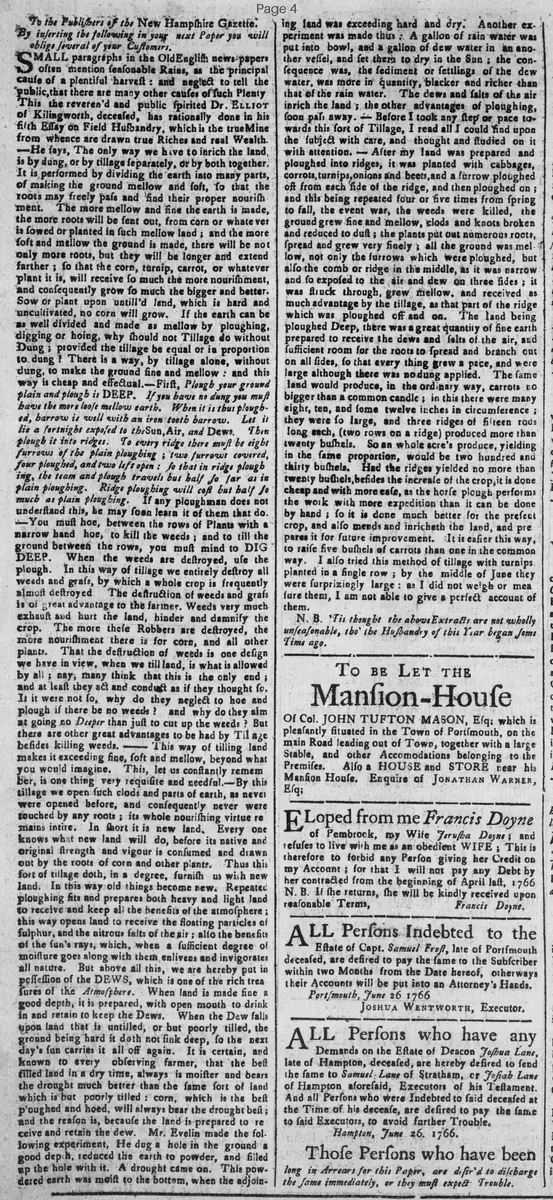
ALL paragraphs in the Old English news-papers often mention seasonable Rains, as the principal cause of a plentiful harvest: and neglect to tell the public that there are many other causes of such Plenty. This the reverend and public spirited Dr. Elliot of Killingworth, deceased, has rationally done in his fifth Essay on Field Husbandry, which is the true Mine from whence are drawn true Riches and real Wealth.
--He says, The only way we have to enrich the land, is by dung, or by tillage separately, or by both together. It is performed by dividing the earth into many parts, of making the ground mellow and soft, so that the roots may freely pass and find their proper nourishment. The more mellow and fine the earth is made, the more roots will be sent out from corn or whatever is sowed or planted in such mellow land; and the more soft and mellow the ground is made, there will be not only more roots, but they will be longer and extend farther; so that the corn, turnip, carrot, or whatever plant it is, will receive so much the more nourishment, and consequently grow so much the bigger and better. Sow or plant upon untilled land, which is hard and uncultivated, no corn will grow. If the earth can be as well divided and made as mellow by ploughing, digging or hoeing, why should not Tillage do without Dung; provided the tillage be equal or in proportion to dung? There is a way, by tillage alone, without dung, to make the ground fine and mellow: and this way is cheap and effectual. --First, Plough your ground plain and plough it DEEP. If you have no dung you must have the more loose mellow earth. When it is thus ploughed, harrow it well with an iron tooth barrow. Let it lie a fortnight exposed to the Sun, Air, and Dews. Then plough it into ridges. To every ridge there must be eight furrows of the plain ploughing; two furrows covered, four ploughed, and two left open: so that in ridge ploughing, the team and plough travels but half so far as in plain ploughing. Ridge ploughing will cost but half so much as plain ploughing. If any ploughman does not understand this, he may soon learn it of them that do. You must hoe, between the rows of Plants with a narrow hand hoe, to kill the weeds: and to till the ground between the rows, you must mind to DIG DEEP. When the weeds are destroyed, use the plough. In this way of tillage we entirely destroy all weeds and grass, by which a whole crop is frequently almost destroyed. The destruction of weeds and grass is of great advantage to the farmer. Weeds very much exhaust and hurt the land, hinder and damnify the crop. The more these Robbers are destroyed, the more nourishment there is for corn, and all other plants. That the destruction of weeds is one design we have in view, when we till land, is what is allowed by all; nay, many think that this is the only end; and at least they act and conduct as if they thought so. If it were not so, why do they neglect to hoe and plough if there be no weeds? and why do they aim at going no Deeper than just to cut up the weeds? But there are other great advantages to be had by Tillage besides killing weeds. -- This way of tilling land makes it exceeding fine, soft and mellow, beyond what you would imagine. This, let us constantly remember, is one thing very requisite and needful. --By this tillage we open such clods and parts of earth, as never were opened before, and consequently never were touched by any roots; its whole nourishing virtue remains entire. In short it is new land. Every one knows what new land will do, before its native and original strength and vigour is consumed and drawn out by the roots of corn and other plants. Thus this sort of tillage doth, in a degree, furnish us with new land. In this way old things become new. Repeated ploughing fits and prepares both heavy and light land to receive and keep all the benefits of the atmosphere; this way opens land to receive the floating particles of sulphur, and the nitrous salts of the air; also the benefits of the sun's rays, which, when a sufficient degree of moisture goes along with them enlivens and invigorates all nature. But above all this, we are hereby put in possession of the DEWS, which is one of the rich Treasures of the Atmosphere. - When land is made fine a good depth, it is prepared, with open mouth to drink in and retain to keep the Dews. When the Dew falls upon land that is untilled, or but poorly tilled, the ground being hard it doth not sink deep, so the next day's sun carries it all off again. It is certain, and known to every observing farmer, that the best tilled land in a dry time, always is moister and bears the drought much better than the same sort of land which is but poorly tilled: corn, which is the best ploughed and hoed, will always bear the drought best; and the reason is, because the land is prepared to receive and retain the dew. Mr. Evelyn made the following experiment, He dug a hole in the ground a good depth, reduced the earth to powder, and filled up the hole with it. A drought came on. This powdered earth was moist so the bottom, when the adjoining land was exceeding hard and dry. Another experiment was made thus: A gallon of rain water was put into bowl, and a gallon of dew water in another vessel, and set them to dry in the Sun; the consequence was, the sediment or settlings of the dew water, was more in quantity, blacker and richer than that of the rain water. The dews and salts of the air enrich the land; the other advantages of ploughing, soon pass away. -- Before I took any step or pace towards this sort of Tillage, I read all I could find upon the subject with care, and thought and studied on it with attention. After my land was prepared and ploughed into ridges, it was planted with cabbages, carrots, turnips, onions and beets, and a furrow ploughed off from each side of the ridge, and then ploughed on; and this being repeated four or five times from spring to fall, the event was, the weeds were killed, the ground grew fine and mellow, clods and knots broken and reduced to dust; the plants put out numerous roots, spread and grew very finely; all the ground was mellow, not only the furrows which were ploughed, but also the comb or ridge in the middle, as it was narrow and so exposed to the air and dew on three sides; it was struck through, grew mellow, and received as much advantage by the tillage, as that part of the ridge which was ploughed off and on. The land being ploughed Deep, there was a great quantity of fine earth prepared to receive the dews and salts of the air, and sufficient room for the roots to spread and branch out on all sides, so that every thing grew apace, and were large although there was nothing applied. The same land would produce, in the ordinary way, carrots no bigger than a common candle; in this there were many eight, ten, and some twelve inches in circumference; they were so large, and three ridges of fifteen rods long each, (two rows on a ridge) produced more than twenty bushels. So an whole acre's produce, yielding in the same proportion, would be two hundred and thirty bushels. And the ridger yielded no more than twenty bushels besides the increase of the crop, it is done cheap and with more ease, as the horse plough performs the work with more expedition than it can be done by hand; so it is done much better for the present crop, and also mends and enricheth the land, and prepares it for future improvement. It is easier this way, to raise five bushels of carrots than one in the common way. I also tried this method of tillage with turnips planted in a single row; by the middle of June they were surprisingly large: as I did not weigh or measure them, I am not able to give a perfect account of them.
N. B. Tis thought the above Extracts are not wholly unseasonable, tho' the Husbandry of this Year began some Time ago.
By inserting the following in your next Paper you will oblige several of your Customers.
ALL paragraphs in the Old English news-papers often mention seasonable Rains, as the principal cause of a plentiful harvest: and neglect to tell the public that there are many other causes of such Plenty. This the reverend and public spirited Dr. Elliot of Killingworth, deceased, has rationally done in his fifth Essay on Field Husbandry, which is the true Mine from whence are drawn true Riches and real Wealth.
--He says, The only way we have to enrich the land, is by dung, or by tillage separately, or by both together. It is performed by dividing the earth into many parts, of making the ground mellow and soft, so that the roots may freely pass and find their proper nourishment. The more mellow and fine the earth is made, the more roots will be sent out from corn or whatever is sowed or planted in such mellow land; and the more soft and mellow the ground is made, there will be not only more roots, but they will be longer and extend farther; so that the corn, turnip, carrot, or whatever plant it is, will receive so much the more nourishment, and consequently grow so much the bigger and better. Sow or plant upon untilled land, which is hard and uncultivated, no corn will grow. If the earth can be as well divided and made as mellow by ploughing, digging or hoeing, why should not Tillage do without Dung; provided the tillage be equal or in proportion to dung? There is a way, by tillage alone, without dung, to make the ground fine and mellow: and this way is cheap and effectual. --First, Plough your ground plain and plough it DEEP. If you have no dung you must have the more loose mellow earth. When it is thus ploughed, harrow it well with an iron tooth barrow. Let it lie a fortnight exposed to the Sun, Air, and Dews. Then plough it into ridges. To every ridge there must be eight furrows of the plain ploughing; two furrows covered, four ploughed, and two left open: so that in ridge ploughing, the team and plough travels but half so far as in plain ploughing. Ridge ploughing will cost but half so much as plain ploughing. If any ploughman does not understand this, he may soon learn it of them that do. You must hoe, between the rows of Plants with a narrow hand hoe, to kill the weeds: and to till the ground between the rows, you must mind to DIG DEEP. When the weeds are destroyed, use the plough. In this way of tillage we entirely destroy all weeds and grass, by which a whole crop is frequently almost destroyed. The destruction of weeds and grass is of great advantage to the farmer. Weeds very much exhaust and hurt the land, hinder and damnify the crop. The more these Robbers are destroyed, the more nourishment there is for corn, and all other plants. That the destruction of weeds is one design we have in view, when we till land, is what is allowed by all; nay, many think that this is the only end; and at least they act and conduct as if they thought so. If it were not so, why do they neglect to hoe and plough if there be no weeds? and why do they aim at going no Deeper than just to cut up the weeds? But there are other great advantages to be had by Tillage besides killing weeds. -- This way of tilling land makes it exceeding fine, soft and mellow, beyond what you would imagine. This, let us constantly remember, is one thing very requisite and needful. --By this tillage we open such clods and parts of earth, as never were opened before, and consequently never were touched by any roots; its whole nourishing virtue remains entire. In short it is new land. Every one knows what new land will do, before its native and original strength and vigour is consumed and drawn out by the roots of corn and other plants. Thus this sort of tillage doth, in a degree, furnish us with new land. In this way old things become new. Repeated ploughing fits and prepares both heavy and light land to receive and keep all the benefits of the atmosphere; this way opens land to receive the floating particles of sulphur, and the nitrous salts of the air; also the benefits of the sun's rays, which, when a sufficient degree of moisture goes along with them enlivens and invigorates all nature. But above all this, we are hereby put in possession of the DEWS, which is one of the rich Treasures of the Atmosphere. - When land is made fine a good depth, it is prepared, with open mouth to drink in and retain to keep the Dews. When the Dew falls upon land that is untilled, or but poorly tilled, the ground being hard it doth not sink deep, so the next day's sun carries it all off again. It is certain, and known to every observing farmer, that the best tilled land in a dry time, always is moister and bears the drought much better than the same sort of land which is but poorly tilled: corn, which is the best ploughed and hoed, will always bear the drought best; and the reason is, because the land is prepared to receive and retain the dew. Mr. Evelyn made the following experiment, He dug a hole in the ground a good depth, reduced the earth to powder, and filled up the hole with it. A drought came on. This powdered earth was moist so the bottom, when the adjoining land was exceeding hard and dry. Another experiment was made thus: A gallon of rain water was put into bowl, and a gallon of dew water in another vessel, and set them to dry in the Sun; the consequence was, the sediment or settlings of the dew water, was more in quantity, blacker and richer than that of the rain water. The dews and salts of the air enrich the land; the other advantages of ploughing, soon pass away. -- Before I took any step or pace towards this sort of Tillage, I read all I could find upon the subject with care, and thought and studied on it with attention. After my land was prepared and ploughed into ridges, it was planted with cabbages, carrots, turnips, onions and beets, and a furrow ploughed off from each side of the ridge, and then ploughed on; and this being repeated four or five times from spring to fall, the event was, the weeds were killed, the ground grew fine and mellow, clods and knots broken and reduced to dust; the plants put out numerous roots, spread and grew very finely; all the ground was mellow, not only the furrows which were ploughed, but also the comb or ridge in the middle, as it was narrow and so exposed to the air and dew on three sides; it was struck through, grew mellow, and received as much advantage by the tillage, as that part of the ridge which was ploughed off and on. The land being ploughed Deep, there was a great quantity of fine earth prepared to receive the dews and salts of the air, and sufficient room for the roots to spread and branch out on all sides, so that every thing grew apace, and were large although there was nothing applied. The same land would produce, in the ordinary way, carrots no bigger than a common candle; in this there were many eight, ten, and some twelve inches in circumference; they were so large, and three ridges of fifteen rods long each, (two rows on a ridge) produced more than twenty bushels. So an whole acre's produce, yielding in the same proportion, would be two hundred and thirty bushels. And the ridger yielded no more than twenty bushels besides the increase of the crop, it is done cheap and with more ease, as the horse plough performs the work with more expedition than it can be done by hand; so it is done much better for the present crop, and also mends and enricheth the land, and prepares it for future improvement. It is easier this way, to raise five bushels of carrots than one in the common way. I also tried this method of tillage with turnips planted in a single row; by the middle of June they were surprisingly large: as I did not weigh or measure them, I am not able to give a perfect account of them.
N. B. Tis thought the above Extracts are not wholly unseasonable, tho' the Husbandry of this Year began some Time ago.
What sub-type of article is it?
Essay
Epistolary
What themes does it cover?
Agriculture Rural
What keywords are associated?
Field Husbandry
Tillage
Ploughing
Ridges
Dews
Weeds
Crops
Carrots
Turnips
What entities or persons were involved?
Dr. Elliot Of Killingworth (Excerpted); Anonymous Letter Writer
Literary Details
Author
Dr. Elliot Of Killingworth (Excerpted); Anonymous Letter Writer
Subject
On Field Husbandry And Tillage Without Dung
Key Lines
The Only Way We Have To Enrich The Land, Is By Dung, Or By Tillage Separately, Or By Both Together.
First, Plough Your Ground Plain And Plough It Deep.
But Above All This, We Are Hereby Put In Possession Of The Dews, Which Is One Of The Rich Treasures Of The Atmosphere.
The Dews And Salts Of The Air Enrich The Land; The Other Advantages Of Ploughing, Soon Pass Away.