Thank you for visiting SNEWPapers!
Sign up free
Mcallen Daily Press
Mcallen, Hidalgo County, Texas
What is this article about?
Foreign correspondents inspect British ports like Portland, Southampton, and Dover after German bombing claims, finding only slight damage and normal operations. Analysis suggests German air blitzkrieg not at maximum, with limits on sustained high-intensity raids due to endurance and 17% losses.
Clipping
OCR Quality
Full Text
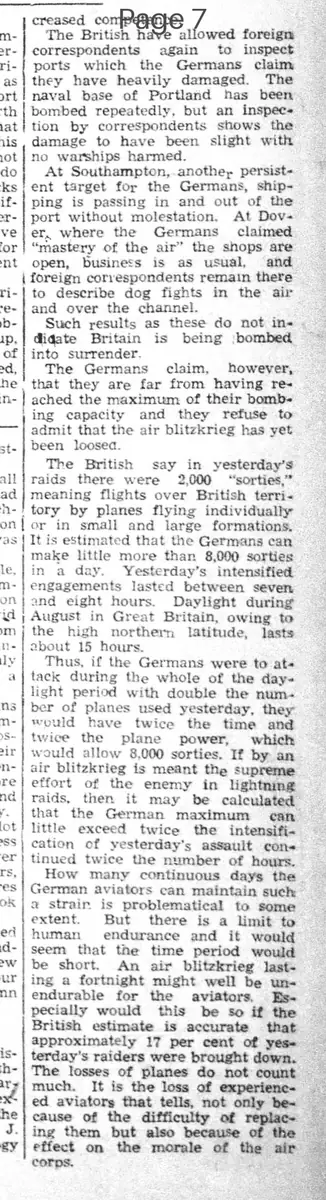
At Southampton, another persistent target for the Germans, shipping is passing in and out of the port without molestation. At Dover, where the Germans claimed "mastery of the air" the shops are open, business is as usual, and foreign correspondents remain there to describe dog fights in the air and over the channel.
Such results as these do not indicate Britain is being bombed into surrender.
The Germans claim, however, that they are far from having reached the maximum of their bombing capacity and they refuse to admit that the air blitzkrieg has yet been loosed.
The British say in yesterday's raids there were 2,000 "sorties," meaning flights over British territory by planes flying individually or in small and large formations. It is estimated that the Germans can make little more than 8,000 sorties in a day. Yesterday's intensified engagements lasted between seven and eight hours. Daylight during August in Great Britain, owing to the high northern latitude, lasts about 15 hours.
Thus, if the Germans were to attack during the whole of the daylight period with double the number of planes used yesterday, they would have twice the time and twice the plane power, which would allow 8,000 sorties. If by an air blitzkrieg is meant the supreme effort of the enemy in lightning raids, then it may be calculated that the German maximum can little exceed twice the intensification of yesterday's assault continued twice the number of hours.
How many continuous days the German aviators can maintain such a strain is problematical to some extent.
But there is a limit to human endurance and it would seem that the time period would be short. An air blitzkrieg lasting a fortnight might well be unendurable for the aviators. Especially would this be so if the British estimate is accurate that approximately 17 per cent of yesterday's raiders were brought down.
The losses of planes do not count much. It is the loss of experienced aviators that tells, not only because of the difficulty of replacing them but also because of the effect on the morale of the air corps.
What sub-type of article is it?
What keywords are associated?
Where did it happen?
Foreign News Details
Primary Location
Portland, Southampton, Dover, Great Britain
Event Date
Yesterday's Raids In August
Outcome
slight damage to portland naval base with no warships harmed; shipping at southampton unaffected; business as usual at dover; approximately 17 per cent of yesterday's german raiders brought down
Event Details
British authorities allowed foreign correspondents to inspect ports claimed heavily damaged by Germans. Inspection showed slight damage at repeatedly bombed Portland naval base with no warships harmed. At Southampton, persistent German target, shipping passes in and out without molestation. At Dover, where Germans claimed air mastery, shops are open, business usual, and correspondents describe dog fights over air and channel. Such results do not indicate Britain bombed into surrender. Germans claim not reached maximum bombing capacity and air blitzkrieg not yet loosed. British report 2,000 sorties in yesterday's raids; estimated German maximum 8,000 sorties per day. Yesterday's engagements lasted 7-8 hours; August daylight in Britain about 15 hours. German maximum calculated as twice yesterday's intensification over twice the hours. Continuous days of such strain problematic due to human endurance limits; fortnight-long air blitzkrieg unendurable, especially with 17% losses affecting experienced aviators' morale.