Thank you for visiting SNEWPapers!

Sign up free
Page thumbnail for Edgefield Advertiser
Domestic News October 30, 1895

Edgefield Advertiser

Edgefield, Edgefield County, South Carolina

What is this article about?

Interstate Commerce Commission report for 1894 details railway casualties: 2,251 employees killed (down from 2,727 in 1893) and 23,422 injured (down from 31,729); 321 passengers killed (up 25) and 3,304 injured (down 195). Causes include coupling cars, falls, collisions. Ratios show higher risk for employees than passengers. Variations by territorial groups.

Clipping
OCR Quality

100% Excellent

Full Text

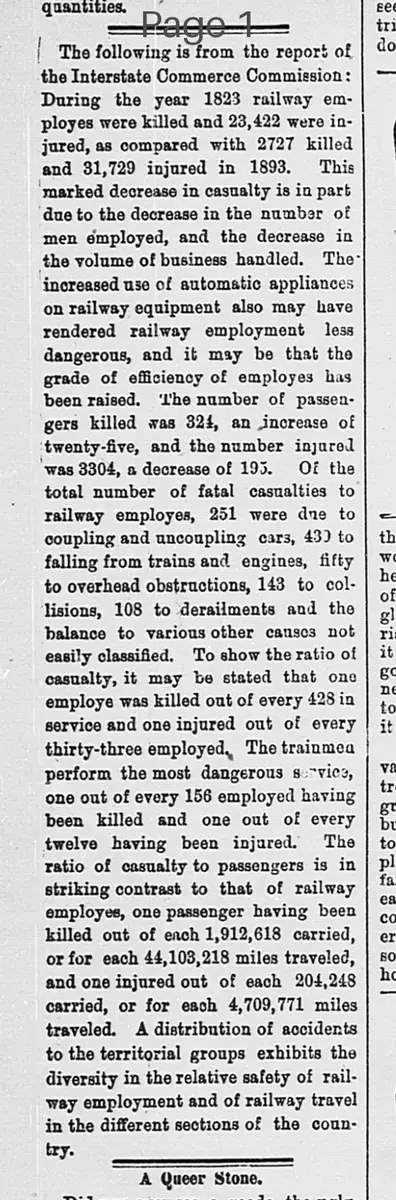
The following is from the report of the Interstate Commerce Commission: During the year 1894 railway employees were killed and 23,422 were injured, as compared with 2,727 killed and 31,729 injured in 1893. This marked decrease in casualty is in part due to the decrease in the number of men employed, and the decrease in the volume of business handled. The increased use of automatic appliances on railway equipment also may have rendered railway employment less dangerous, and it may be that the grade of efficiency of employees has been raised. The number of passengers killed was 321, an increase of twenty-five, and the number injured was 3,304, a decrease of 195. Of the total number of fatal casualties to railway employees, 251 were due to coupling and uncoupling cars, 439 to falling from trains and engines, fifty to overhead obstructions, 143 to collisions, 108 to derailments and the balance to various other causes not easily classified. To show the ratio of casualty, it may be stated that one employee was killed out of every 428 in service and one injured out of every thirty-three employed. The trainmen perform the most dangerous service, one out of every 156 employed having been killed and one out of every twelve having been injured. The ratio of casualty to passengers is in striking contrast to that of railway employees, one passenger having been killed out of each 1,912,618 carried or for each 44,103,218 miles traveled, and one injured out of each 204,248 carried, or for each 4,709,771 miles traveled. A distribution of accidents to the territorial groups exhibits the diversity in the relative safety of railway employment and of railway travel in the different sections of the country.

What sub-type of article is it?

Accident Transportation

What keywords are associated?

Railway Casualties Employee Deaths Passenger Injuries Interstate Commerce Commission 1894 Report Train Accidents

Domestic News Details

Event Date

1894

Outcome

railway employees: 2,251 killed (251 from coupling/uncoupling, 439 from falling, 50 from overhead obstructions, 143 from collisions, 108 from derailments, balance other causes), 23,422 injured; compared to 2,727 killed, 31,729 injured in 1893. passengers: 321 killed, 3,304 injured. ratios: 1 employee killed per 428 in service, 1 injured per 33; trainmen: 1 killed per 156, 1 injured per 12. passengers: 1 killed per 1,912,618 carried or 44,103,218 miles, 1 injured per 204,248 carried or 4,709,771 miles.

Event Details

Report from Interstate Commerce Commission on 1894 railway casualties, attributing decrease in employee deaths and injuries to fewer men employed, less business volume, automatic appliances, and improved employee efficiency. Passenger deaths increased slightly, injuries decreased. Diversity in safety across territorial groups.

Are you sure?