Thank you for visiting SNEWPapers!
Sign up free
Editorial
May 26, 1795
The New Hampshire Gazette
Portsmouth, Rockingham County, New Hampshire
What is this article about?
A letter criticizes two Supreme Federal Court decisions in Philadelphia: one favoring Doane's administrators against privateer owners, overriding New Hampshire laws, and another evicting settlers in Vanhorne v. Dorrance. It argues this annihilates state sovereignty and warns of federal judicial overreach, quoting a 1789 patriot's letter.
Clipping
OCR Quality
98%
Excellent
Full Text
FOR THE GAZETTE.
Mr. Melcher,
Please to give the following a place in your next paper, and you will oblige many of your customers.
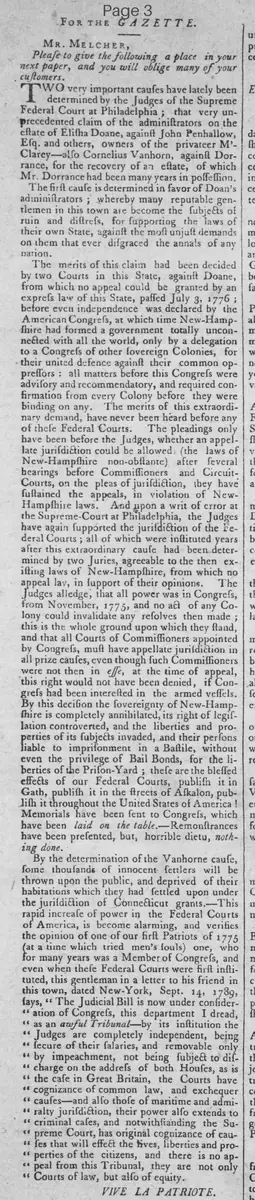
Two very important causes have lately been determined by the Judges of the Supreme Federal Court at Philadelphia; that very unprecedented claim of the administrators on the estate of Elisha Doane, against John Penhallow, Esq. and others, owners of the privateer McClary—also Cornelius Vanhorn, against Dorrance, for the recovery of an estate, of which Mr. Dorrance had been many years in possession.
The first cause is determined in favor of Doane's administrators; whereby many reputable gentlemen in this town are become the subjects of ruin and distress, for supporting the laws of their own State, against the most unjust demands on them that ever disgraced the annals of any nation.
The merits of this claim had been decided by two Courts in this State, against Doane, from which no appeal could be granted by an express law of this State, passed July 3, 1776; before even independence was declared by the American Congress, at which time New-Hampshire had formed a government totally unconnected with all the world, only by a delegation to a Congress of other sovereign Colonies, for their united defence against their common oppressors: all matters before this Congress were advisory and recommendatory, and required confirmation from every Colony before they were binding on any. The merits of this extraordinary demand, have never been heard before any of these Federal Courts. The pleadings only have been before the Judges, whether an appellate jurisdiction could be allowed, (the laws of New-Hampshire notwithstanding) after several hearings before Commissioners and Circuit-Courts, on the pleas of jurisdiction, they have sustained the appeals, in violation of New-Hampshire laws. And upon a writ of error at the Supreme-Court at Philadelphia, the Judges have again supported the jurisdiction of the Federal Courts: all of which were instituted years after this extraordinary cause had been determined by two Juries, agreeable to the then existing laws of New-Hampshire, from which no appeal lay, in support of their opinions. The Judges allege, that all power was in Congress, from November, 1775, and no act of any Colony could invalidate any resolves then made; this is the whole ground upon which they stand, and that all Courts of Commissioners appointed by Congress, must have appellate jurisdiction in all prize causes, even though such Commissioners were not then in esse, at the time of appeal, this right would not have been denied, if Congress had been interested in the armed vessels.
By this decision the sovereignty of New-Hampshire is completely annihilated, its right of legislation controverted, and the liberties and properties of its subjects invaded, and their persons liable to imprisonment in a Bastile, without even the privilege of Bail Bonds, for the liberties of the Prison-Yard; these are the blessed effects of our Federal Courts, publish it in Gath, publish it in the streets of Askalon, publish it throughout the United States of America!
Memorials have been sent to Congress, which have been laid on the table.—Remonstrances have been presented, but, horrible dictu, nothing done.
By the determination of the Vanhorne cause, some thousands of innocent settlers will be thrown upon the public, and deprived of their habitations which they had settled upon under the jurisdiction of Connecticut grants.—This rapid increase of power in the Federal Courts of America, is become alarming, and verifies the opinion of one of our first Patriots of 1775 (at a time which tried men's souls) one, who for many years was a Member of Congress, and even when these Federal Courts were first instituted, this gentleman in a letter to his friend in this town, dated New-York, Sept. 14, 1789, says, "The Judicial Bill is now under consideration of Congress, this department I dread as an awful Tribunal—by its institution the Judges are completely independent, being secure of their salaries, and removable only by impeachment, not being subject to discharge on the address of both Houses, as is the case in Great Britain, the Courts have cognizance of common law, and exchequer causes—and also those of maritime and admiralty jurisdiction, their power also extends to criminal cases, and notwithstanding the Supreme Court, has original cognizance of causes that will affect the lives, liberties and properties of the citizens, and there is no appeal from this Tribunal, they are not only Courts of law, but also of equity."
Mr. Melcher,
Please to give the following a place in your next paper, and you will oblige many of your customers.
Two very important causes have lately been determined by the Judges of the Supreme Federal Court at Philadelphia; that very unprecedented claim of the administrators on the estate of Elisha Doane, against John Penhallow, Esq. and others, owners of the privateer McClary—also Cornelius Vanhorn, against Dorrance, for the recovery of an estate, of which Mr. Dorrance had been many years in possession.
The first cause is determined in favor of Doane's administrators; whereby many reputable gentlemen in this town are become the subjects of ruin and distress, for supporting the laws of their own State, against the most unjust demands on them that ever disgraced the annals of any nation.
The merits of this claim had been decided by two Courts in this State, against Doane, from which no appeal could be granted by an express law of this State, passed July 3, 1776; before even independence was declared by the American Congress, at which time New-Hampshire had formed a government totally unconnected with all the world, only by a delegation to a Congress of other sovereign Colonies, for their united defence against their common oppressors: all matters before this Congress were advisory and recommendatory, and required confirmation from every Colony before they were binding on any. The merits of this extraordinary demand, have never been heard before any of these Federal Courts. The pleadings only have been before the Judges, whether an appellate jurisdiction could be allowed, (the laws of New-Hampshire notwithstanding) after several hearings before Commissioners and Circuit-Courts, on the pleas of jurisdiction, they have sustained the appeals, in violation of New-Hampshire laws. And upon a writ of error at the Supreme-Court at Philadelphia, the Judges have again supported the jurisdiction of the Federal Courts: all of which were instituted years after this extraordinary cause had been determined by two Juries, agreeable to the then existing laws of New-Hampshire, from which no appeal lay, in support of their opinions. The Judges allege, that all power was in Congress, from November, 1775, and no act of any Colony could invalidate any resolves then made; this is the whole ground upon which they stand, and that all Courts of Commissioners appointed by Congress, must have appellate jurisdiction in all prize causes, even though such Commissioners were not then in esse, at the time of appeal, this right would not have been denied, if Congress had been interested in the armed vessels.
By this decision the sovereignty of New-Hampshire is completely annihilated, its right of legislation controverted, and the liberties and properties of its subjects invaded, and their persons liable to imprisonment in a Bastile, without even the privilege of Bail Bonds, for the liberties of the Prison-Yard; these are the blessed effects of our Federal Courts, publish it in Gath, publish it in the streets of Askalon, publish it throughout the United States of America!
Memorials have been sent to Congress, which have been laid on the table.—Remonstrances have been presented, but, horrible dictu, nothing done.
By the determination of the Vanhorne cause, some thousands of innocent settlers will be thrown upon the public, and deprived of their habitations which they had settled upon under the jurisdiction of Connecticut grants.—This rapid increase of power in the Federal Courts of America, is become alarming, and verifies the opinion of one of our first Patriots of 1775 (at a time which tried men's souls) one, who for many years was a Member of Congress, and even when these Federal Courts were first instituted, this gentleman in a letter to his friend in this town, dated New-York, Sept. 14, 1789, says, "The Judicial Bill is now under consideration of Congress, this department I dread as an awful Tribunal—by its institution the Judges are completely independent, being secure of their salaries, and removable only by impeachment, not being subject to discharge on the address of both Houses, as is the case in Great Britain, the Courts have cognizance of common law, and exchequer causes—and also those of maritime and admiralty jurisdiction, their power also extends to criminal cases, and notwithstanding the Supreme Court, has original cognizance of causes that will affect the lives, liberties and properties of the citizens, and there is no appeal from this Tribunal, they are not only Courts of law, but also of equity."
What sub-type of article is it?
Constitutional
Legal Reform
What keywords are associated?
Federal Courts
New Hampshire Sovereignty
Doane Case
Vanhorne Case
Prize Causes
Judicial Overreach
State Rights
Congressional Power
What entities or persons were involved?
Judges Of The Supreme Federal Court
Elisha Doane's Administrators
John Penhallow
Cornelius Vanhorn
Dorrance
Congress
New Hampshire Courts
Connecticut Grants Settlers
Editorial Details
Primary Topic
Federal Court Overreach On State Sovereignty In Doane And Vanhorne Cases
Stance / Tone
Strongly Critical Of Federal Judicial Power, Pro New Hampshire Sovereignty
Key Figures
Judges Of The Supreme Federal Court
Elisha Doane's Administrators
John Penhallow
Cornelius Vanhorn
Dorrance
Congress
New Hampshire Courts
Connecticut Grants Settlers
Key Arguments
Federal Courts Violated New Hampshire Laws By Allowing Appeals Where None Were Permitted
Merits Of Doane Claim Decided Against Him In State Courts, Never Heard In Federal Courts
Congressional Power From 1775 Does Not Invalidate State Acts Or Grant Appellate Jurisdiction Retroactively
Decision Ruins Reputable Gentlemen For Upholding State Laws Against Unjust Demands
Vanhorne Decision Displaces Thousands Of Innocent Settlers
Federal Courts Annihilate State Sovereignty, Invade Liberties And Properties
Memorials And Remonstrances To Congress Ignored
Judicial Independence And Broad Powers Alarming, As Warned By 1789 Patriot Letter