Thank you for visiting SNEWPapers!
Sign up free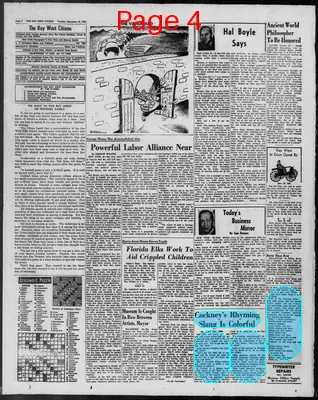
Story
November 29, 1955
The Key West Citizen
Key West, Monroe County, Florida
What is this article about?
Article on Cockney rhyming slang, a colorful 19th-century linguistic tradition from Londoners born within earshot of St. Mary-le-Bow Church bells, featuring examples like 'mince pies' for eyes and 'trouble and strife' for wife.
Clipping
OCR Quality
98%
Excellent
Full Text
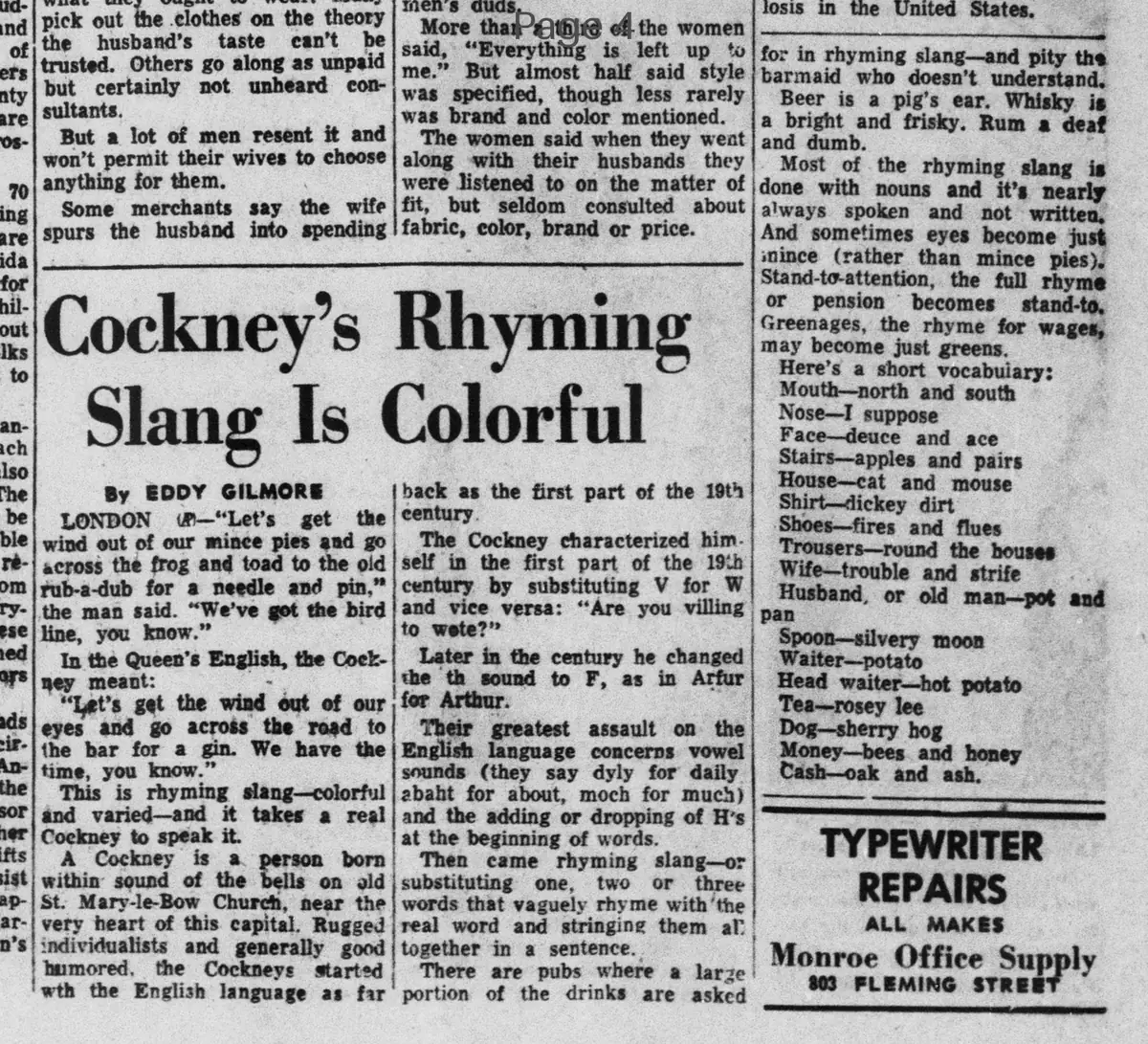
Cockney's Rhyming Slang Is Colorful
By Eddy Gilmore
LONDON (—"Let's get the wind out of our mince pies and go across the frog and toad to the old rub-a-dub for a needle and pin," the man said. "We've got the bird line, you know."
In the Queen's English, the Cockney meant:
"Let's get the wind out of our eyes and go across the road to the bar for a gin. We have the time, you know."
This is rhyming slang—colorful and varied—and it takes a real Cockney to speak it.
A Cockney is a person born within sound of the bells on old St. Mary-le-Bow Church, near the very heart of this capital. Rugged individualists and generally good humored, the Cockneys started with the English language as far back as the first part of the 19th century.
The Cockney characterized himself in the first part of the 19th century by substituting V for W and vice versa: "Are you villing to vote?"
Later in the century he changed the th sound to F, as in Arfur for Arthur.
Their greatest assault on the English language concerns vowel sounds (they say dyly for daily, abaht for about, moch for much) and the adding or dropping of H's at the beginning of words.
Then came rhyming slang—or substituting one, two or three words that vaguely rhyme with the real word and stringing them all together in a sentence.
There are pubs where a large portion of the drinks are asked for in rhyming slang and pity the barmaid who doesn't understand.
Beer is a pig's ear. Whisky is a bright and frisky. Rum a deaf and dumb.
Most of the rhyming slang is done with nouns and it's nearly always spoken and not written.
And sometimes eyes become just mince (rather than mince pies).
Stand-to-attention, the full rhyme for pension becomes stand-to.
Greenages, the rhyme for wages, may become just greens.
Here's a short vocabulary:
Mouth—north and south
Nose—I suppose
Face—deuce and ace
Stairs—apples and pears
House—cat and mouse
Shirt—dickey dirt
Shoes—fires and flues
Trousers—round the houses
Wife—trouble and strife
Husband, or old man—pot and pan
Spoon—silvery moon
Waiter—potato
Head waiter—hot potato
Tea—rosy lee
Dog—sherry hog
Money—bees and honey
Cash—oak and ash.
By Eddy Gilmore
LONDON (—"Let's get the wind out of our mince pies and go across the frog and toad to the old rub-a-dub for a needle and pin," the man said. "We've got the bird line, you know."
In the Queen's English, the Cockney meant:
"Let's get the wind out of our eyes and go across the road to the bar for a gin. We have the time, you know."
This is rhyming slang—colorful and varied—and it takes a real Cockney to speak it.
A Cockney is a person born within sound of the bells on old St. Mary-le-Bow Church, near the very heart of this capital. Rugged individualists and generally good humored, the Cockneys started with the English language as far back as the first part of the 19th century.
The Cockney characterized himself in the first part of the 19th century by substituting V for W and vice versa: "Are you villing to vote?"
Later in the century he changed the th sound to F, as in Arfur for Arthur.
Their greatest assault on the English language concerns vowel sounds (they say dyly for daily, abaht for about, moch for much) and the adding or dropping of H's at the beginning of words.
Then came rhyming slang—or substituting one, two or three words that vaguely rhyme with the real word and stringing them all together in a sentence.
There are pubs where a large portion of the drinks are asked for in rhyming slang and pity the barmaid who doesn't understand.
Beer is a pig's ear. Whisky is a bright and frisky. Rum a deaf and dumb.
Most of the rhyming slang is done with nouns and it's nearly always spoken and not written.
And sometimes eyes become just mince (rather than mince pies).
Stand-to-attention, the full rhyme for pension becomes stand-to.
Greenages, the rhyme for wages, may become just greens.
Here's a short vocabulary:
Mouth—north and south
Nose—I suppose
Face—deuce and ace
Stairs—apples and pears
House—cat and mouse
Shirt—dickey dirt
Shoes—fires and flues
Trousers—round the houses
Wife—trouble and strife
Husband, or old man—pot and pan
Spoon—silvery moon
Waiter—potato
Head waiter—hot potato
Tea—rosy lee
Dog—sherry hog
Money—bees and honey
Cash—oak and ash.
What sub-type of article is it?
Curiosity
What themes does it cover?
Social Manners
What keywords are associated?
Cockney
Rhyming Slang
London
English Language
Pubs
Vocabulary
Where did it happen?
London
Story Details
Location
London
Event Date
First Part Of The 19th Century
Story Details
Explanation of Cockney rhyming slang, its origins in 19th-century English modifications, and examples of substitutions for everyday words and phrases.