Thank you for visiting SNEWPapers!
Sign up free
Editorial
August 23, 1873
American Citizen
Canton, Madison County, Mississippi
What is this article about?
This editorial advocates for educating children in Mississippi's home institutions, emphasizing moral and intellectual development over superficial accomplishments. It criticizes sending youth to distant schools and urges parents and the state to support local colleges for building character and state pride.
Clipping
OCR Quality
98%
Excellent
Full Text
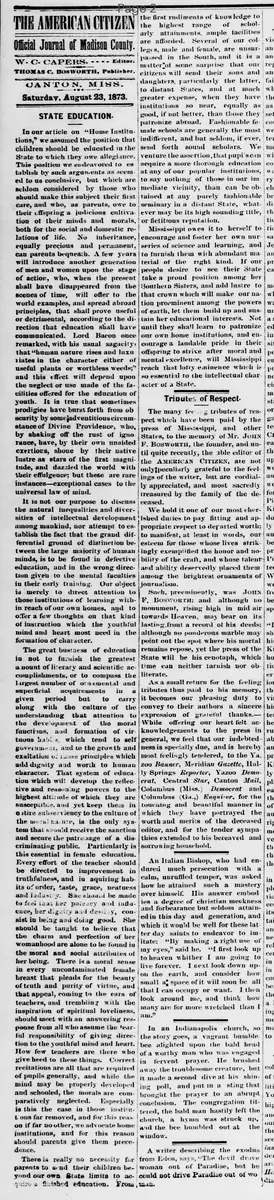
STATE EDUCATION.
In our article on "Home Institutions," we assumed the position that children should be educated in the State to which they owe allegiance. This position we endeavored to establish by such arguments as seemed to us conclusive, but which are seldom considered by those who should make this subject their first care, and who, as parents, owe to their offspring a judicious cultivation of their minds and morals, both for the social and domestic relations of life. No inheritance, equally precious and permanent, can parents bequeath. A few years will introduce another generation of men and women upon the stage of action, who, when the present shall have disappeared from the scenes of time, will offer to the world examples, and spread abroad principles, that shall prove useful or detrimental, according to the direction that education shall have communicated. Lord Bacon once remarked, with his usual sagacity, that "human nature rises and luxuriates in the character either of useful plants or worthless weeds;" and this effect will depend upon the neglect or use made of the facilities offered for the education of youth. It is true that sometimes prodigies have burst forth from obscurity by some adventitious circumstance of Divine Providence, who, by shaking off the rust of ignorance, have, by their own unaided exertions, shone by their native lustre as stars of the first magnitude, and dazzled the world with their effulgence; but these are rare instances—exceptional cases to the universal law of mind.
It is not our purpose to discuss the natural inequalities and diversities of intellectual development among mankind, nor attempt to establish the fact that the grand differential ground of distinction between the large majority of human minds, is to be found in defective education, and in the wrong direction given to the mental faculties in their early training. Our object is merely to direct attention to those institutions of learning within reach of our own homes, and to offer a few thoughts on that kind of instruction which the youthful mind and heart most need in the formation of character.
The great business of education is not to furnish the greatest amount of literary and scientific accomplishments, or to compass the largest number of ornamental and superficial acquirements in a given period, but to carry along with the culture of the understanding that attention to the development of the moral functions, and formation of virtuous habits, which tend to self-government, and to the growth and exaltation of those principles which add dignity and worth to human character. That system of education which will develop the reflective and reasoning powers to the highest altitude of which they are susceptible, and yet keep them in entire subserviency to the culture of the woman nature, is the only system that should receive the sanction and secure the patronage of a discriminating public. Particularly is this essential in female education. Every effort of the teacher should be directed to improvement in truthfulness, and in acquiring habits of order, taste, grace, neatness and industry. She should be made to feel that her potency and influence, her dignity and destiny, consist in being and doing good. She should be taught to believe that the charm and perfection of her womanhood are alone to be found in the moral and social attributes of her being. There is a moral sense in every uncontaminated female breast that pleads for the beauty of truth and purity of virtue, and that appeal, coming to the ears of teachers, and trembling with the inspiration of spiritual loveliness, should meet with an answering response from all who assume the fearful responsibility of giving direction to the youthful mind and heart. How few teachers are there who give heed to these things. Correct recitations are all that are required of pupils generally, and while the mind may be properly developed and schooled, the morals are comparatively neglected. Especially is this the case in those institutions far removed, and for this reason if for no other, we advocate home institutions, and for this reason should parents give them precedence.
There is really no necessity for parents to send their children beyond our own State limits to acquire a finished education. From the first rudiments of knowledge to the highest range of scholarly attainments, ample facilities are afforded. Several of our colleges, male and female, are unsurpassed in the South, and it is a matter of some surprise that our citizens will send their sons and daughters, particularly the latter, to distant States, and at much greater expense, when they have institutions so near, equally as good, if not better, than those they patronize abroad. Fashionable female schools are generally the most indifferent, and but seldom, if ever, send forth sound scholars. We venture the assertion, that pupils can acquire a more thorough education at any of our popular institutions, to say nothing of those in our immediate vicinity, than can be obtained at any purely fashionable seminary in a distant State, whatever may be its high sounding title, or fictitious reputation.
Mississippi owes it to herself to encourage and foster her own nurseries of science and learning, and to furnish them with abundant material of the right kind. If our people desire to see their State take a proud position among her Southern Sisters, and add lustre to that crown which will make our nation preeminent among the powers of earth, let them build up and sustain her educational interests. Not until they shall learn to patronize our own home institutions, and encourage a laudable pride in their offspring to strive after moral and mental excellence, will Mississippi reach that lofty eminence which is so essential to the intellectual character of a State.
In our article on "Home Institutions," we assumed the position that children should be educated in the State to which they owe allegiance. This position we endeavored to establish by such arguments as seemed to us conclusive, but which are seldom considered by those who should make this subject their first care, and who, as parents, owe to their offspring a judicious cultivation of their minds and morals, both for the social and domestic relations of life. No inheritance, equally precious and permanent, can parents bequeath. A few years will introduce another generation of men and women upon the stage of action, who, when the present shall have disappeared from the scenes of time, will offer to the world examples, and spread abroad principles, that shall prove useful or detrimental, according to the direction that education shall have communicated. Lord Bacon once remarked, with his usual sagacity, that "human nature rises and luxuriates in the character either of useful plants or worthless weeds;" and this effect will depend upon the neglect or use made of the facilities offered for the education of youth. It is true that sometimes prodigies have burst forth from obscurity by some adventitious circumstance of Divine Providence, who, by shaking off the rust of ignorance, have, by their own unaided exertions, shone by their native lustre as stars of the first magnitude, and dazzled the world with their effulgence; but these are rare instances—exceptional cases to the universal law of mind.
It is not our purpose to discuss the natural inequalities and diversities of intellectual development among mankind, nor attempt to establish the fact that the grand differential ground of distinction between the large majority of human minds, is to be found in defective education, and in the wrong direction given to the mental faculties in their early training. Our object is merely to direct attention to those institutions of learning within reach of our own homes, and to offer a few thoughts on that kind of instruction which the youthful mind and heart most need in the formation of character.
The great business of education is not to furnish the greatest amount of literary and scientific accomplishments, or to compass the largest number of ornamental and superficial acquirements in a given period, but to carry along with the culture of the understanding that attention to the development of the moral functions, and formation of virtuous habits, which tend to self-government, and to the growth and exaltation of those principles which add dignity and worth to human character. That system of education which will develop the reflective and reasoning powers to the highest altitude of which they are susceptible, and yet keep them in entire subserviency to the culture of the woman nature, is the only system that should receive the sanction and secure the patronage of a discriminating public. Particularly is this essential in female education. Every effort of the teacher should be directed to improvement in truthfulness, and in acquiring habits of order, taste, grace, neatness and industry. She should be made to feel that her potency and influence, her dignity and destiny, consist in being and doing good. She should be taught to believe that the charm and perfection of her womanhood are alone to be found in the moral and social attributes of her being. There is a moral sense in every uncontaminated female breast that pleads for the beauty of truth and purity of virtue, and that appeal, coming to the ears of teachers, and trembling with the inspiration of spiritual loveliness, should meet with an answering response from all who assume the fearful responsibility of giving direction to the youthful mind and heart. How few teachers are there who give heed to these things. Correct recitations are all that are required of pupils generally, and while the mind may be properly developed and schooled, the morals are comparatively neglected. Especially is this the case in those institutions far removed, and for this reason if for no other, we advocate home institutions, and for this reason should parents give them precedence.
There is really no necessity for parents to send their children beyond our own State limits to acquire a finished education. From the first rudiments of knowledge to the highest range of scholarly attainments, ample facilities are afforded. Several of our colleges, male and female, are unsurpassed in the South, and it is a matter of some surprise that our citizens will send their sons and daughters, particularly the latter, to distant States, and at much greater expense, when they have institutions so near, equally as good, if not better, than those they patronize abroad. Fashionable female schools are generally the most indifferent, and but seldom, if ever, send forth sound scholars. We venture the assertion, that pupils can acquire a more thorough education at any of our popular institutions, to say nothing of those in our immediate vicinity, than can be obtained at any purely fashionable seminary in a distant State, whatever may be its high sounding title, or fictitious reputation.
Mississippi owes it to herself to encourage and foster her own nurseries of science and learning, and to furnish them with abundant material of the right kind. If our people desire to see their State take a proud position among her Southern Sisters, and add lustre to that crown which will make our nation preeminent among the powers of earth, let them build up and sustain her educational interests. Not until they shall learn to patronize our own home institutions, and encourage a laudable pride in their offspring to strive after moral and mental excellence, will Mississippi reach that lofty eminence which is so essential to the intellectual character of a State.
What sub-type of article is it?
Education
Moral Or Religious
Social Reform
What keywords are associated?
State Education
Home Institutions
Moral Development
Female Education
Mississippi Colleges
Parental Duty
What entities or persons were involved?
Lord Bacon
Mississippi Colleges
Parents
Teachers
Editorial Details
Primary Topic
Advocacy For Education In Mississippi Home Institutions
Stance / Tone
Strongly Supportive Of Local Moral And Intellectual Education
Key Figures
Lord Bacon
Mississippi Colleges
Parents
Teachers
Key Arguments
Children Should Be Educated In Their Home State For Allegiance And Proper Moral Cultivation.
Education's Primary Goal Is Moral Development And Virtuous Habits, Not Just Intellectual Accomplishments.
Home Institutions Provide Better Moral Oversight Than Distant Schools.
Mississippi's Colleges Are Equal Or Superior To Those Elsewhere, At Lower Cost.
State Pride Requires Supporting Local Educational Institutions.