Thank you for visiting SNEWPapers!
Sign up free
The Enquirer
Richmond, Henrico County, Virginia
What is this article about?
On May 30, 1812, citizens of Richmond and Manchester met at the Capitol, chaired by Governor James Barbour, adopting resolutions condemning British aggressions like impressment and blockades, supporting war against Britain, criticizing France, and pledging support to the government. A substitute resolution for war against both was rejected.
Merged-components note: merged public meeting resolutions and substitute amendment; relabeled from notice to domestic_news as it reports on political event and sentiments
Clipping
OCR Quality
Full Text
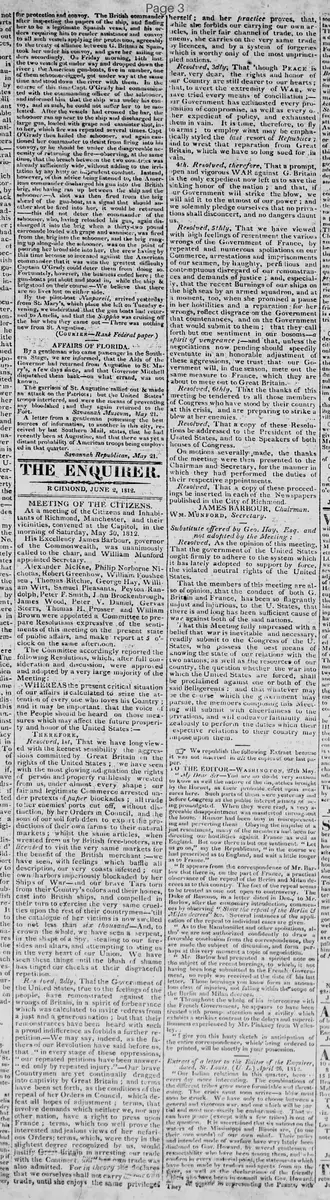
RICHMOND, JUNE 2, 1812.
MEETING OF THE CITIZENS
At a meeting of the Citizens and Inhabitants of Richmond, Manchester, and their vicinities, convened at the Capitol, in the morning of Saturday, May 30, 1812.
His Excellency James Barbour, governor of the Commonwealth, was unanimously called to the chair, and William Munford appointed Secretary.
Alexander McRae, Philip Norborne Nicholas, Robert Greenhow, William Foushee sen., Thomas Ritchie, George Hay, William Wirt, Samuel Pleasants, Peyton Randolph, Peter F. Smith, John Brockenbrough, James Wood, Peter V. Daniel, Gervas Storrs, Thomas H. Prosser and William Brown were appointed a Committee to prepare Resolutions expressive of the sentiments of this meeting on the present state of public affairs, and make report at 5 o'clock on the same afternoon.
The Committee accordingly reported the following Resolutions, which, after full consideration and discussion, were approved and adopted by a very large majority of the Meeting:
WHEREAS the present critical situation of our affairs is calculated to seize the attention of every one who loves his Country; and it may be important, that the voice of the People should be heard on those measures which may affect the future prosperity and honor of the United States:--
Therefore,
Resolved, 1st, That we have long viewed with the keenest sensibility the aggressions committed by Great Britain on the rights of the United States; we have seen with the most glowing indignation the rights of person and property ruthlessly wrested from us, under almost every shape; our fair and legitimate Commerce arrested under pretexts of paper blockades; all trade to her enemies' ports cut off, without distinction, by her Orders in Council, and the sons of our soil forbidden to export the productions of their own farms to their natural markets; whilst the same articles, when wrested from us by British free-booters, are licensed to visit the very same markets for the benefit of the British merchant: we have seen, with feelings which baffle all description, our very coasts infested; our own harbors imperiously blockaded by her Ships of War--and our brave Tars torn from their Country's colors and their homes, cast into British ships, and compelled in their turn to exercise the very same cruelties upon the rest of their countrymen--till the catalogue of her victims is now swelled to not less than six thousand--And, to crown the whole, we have seen a serpent, in the shape of a Spy, stealing to our firesides and altars, and attempting to sting us in the very heart of our Union. We have seen these things until the blush of shame has tinged our cheeks at their disgraceful repetition.
Resolved, 2dly, That the Government of the United States, true to the feelings of the people, have remonstrated against the wrongs of Britain, in a spirit of forbearance which was calculated to invite redress from a just and a generous nation; but that their remonstrances have been heard with such a proud indifference as forbids a further repetition. We may say, indeed, as the fathers of our Revolution have said before us, that "in every stage of these oppressions, our repeated petitions have been answered only by repeated injury." Our brave Countrymen are yet continually dragged into captivity by Great Britain; and terms have been set forth, as the conditions of the repeal of her Orders in Council, which defeat all hopes of adjustment; terms, that involve demands which neither we, nor any other nation, have a right to press upon France; terms, which too well prove the interested and jealous views of her nefarious Orders; terms, which, were they in the slightest degree recognized by us, would justify Great Britain in arresting our trade with the Continent, when her own trade was also admitted. For in theory she declares that we ourselves shall not carry on our own trade, until she enjoys the same privileges herself; and her practice proves, that, while she forbids our carrying our own articles, in their fair channel of trade, to the enemy, she carries on the very same trade by licences, and by a system of forgeries which is worthy only of the most unprincipled nations.
Resolved, 3dly; That though Peace is dear, very dear, the rights and honor of our Country are still dearer to our hearts; that, to avert the extremity of WAR, we have tried every means of conciliation; our Government has exhausted every proposition of compromise, as well as every other expedient of policy, and exhausted them in vain. It is time, therefore, to fly to arms; to employ what may be emphatically styled the last resort of Republics; and to wrest that reparation from Great Britain, which we have so long sued for in vain.
4th. Resolved, therefore, That a prompt, open and vigorous WAR against G. Britain is the only expedient now left us to save the sinking honor of the nation; and that, if our Government will strike the blow, we will aid it to the utmost of our power; and we solemnly pledge ourselves that no privations shall disconcert, and no dangers daunt us.
Resolved, 5thly, That we have viewed with high feelings of resentment the various wrongs of the Government of France, by repeated and numerous spoliations on our Commerce, arrestations and imprisonments of our seamen, by haughty, perfidious and contemptuous disregard of our remonstrances and demands of justice; and, especially, that the recent Burnings of our ships on the high seas by an armed squadron, and at a moment, too, when she promised a pause in her hostilities and a reparation for her wrongs, reflect disgrace on the Government that countenances, and on the Government that would submit to them; that they call forth but one sentiment in our bosoms--a spirit of vengeance; and that, unless the negociations now pending should speedily eventuate in an honorable adjustment of these aggressions, we trust that our Government will, in due season, mete out the same measure to France, which they are about to mete out to Great Britain.
Resolved, 6thly, That the thanks of this meeting be tendered to all those members of Congress who have stood by their country at this crisis, and are preparing to strike a blow at her enemies.
Resolved, That a copy of these Resolutions be addressed to the President of the United States, and to the Speakers of both houses of Congress.
On motions severally made, the thanks of the meeting were then presented to the Chairman and Secretary, for the manner in which they had performed the duties of their respective appointments.
Resolved, That a copy of these proceedings be inserted in each of the Newspapers published in the City of Richmond.
JAMES BARBOUR, Chairman.
WM. MUNFORD, Secretary.
Substitute offered by Geo. Hay Esq, and not adopted by the Meeting:
Resolved, As the opinion of this meeting That the government of the United States ought firmly to adhere to the system which it has lately adopted to support by force, the violated neutral rights of the United States.
That the members of this meeting are also of opinion, that the conduct of both G. Britain and France, has been so flagrantly unjust and injurious, to the U. States, that there is and long has been sufficient cause of war against both of the said nations.
That this Meeting fully impressed with a belief that war is inevitable and necessary, readily submit to the Congress of the U. States, who possess the best means of knowing the state of our relations with the two nations, as well as the resources of our country, the question whether the war into which the United States are forced, shall be proclaimed against one or both of the said Belligerents: and that whatever may be the course which the government may pursue, the members Composing this Meeting will submit with cheerfulness to the privations, and will endeavor faithfully and zealously to perform the duties which their respective relations to their country may impose upon them.
What sub-type of article is it?
What keywords are associated?
What entities or persons were involved?
Where did it happen?
Domestic News Details
Primary Location
Richmond
Event Date
May 30, 1812
Key Persons
Outcome
resolutions adopted by large majority supporting war against great britain, criticizing france, pledging support to government; substitute resolution by geo. hay rejected; thanks to chairman, secretary, and congress members; copies sent to president and congress speakers.
Event Details
Citizens meeting at Capitol chaired by Governor James Barbour with William Munford as secretary; committee prepared and reported resolutions on British and French aggressions, impressment of seamen, blockades, and spoliations; resolutions called for war against Britain as last resort, potential action against France, and support for government.