Thank you for visiting SNEWPapers!
Sign up free
The Virginia Gazette
Richmond, Williamsburg, Richmond County, Virginia
What is this article about?
A pseudonymous writer from a New York paper reflects on colonial resistance to British acts since the Stamp Act, critiques the failure of extensive non-importation agreements due to overestimation of leverage, and urges unity in a restricted agreement against dutiable imports to preserve liberty and avoid internal divisions.
Clipping
OCR Quality
Full Text
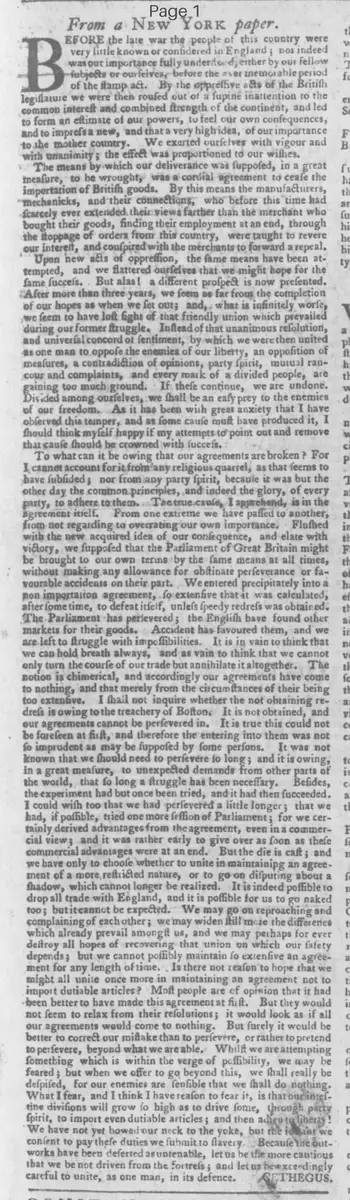
BEFORE the late war the people of this country were very little known or considered in England; nor indeed was our importance fully understood, either by our fellow subjects or ourselves, before the ever memorable period of the stamp act. By the oppressive acts of the British legislature we were then roused out of a supine inattention to the common interest and combined strength of the continent, and led to form an estimate of our powers, to feel our own consequence, and to impress a new, and that a very high idea, of our importance to the mother country. We exerted ourselves with vigour and with unanimity; the effect was proportioned to our wishes.
The means by which our deliverance was supposed, in a great measure, to be wrought, was a cordial agreement to cease the importation of British goods. By this means the manufacturers, mechanics, and their connections, who before this time had scarcely ever extended their views farther than the merchant who bought their goods, finding their employment at an end, through the stoppage of orders from this country, were taught to revere our interest, and conspired with the merchants to forward a repeal.
Upon new acts of oppression, the same means have been attempted, and we flattered ourselves that we might hope for the same success. But alas! a different prospect is now presented. After more than three years, we seem as far from the completion of our hopes as when we set out; and, what is infinitely worse, we seem to have lost sight of that friendly union which prevailed during our former struggle. Instead of that unanimous resolution, and universal concord of sentiment, by which we were then united as one man to oppose the enemies of our liberty, an opposition of measures, a contradiction of opinions, party spirit, mutual rancour and complaints, and every mark of a divided people, are gaining too much ground. If these continue, we are undone. Divided among ourselves, we shall be an easy prey to the enemies of our freedom.
As it has been with great anxiety that I have observed this temper, and as some cause must have produced it, I should think myself happy if my attempts to point out and remove that cause should be crowned with success.
To what can it be owing that our agreements are broken? For I cannot account for it from any religious quarrel, as that seems to have subsided; nor from any party spirit, because it was but the other day the common principles, and indeed the glory, of every party, to adhere to them. The true cause, I apprehend, is in the agreement itself. From one extreme we have passed to another, from not regarding to overrating our own importance. Flushed with the new acquired idea of our consequence, and elate with victory, we supposed that the Parliament of Great Britain might be brought to our own terms by the same means at all times, without making any allowance for obstinate perseverance or favourable accidents on their part.
We entered precipitately into a non importation agreement, so extensive that it was calculated, after some time, to defeat itself, unless speedy redress was obtained. The Parliament has persevered; the English have found other markets for their goods. Accident has favoured them, and we are left to struggle with impossibilities. It is in vain to think that we can hold breath always, and as vain to think that we can not only turn the course of our trade but annihilate it altogether. The motion is chimerical, and accordingly our agreements have come to nothing, and that merely from the circumstances of their being too extensive.
I shall not inquire whether the not obtaining redress is owing to the treachery of Boston. It is not obtained, and our agreements cannot be persevered in. It is true this could not be foreseen at first, and therefore the entering into them was not so imprudent as may be supposed by some persons. It was not known that we should need to persevere so long; and it is owing, in a great measure, to unexpected demands from other parts of the world, that so long a struggle has been necessary. Besides, the experiment had but once been tried, and it had then succeeded.
I could wish too that we had persevered a little longer; that we had, if possible, tried one more session of Parliament; for we certainly derived advantages from the agreement, even in a commercial view; and it was rather early to give over as soon as these commercial advantages were at an end. But the die is cast; and we have only to choose whether to unite in maintaining an agreement of a more restricted nature, or to go on disputing about a shadow, which cannot longer be realized. It is indeed possible to drop all trade with England, and it is possible for us to go naked too; but it cannot be expected.
We may go on reproaching and complaining of each other; we may widen still more the differences which already prevail amongst us, and we may perhaps for ever destroy all hopes of recovering that union on which our safety depends; but we cannot possibly maintain so extensive an agreement for any length of time. Is there not reason to hope that we might all unite once more in maintaining an agreement not to import dutiable articles? Most people are of opinion that it had been better to have made this agreement at first. But they would not seem to relax from their resolutions; it would look as if all our agreements would come to nothing.
But surely it would be better to correct our mistake than to persevere, or rather to pretend to persevere, beyond what we are able. Whilst we are attempting something which is within the verge of possibility, we may be feared; but when we offer to go beyond this, we shall really be despised, for our enemies are sensible that we shall do nothing.
What I fear, and I think I have reason to fear it, is that our intestine divisions will grow so high as to drive some, through party spirit, to import even dutiable articles; and then adieu to liberty! We have not yet bowed our neck to the yoke, but the instant we consent to pay these duties we submit to slavery. Because the outworks have been deserted as untenable, let us be the more cautious that we be not driven from the fortress; and let us be exceedingly careful to unite, as one man, in its defence.
GETHEGUS.
What sub-type of article is it?
What themes does it cover?
What keywords are associated?
What entities or persons were involved?
Letter to Editor Details
Author
Gethegus.
Main Argument
colonial non-importation agreements have failed due to their excessive scope and unforeseen british perseverance; the author urges unity in a more limited agreement against dutiable imports to resist oppression and prevent internal divisions that could lead to submission to british duties and loss of liberty.
Notable Details