Thank you for visiting SNEWPapers!
Sign up free
The Virginia Gazette
Williamsburg, Virginia
What is this article about?
A critical letter to Mr. Rinde responding to Mr. Prophulax's sermon promoting smallpox inoculation. The author argues against the practice, claiming it unnecessarily spreads infection, questions its origins and efficacy, and deems it morally questionable, advocating for natural prevention instead. References historical medical figures and Virginia's quarantine laws. Signed M B.
Merged-components note: Continuation of the letter criticizing Mr. Prophulax's sermon on inoculation, sequential reading order across pages 2 and 3.
Clippings
1 of 2
OCR Quality
Full Text
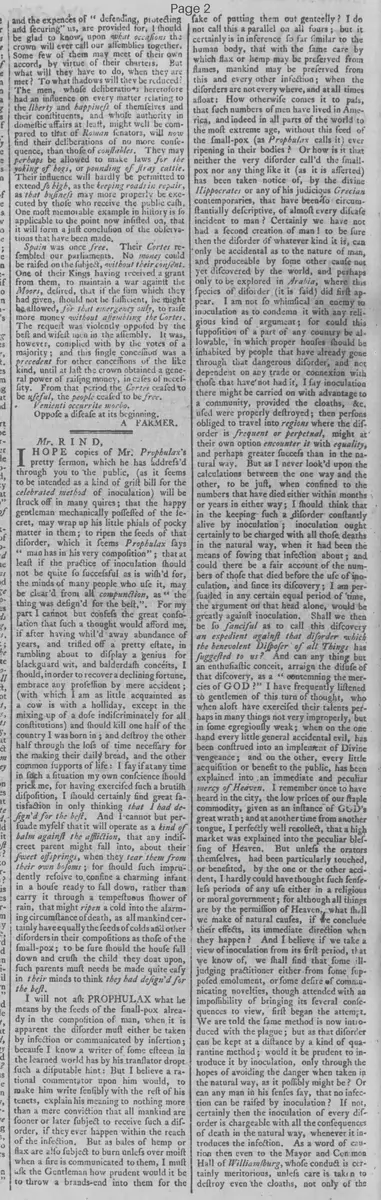
I HOPE copies of Mr. Prophulax's pretty sermon, which he has addressed through you to the public, (as it seems to be intended as a kind of grist bill for the celebrated method of inoculation) will be struck off in many quires; that the happy gentleman mechanically possessed of the secret, may wrap up his little phials of pocky matter in them; to ripen the seeds of that disorder, which it seems Prophulax says "man has in his very composition"; that at least if the practice of inoculation should not be quite so successful as is wished for, the minds of many people who use it, may be cleared from all compunction, as "the thing was designed for the best." For my part I cannot but confess the great consolation that such a thought would afford me, if after having whil'd away abundance of years, and trifled off a pretty estate, in rambling about to display a genius for blackguard wit, and balderdash conceits, I should, in order to recover a declining fortune, embrace any profession by mere accident; (with which I am as little acquainted as a cow is with a holiday, except in the mixing up of a dose indiscriminately for all constitutions) and should kill one half of the country I was born in; and destroy the other half through the loss of time necessary for the making their daily bread, and the other common supports of life: I say if at any time in such a situation my own conscience should prick me, for having exercised such a brutish disposition, I should certainly find great satisfaction in only thinking that I had designed for the best. And I cannot but persuade myself that it will operate as a kind of balm against the affliction, that any indiscreet parent might fall into, about their sweet offsprings, when they tear them from their own bosoms; for should such imprudently resolve to confine a charming infant in a house ready to fall down, rather than carry it through a tempestuous shower of rain, that might ripen a cold into the alarming circumstance of death, as all mankind certainly have equally the seeds of colds and other disorders in their compositions as those of the small-pox; to be sure should the house fall down and crush the child they doat upon, such parents must needs be made quite easy in their minds to think they had designed for the best.
I will not ask PROPHULAX what he means by the seeds of the small-pox already in the composition of man, when it is apparent the disorder must either be taken by infection or communicated by insertion; because I know a writer of some esteem in the learned world has by his translator dropt such a disputable hint: But I believe a rational commentator upon him would, to make him write sensibly with the rest of his tenets, explain his meaning to nothing more than a mere conviction that all mankind are sooner or later subject to receive such a disorder, if they ever happen within the reach of the infection. But as bales of hemp or flax are also subject to burn unless over moist when a fire is communicated to them, I must ask the Gentleman how prudent would it be to throw a brand's-end into them for the sake of putting them out genteelly? I do not call this a parallel on all fours: but it certainly is in inference so far similar to the human body, that with the same care by which flax or hemp may be preserved from flames, mankind may be preserved from this and every other infection; when the disorders are not every where, and at all times afloat: How otherwise comes it to pass, that such numbers of men have lived in America, and indeed in all parts of the world to the most extreme age, without this seed of the small-pox (as Prophulax calls it) ever ripening in their bodies? Or how is it that neither the very disorder call'd the small-pox nor any thing like it (as it is asserted) has been taken notice of, by the divine Hippocrates or any of his judicious Grecian contemporaries, that have been so substantially descriptive, of almost every disease incident to man? Certainly we have not had a second creation of man! to be sure then the disorder of whatever kind it is, can only be accidental as to the nature of man, and producible by some other cause not yet discovered by the world, and perhaps only to be explored in Arabia, where this species of disorder. (it is said) did first appear. I am not so whimsical an enemy to inoculation as to condemn it with any religious kind of argument; for could this supposition of a part of any country be allowable, in which proper houses should be inhabited by people that have already gone through that dangerous disorder, and not dependent on any trade or connexion with those that have' not had it, I say inoculation there might be carried on with advantage to a community, provided the cloaths, &c. used were properly destroyed; then persons obliged to travel into regions where the disorder is frequent or perpetual, might at their own option encounter it with equality, and perhaps greater success than in the natural way. But as I never look'd upon the calculations between the one way and the other, to be just, when confined to the numbers that have died either within months or years in either way; I should think that in the keeping such a disorder constantly alive by inoculation; inoculation ought certainly to be charged with all those deaths in the natural way, when it had been the means of sowing that infection about; and could there be a fair account of the numbers of those that died before the use of inoculation, and since its discovery; I am persuaded in any certain equal period of time, the argument on that head alone, would be greatly against inoculation. Shall we then be so fanciful as to call this discovery an expedient against that disorder which the benevolent Disposer of all Things has suggested to us? And can any thing but an enthusiastic conceit, arraign the use of that discovery, as a "contemning the mercies of GOD?" I have frequently listened to gentlemen of this turn of thought, who when aloft have exercised their talents perhaps in many things not very improperly, but in some egregiously weak; when on the one hand every little general accidental evil, has been construed into an implement of Divine vengeance; and on the other, every little acquisition or benefit to the public, has been explained into an immediate and peculiar mercy of Heaven. I remember once to have heard in the city, the low prices of our staple commodity, given as an instance of GOD's great wrath; and at another time from another tongue, I perfectly well recollect, that a high market was explained into the peculiar blessing of Heaven. But unless the orators themselves, had been particularly touched, or benefited, by the one or the other accident, I hardly could have thought such senseless periods of any use either in a religious or moral government; for although all things are by the permission of Heaven., what shall we make of natural causes, if we conclude their effects, its immediate direction when they happen? And I believe if we take a view of inoculation from its first period, that we know of, we shall find that some ill-judging practitioner either from some supposed emolument, or some desire of communicating novelties, though attended with an impossibility of bringing its several consequences to view, first began the attempt. We are told the same method is now introduced with the plague; but as that disorder can be kept at a distance by a kind of quarantine method; would it be prudent to introduce it by inoculation, only through the hopes of avoiding the danger when taken in the natural way, as it possibly might be? Or can any man in his senses say, that no infection can be raised by inoculation? If not, certainly then the inoculation of every disorder is chargeable with all the consequences of death in the natural way, whenever it introduces the infection. As a word of caution then even to the Mayor and Common Hall of Williamsburg, whose conduct is certainly meritorious, unless care is taken to destroy even the cloaths, not only of the
patients that get well, but of the guards that surround the hospitals, who may possibly step in upon every approach of bad weather; they will not probably arrive at their intended merit, by stopping the infection; for it is a truth not to be denied, though perhaps now forgotten, that clothes and goods will preserve it for many months. A book of cambrick sent from England once introduced it in Williamsburg; and in my own memory the clothes of a sailor that died at sea with the disorder, gave it to a whole neighbourhood, though the chest was not opened sooner than his relation could send from England to have his things sold here. Upon the whole then these mercies talked of, seem in this particular case to be nothing but an ill-judged disguise of a very bad disposition; and at best inoculation in this colony a very stupid as well as destructive practice, unless it could be pursued under strict regulations; which I imagine cannot ever be done so as to prevent the spreading of the infection. Prophylax must excuse me; I think I see the pleasure in recommending by way of puff, riding down the pain that he must certainly endure by great forgetfulness, otherwise he would have recollected, that long before the present gentleman tendered his service to the public, inoculation had been in practice even in Virginia, as well as the neighbouring colonies; and if he looks into Boerhaave he will somewhere find a sentiment of his, "that the practice will one day arrive to such a certainty, as to preserve every "beauty from the least pillage by the di"sorder." Van Swieten also, his commentator, suggests even the present method, and Dimsdale (I suppose a Leyden student) has also published, as well as recommended, this much boasted secret, under sensible directions. It is a joke then for Prophylax to express any particular pleasure upon being informed that the celebrated method was known in this country. Before any of the S--'s had been heard of in this part of the world, some practitioners with boldness ventured on it, as the disorder had crept in, in the natural way, and would have continued the practice, had they not been convinced the infection becomes greatly increased by the stench and clothes of the hospitals used: But these were men of humanity and tenderness, who could not bring themselves (like the Vicegerent) to sell a whole country for the sake of a penny to themselves. It is very remarkable in the late quarantine law, one of the reasons given for it in the preamble, is to prevent the introduction of the small pox. How consistent then will it be with legislative prudence to stop an enemy from coming in by sea, and suffer it to enter thus by land, by means of bold and giddy brained projectors? M B
What sub-type of article is it?
What themes does it cover?
What keywords are associated?
What entities or persons were involved?
Letter to Editor Details
Author
M B
Recipient
Mr. Rinde
Main Argument
the practice of smallpox inoculation is dangerous, spreads infection unnecessarily, and is morally questionable, as it keeps the disease alive and causes more harm than natural prevention methods like quarantine; historical evidence and medical authorities suggest it originated from poor judgment rather than divine mercy.
Notable Details
- criticizes prophulax's sermon as promotional for inoculation
- references hippocrates not mentioning smallpox
- cites boerhaave, van swieten, dimsdale on inoculation
- mentions virginia quarantine law and historical outbreaks via clothes
- analogies to fire in hemp/flax and imprudent parenting