Thank you for visiting SNEWPapers!
Sign up free
The North Carolina Standard
Raleigh, Wake County, North Carolina
What is this article about?
Daniel Webster delivers a conciliatory Senate speech on slavery, tracing its history, defending Southern views, criticizing abolitionists, supporting slave states from Texas, opposing Wilmot Proviso for California and New Mexico, and urging free states to honor fugitive slave laws. The speech is widely praised for promoting compromise to preserve the Union.
Clipping
OCR Quality
Full Text
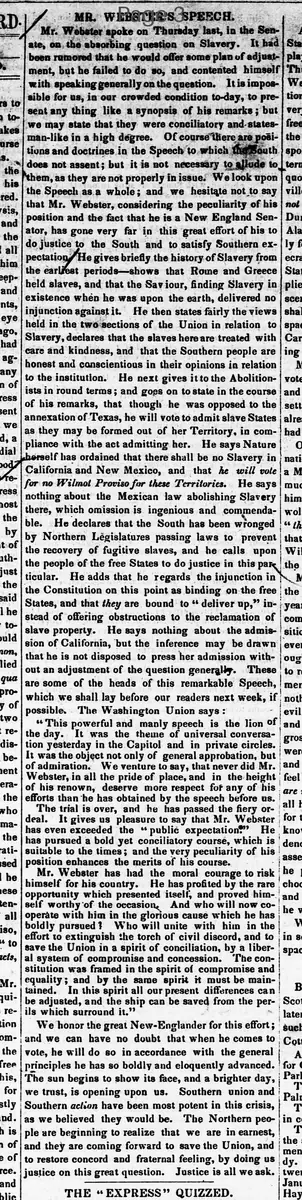
He gives briefly the history of Slavery from the earliest periods—shows that Rome and Greece held slaves, and that the Saviour, finding Slavery in existence when he was upon the earth, delivered no injunction against it. He then states fairly the views held in the two sections of the Union in relation to Slavery, declares that the slaves here are treated with care and kindness, and that the Southern people are honest and conscientious in their opinions in relation to the institution. He next gives it to the Abolitionists in round terms; and goes on to state in the course of his remarks, that though he was opposed to the annexation of Texas, he will vote to admit slave States as they may be formed out of her Territory, in compliance with the act admitting her. He says Nature herself has ordained that there shall be no Slavery in California and New Mexico, and that he will vote for no Wilmot Proviso for these Territories. He says nothing about the Mexican law abolishing Slavery there, which omission is ingenious and commendable. He declares that the South has been wronged by Northern Legislatures passing laws to prevent the recovery of fugitive slaves, and he calls upon the people of the free States to do justice in this particular. He adds that he regards the injunction in the Constitution on this point as binding on the free States, and that they are bound to "deliver up," instead of offering obstructions to the reclamation of slave property. He says nothing about the admission of California, but the inference may be drawn that he is not disposed to press her admission without an adjustment of the question generally.
These are some of the heads of this remarkable Speech, which we shall lay before our readers next week, if possible. The Washington Union says: "This powerful and manly speech is the lion of the day. It was the theme of universal conversation yesterday in the Capitol and in private circles. It was the object not only of general approbation, but of admiration. We venture to say, that never did Mr. Webster, in all the pride of place, and in the height of his renown, deserve more respect for any of his efforts than he has obtained by the speech before us. The trial is over, and he has passed the fiery ordeal. It gives us pleasure to say that Mr. Webster has even exceeded the "public expectation." He has pursued a bold yet conciliatory course, which is suitable to the times; and the very peculiarity of his position enhances the merits of his course. Mr. Webster has had the moral courage to risk himself for his country. He has profited by the rare opportunity which presented itself, and proved himself worthy of the occasion. And who will now co-operate with him in the glorious cause which he has boldly pursued? Who will unite with him in the effort to extinguish the torch of civil discord, and to save the Union in a spirit of conciliation, by a liberal system of compromise and concession. The constitution was framed in the spirit of compromise and equality; and by the same spirit it must be maintained. In this spirit all our present differences can be adjusted, and the ship can be saved from the perils which surround it."
We honor the great New-Englander for this effort; and we can have no doubt that when he comes to vote, he will do so in accordance with the general principles he has so boldly and eloquently advanced. The sun begins to show its face, and a brighter day, we trust, is opening upon us. Southern union and Southern action have been most potent in this crisis, as we believed they would be. The Northern people are beginning to realize that we are in earnest, and they are coming forward to save the Union, and to restore concord and fraternal feeling, by doing us justice on this great question. Justice is all we ask.
What sub-type of article is it?
What themes does it cover?
What keywords are associated?
What entities or persons were involved?
Where did it happen?
Story Details
Key Persons
Location
Senate
Event Date
Thursday Last
Story Details
Mr. Webster delivers a conciliatory speech on slavery, providing historical context, defending Southern treatment of slaves, criticizing abolitionists, supporting admission of slave states from Texas territory, stating no slavery in California and New Mexico by nature, urging free states to comply with fugitive slave laws, and implying no push for California's admission without broader adjustment.