Thank you for visiting SNEWPapers!
Sign up free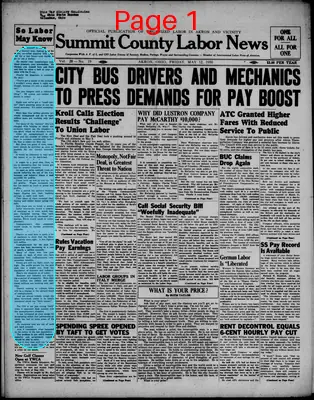
Editorial
May 12, 1950
Summit County Labor News
Akron, Summit County, Ohio
What is this article about?
Post-World War II editorial by Allan L. Swim likens rising unemployment—over 4 million fully jobless and millions part-time—to a 'small cancer' in the U.S. economy, caused by unchecked price hikes outpacing wages. Criticizes inaction by business leaders and urges government, industry, and labor to address it before a crisis ensues, recalling the Great Depression.
Clipping

OCR Quality
98%
Excellent
Full Text
By ALLAN L. SWIM
You haven't been feeling good for weeks, so--after arguing with yourself for a few hours--you decide to go to see a doctor.
He checks your temperature, your blood pressure, your metabolism. He thumps you around here and there and then he takes a look at your insides with his X-ray.
Finally his diagnosis is complete. He says:
"You've got a cancer of the stomach. I wouldn't worry about it right now, though, because it's only a small cancer."
Can you imagine such a ridiculous thing? Of course not--unless the doctor is crazy!
Right now we've got a "small cancer" that's gnawing away at our national economy. It's called unemployment.
More than four million persons are wholly unemployed and six to eight million more are working only part time.
Yet many of the "doctors" who are charged with helping us retain our economic health say the situation is one about which we shouldn't worry.
After all, unemployment is still small and the number of jobless will have to increase considerably before we face a crisis--so they say.
But, from our point of view, treatment should be provided as soon as possible for our current economic ills.
It would be ridiculous to wait until the nation is on its death-bed.
It might be a good idea, first, to try to determine how the nation got into its present situation.
As soon as price controls were removed following the end of the war, business and industry began a mad scramble for profits.
Prices went up and up and up. So did profits. Wages increased, too, but not nearly as much as prices and profits.
For a period the nation's workers began dipping into their wartime savings to make ends meet.
Then many of them curtailed their buying and others began going into debt.
Still there was no break in prices.
Labor economists issued a number of warnings as to what would happen. Curtailed buying, they said, would be followed by decreased production, which would result in unemployment.
Unemployment, they explained, would result in further production cutbacks.
There's no need here to quote a lot of statistics to show that the labor economists were right. A few figures will suffice.
Unemployment for the past few years has been increasing at a rate of nearly a million annually.
Many of those who lost jobs through no fault of their own have exhausted their unemployment compensation benefits.
Prices are still too high--much too high. The profit picture for the past year was a bright one, from the standpoint of business and industry.
Here's the situation as of today:
Business and industry are enjoying a period of prosperity. More than four million are jobless and additional millions are working only part time.
There's nothing to indicate there will be a change in the upward trend of unemployment.
And yet almost nobody except the labor movement seems to be deeply concerned about our "little cancer."
The CIO is not just crying "wolf" when it expresses deep concern over the unemployment situation.
It has witnessed at close range the devastating effect that joblessness already has had on some areas of the nation.
Its members who are out of work are hard pressed.
And it remembers what happened to the nation in the last depression.
The problem is one which business, industry and government together should be able to solve.
And if they wait until the "cancer" becomes much larger they may find it's too late and that all of us have a crisis on our hands.
You haven't been feeling good for weeks, so--after arguing with yourself for a few hours--you decide to go to see a doctor.
He checks your temperature, your blood pressure, your metabolism. He thumps you around here and there and then he takes a look at your insides with his X-ray.
Finally his diagnosis is complete. He says:
"You've got a cancer of the stomach. I wouldn't worry about it right now, though, because it's only a small cancer."
Can you imagine such a ridiculous thing? Of course not--unless the doctor is crazy!
Right now we've got a "small cancer" that's gnawing away at our national economy. It's called unemployment.
More than four million persons are wholly unemployed and six to eight million more are working only part time.
Yet many of the "doctors" who are charged with helping us retain our economic health say the situation is one about which we shouldn't worry.
After all, unemployment is still small and the number of jobless will have to increase considerably before we face a crisis--so they say.
But, from our point of view, treatment should be provided as soon as possible for our current economic ills.
It would be ridiculous to wait until the nation is on its death-bed.
It might be a good idea, first, to try to determine how the nation got into its present situation.
As soon as price controls were removed following the end of the war, business and industry began a mad scramble for profits.
Prices went up and up and up. So did profits. Wages increased, too, but not nearly as much as prices and profits.
For a period the nation's workers began dipping into their wartime savings to make ends meet.
Then many of them curtailed their buying and others began going into debt.
Still there was no break in prices.
Labor economists issued a number of warnings as to what would happen. Curtailed buying, they said, would be followed by decreased production, which would result in unemployment.
Unemployment, they explained, would result in further production cutbacks.
There's no need here to quote a lot of statistics to show that the labor economists were right. A few figures will suffice.
Unemployment for the past few years has been increasing at a rate of nearly a million annually.
Many of those who lost jobs through no fault of their own have exhausted their unemployment compensation benefits.
Prices are still too high--much too high. The profit picture for the past year was a bright one, from the standpoint of business and industry.
Here's the situation as of today:
Business and industry are enjoying a period of prosperity. More than four million are jobless and additional millions are working only part time.
There's nothing to indicate there will be a change in the upward trend of unemployment.
And yet almost nobody except the labor movement seems to be deeply concerned about our "little cancer."
The CIO is not just crying "wolf" when it expresses deep concern over the unemployment situation.
It has witnessed at close range the devastating effect that joblessness already has had on some areas of the nation.
Its members who are out of work are hard pressed.
And it remembers what happened to the nation in the last depression.
The problem is one which business, industry and government together should be able to solve.
And if they wait until the "cancer" becomes much larger they may find it's too late and that all of us have a crisis on our hands.
What sub-type of article is it?
Economic Policy
Labor
What keywords are associated?
Unemployment
Post War Economy
Price Controls
Labor Concerns
Economic Cancer
Joblessness
Wage Price Gap
What entities or persons were involved?
Cio
Labor Movement
Business And Industry
Government
Labor Economists
Editorial Details
Primary Topic
Rising Unemployment As Economic Threat Post War
Stance / Tone
Urgently Concerned, Calling For Immediate Action
Key Figures
Cio
Labor Movement
Business And Industry
Government
Labor Economists
Key Arguments
Unemployment Is A 'Small Cancer' Gnawing At The National Economy
Over 4 Million Fully Unemployed, 6 8 Million Part Time
Post War Removal Of Price Controls Led To Profit Scramble And Rising Prices Outpacing Wages
Workers Dipped Into Savings Then Curtailed Buying, Leading To Decreased Production
Labor Economists Predicted Unemployment Cycle, Which Is Now Occurring
Unemployment Increasing By Nearly A Million Annually
Many Jobless Have Exhausted Unemployment Benefits
Business And Industry Prosper While Workers Suffer
Cio Deeply Concerned Based On Past Depression Experiences
Business, Industry, And Government Must Solve Problem Before Crisis Worsens