Thank you for visiting SNEWPapers!
Sign up free
Editorial
May 9, 1850
The Star Of The North
Bloomsburg, Columbia County, Pennsylvania
What is this article about?
Editorial titled 'Science and the Working Man' argues that laborers in trades like quarrying, metalworking, farming, and butchery unknowingly apply scientific principles and should consciously observe and learn from their daily work to gain knowledge, rather than relying solely on instinct.
Clipping
OCR Quality
95%
Excellent
Full Text
Science and the Working Man.
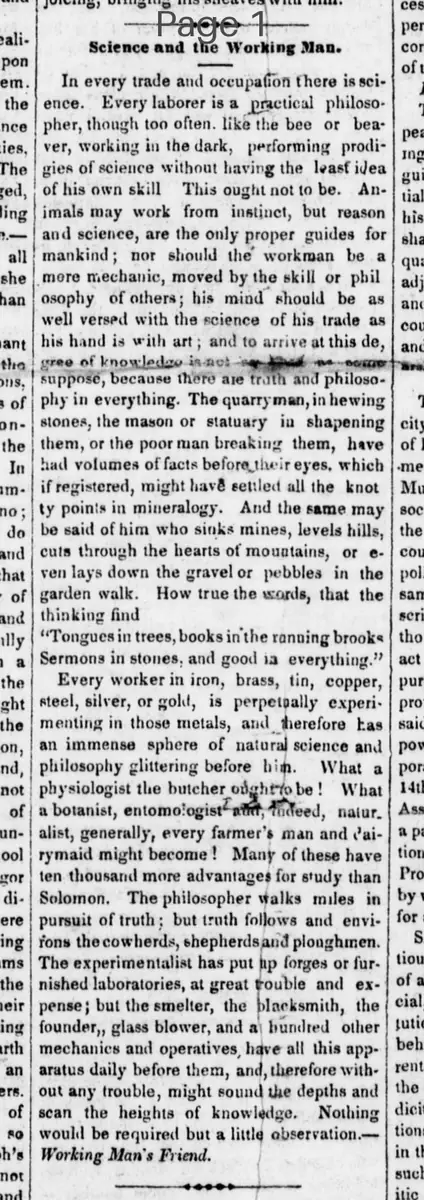
In every trade and occupation there is science. Every laborer is a practical philosopher, though too often, like the bee or beaver, working in the dark, performing prodigies of science without having the least idea of his own skill. This ought not to be. Animals may work from instinct, but reason and science, are the only proper guides for mankind; nor should the workman be a mere mechanic, moved by the skill or philosophy of others; his mind should be as well versed with the science of his trade as his hand is with art; and to arrive at this degree of knowledge is not so difficult as you suppose, because there are truth and philosophy in everything. The quarryman, in hewing stones, the mason or statuary in shaping them, or the poor man breaking them, have had volumes of facts before their eyes, which if registered, might have settled all the knotty points in mineralogy. And the same may be said of him who sinks mines, levels hills, cuts through the hearts of mountains, or even lays down the gravel or pebbles in the garden walk. How true the words, that the thinking find
"Tongues in trees, books in the running brooks
Sermons in stones, and good in everything."
Every worker in iron, brass, tin, copper, steel, silver, or gold, is perpetually experimenting in those metals, and therefore has an immense sphere of natural science and philosophy glittering before him. What a physiologist the butcher ought to be! What a botanist, entomologist and, indeed, naturalist, generally, every farmer's man and dairymaid might become! Many of these have ten thousand more advantages for study than Solomon. The philosopher walks miles in pursuit of truth; but truth follows and environs the cowherds, shepherds and ploughmen. The experimentalist has put up forges or furnished laboratories, at great trouble and expense; but the smelter, the blacksmith, the founder, glass blower, and a hundred other mechanics and operatives, have all this apparatus daily before them, and, therefore without any trouble, might sound the depths and scan the heights of knowledge. Nothing would be required but a little observation.—
Working Man's Friend.
In every trade and occupation there is science. Every laborer is a practical philosopher, though too often, like the bee or beaver, working in the dark, performing prodigies of science without having the least idea of his own skill. This ought not to be. Animals may work from instinct, but reason and science, are the only proper guides for mankind; nor should the workman be a mere mechanic, moved by the skill or philosophy of others; his mind should be as well versed with the science of his trade as his hand is with art; and to arrive at this degree of knowledge is not so difficult as you suppose, because there are truth and philosophy in everything. The quarryman, in hewing stones, the mason or statuary in shaping them, or the poor man breaking them, have had volumes of facts before their eyes, which if registered, might have settled all the knotty points in mineralogy. And the same may be said of him who sinks mines, levels hills, cuts through the hearts of mountains, or even lays down the gravel or pebbles in the garden walk. How true the words, that the thinking find
"Tongues in trees, books in the running brooks
Sermons in stones, and good in everything."
Every worker in iron, brass, tin, copper, steel, silver, or gold, is perpetually experimenting in those metals, and therefore has an immense sphere of natural science and philosophy glittering before him. What a physiologist the butcher ought to be! What a botanist, entomologist and, indeed, naturalist, generally, every farmer's man and dairymaid might become! Many of these have ten thousand more advantages for study than Solomon. The philosopher walks miles in pursuit of truth; but truth follows and environs the cowherds, shepherds and ploughmen. The experimentalist has put up forges or furnished laboratories, at great trouble and expense; but the smelter, the blacksmith, the founder, glass blower, and a hundred other mechanics and operatives, have all this apparatus daily before them, and, therefore without any trouble, might sound the depths and scan the heights of knowledge. Nothing would be required but a little observation.—
Working Man's Friend.
What sub-type of article is it?
Science Or Medicine
Education
Labor
What keywords are associated?
Working Man
Science In Labor
Practical Philosophy
Natural Observation
Trade Knowledge
Editorial Details
Primary Topic
Science In Everyday Labor For Working Men
Stance / Tone
Encouraging Intellectual Pursuit Among Laborers
Key Arguments
Laborers Apply Science Unknowingly In Trades
Workers Should Study Science Consciously Like Philosophers
Daily Work Provides Natural Laboratories For Observation
Truth And Knowledge Surround Manual Occupations