Thank you for visiting SNEWPapers!
Sign up free
Editorial
October 5, 1861
Daily Richmond Whig
Richmond, Virginia
What is this article about?
Editorial critiques price gouging on pork and necessities in New Orleans during scarcity, quoting the Delta's view that price rises are natural correctives to consumption, but condemns dealers buying at $17/barrel and selling at $45 as extortion, suggesting Governor seize supplies for public defense if needed.
Clipping
OCR Quality
95%
Excellent
Full Text
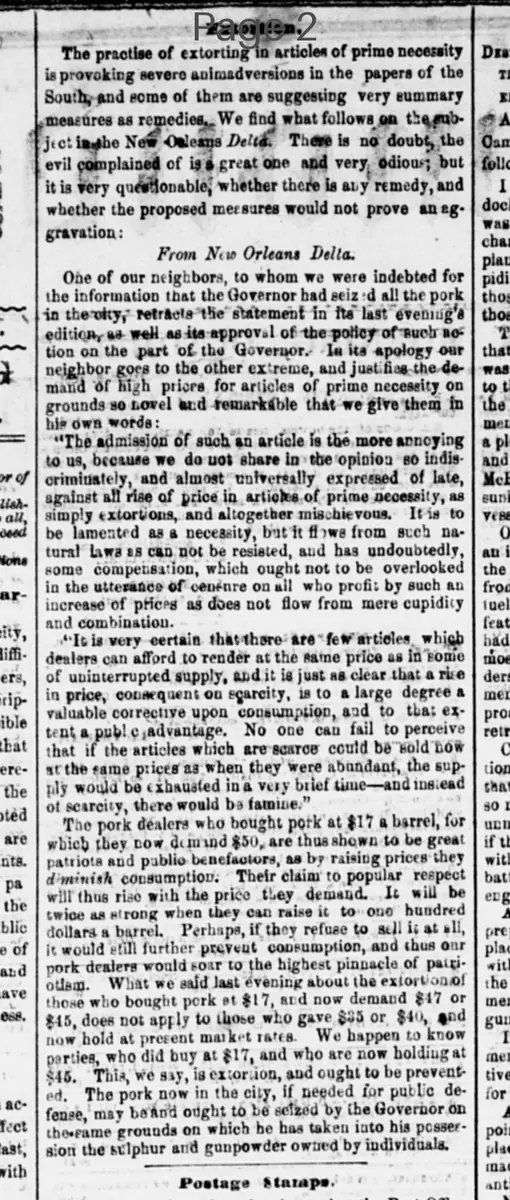
The practice of extorting in articles of prime necessity is provoking severe animadversions in the papers of the South, and some of them are suggesting very summary measures as remedies. We find what follows on the subject in the New Orleans Delta. There is no doubt, the evil complained of is great one and very odious; but it is very questionable, whether there is any remedy, and whether the proposed measures would not prove an aggravation:
From New Orleans Delta.
One of our neighbors, to whom we were indebted for the information that the Governor had seized all the pork in the city, retracts the statement in its last evening's edition, as well as its approval of the policy of such seizure on the part of the Governor. In its apology our neighbor goes to the other extreme, and justifies the demand of high prices for articles of prime necessity on grounds so novel and remarkable that we give them in his own words:
"The admission of such an article is the more apocryphal to us, because we do not share in the opinion so indiscriminately, and almost universally expressed of late, against all rise of price in articles of prime necessity, as simply extortions, and altogether mischievous. It is to be lamented as a necessity, but it flows from such natural laws as cannot be resisted, and has undoubtedly some compensation, which ought not to be overlooked in the utterance of censure on all who profit by such an increase of prices as does not flow from mere cupidity and combination.
"It is very certain that there are few articles which dealers can afford to render at the same price as in some time of uninterrupted supply, and it is just as clear that a rise in price, consequent on scarcity, is to a large degree a valuable corrective upon consumption, and to that extent a public advantage. No one can fail to perceive that if the articles which are scarce could be sold now at the same prices as when they were abundant, the supply would be exhausted in a very brief time—and instead of scarcity, there would be famine."
The pork dealers who bought pork at $17 a barrel, for which they now demand $50, are thus shown to be great patriots and public benefactors, as by raising prices they diminish consumption. Their claim to popular respect will thus rise with the price they demand. It will be twice as strong when they can raise it to one hundred dollars a barrel. Perhaps, if they refuse to sell it at all, it would still further prevent consumption, and thus our pork dealers would soar to the highest pinnacle of patriotism. What we said last evening about the extortion of those who bought pork at $17, and now demand $45, does not apply to those who gave $35 or $40, and now hold at present market rates. We happen to know parties, who did buy at $17, and who are now holding at $45. This, we say, is extortion, and ought to be prevented. The pork now in the city, if needed for public defense, may be and ought to be seized by the Governor on the same grounds on which he has taken into his possession the sulphur and gunpowder owned by individuals.
From New Orleans Delta.
One of our neighbors, to whom we were indebted for the information that the Governor had seized all the pork in the city, retracts the statement in its last evening's edition, as well as its approval of the policy of such seizure on the part of the Governor. In its apology our neighbor goes to the other extreme, and justifies the demand of high prices for articles of prime necessity on grounds so novel and remarkable that we give them in his own words:
"The admission of such an article is the more apocryphal to us, because we do not share in the opinion so indiscriminately, and almost universally expressed of late, against all rise of price in articles of prime necessity, as simply extortions, and altogether mischievous. It is to be lamented as a necessity, but it flows from such natural laws as cannot be resisted, and has undoubtedly some compensation, which ought not to be overlooked in the utterance of censure on all who profit by such an increase of prices as does not flow from mere cupidity and combination.
"It is very certain that there are few articles which dealers can afford to render at the same price as in some time of uninterrupted supply, and it is just as clear that a rise in price, consequent on scarcity, is to a large degree a valuable corrective upon consumption, and to that extent a public advantage. No one can fail to perceive that if the articles which are scarce could be sold now at the same prices as when they were abundant, the supply would be exhausted in a very brief time—and instead of scarcity, there would be famine."
The pork dealers who bought pork at $17 a barrel, for which they now demand $50, are thus shown to be great patriots and public benefactors, as by raising prices they diminish consumption. Their claim to popular respect will thus rise with the price they demand. It will be twice as strong when they can raise it to one hundred dollars a barrel. Perhaps, if they refuse to sell it at all, it would still further prevent consumption, and thus our pork dealers would soar to the highest pinnacle of patriotism. What we said last evening about the extortion of those who bought pork at $17, and now demand $45, does not apply to those who gave $35 or $40, and now hold at present market rates. We happen to know parties, who did buy at $17, and who are now holding at $45. This, we say, is extortion, and ought to be prevented. The pork now in the city, if needed for public defense, may be and ought to be seized by the Governor on the same grounds on which he has taken into his possession the sulphur and gunpowder owned by individuals.
What sub-type of article is it?
Economic Policy
Trade Or Commerce
Moral Or Religious
What keywords are associated?
Price Gouging
Pork Prices
Scarcity
Extortion
New Orleans
Governor Seizure
Public Defense
What entities or persons were involved?
New Orleans Delta
Governor
Pork Dealers
Editorial Details
Primary Topic
Critique Of Extortionate Pricing On Necessities During Scarcity
Stance / Tone
Critical Of Price Gouging And Supportive Of Government Intervention
Key Figures
New Orleans Delta
Governor
Pork Dealers
Key Arguments
Rise In Prices Due To Scarcity Is A Natural Law And Corrective To Consumption
Extortion Occurs When Dealers Buy Low ($17/Barrel) And Sell High ($45 $50/Barrel)
High Prices Prevent Famine By Reducing Consumption
Dealers Profiting From Low Buys Are Not Benefactors But Extortionists
Governor Should Seize Pork For Public Defense If Needed, As With Sulphur And Gunpowder