Thank you for visiting SNEWPapers!
Sign up free
Editorial
October 28, 1854
Thibodaux Minerva
Thibodaux, Lafourche County, Louisiana
What is this article about?
This editorial critiques societal hypocrisy in condemning 'fallen women' more harshly than men, emphasizing temptations like poverty and vanity that lead poor young women to prostitution, and calls for more humane, Christian-inspired mercy toward them.
Clipping
OCR Quality
98%
Excellent
Full Text
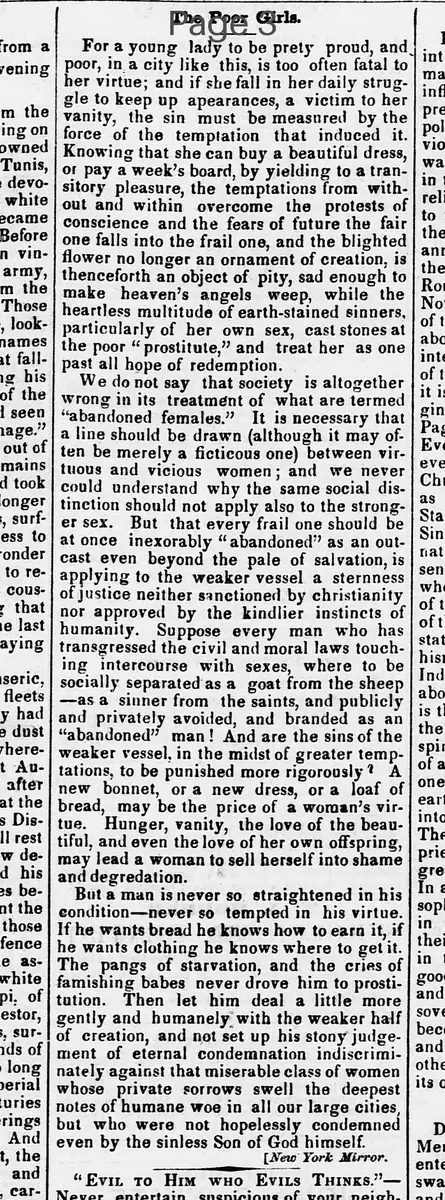
For a young lady to be pretty proud, and poor, in a city like this, is too often fatal to her virtue; and if she fall in her daily struggle to keep up appearances, a victim to her vanity, the sin must be measured by the force of the temptation that induced it. Knowing that she can buy a beautiful dress, or pay a week's board, by yielding to a transitory pleasure, the temptations from without and within overcome the protests of conscience and the fears of future the fair one falls into the frail one, and the blighted flower no longer an ornament of creation, is thenceforth an object of pity, sad enough to make heaven's angels weep, while the heartless multitude of earth-stained sinners, particularly of her own sex, cast stones at the poor "prostitute," and treat her as one past all hope of redemption.
We do not say that society is altogether wrong in its treatment of what are termed "abandoned females." It is necessary that a line should be drawn (although it may often be merely a fictitious one) between virtuous and vicious women; and we never could understand why the same social distinction should not apply also to the stronger sex. But that every frail one should be at once inexorably "abandoned" as an outcast even beyond the pale of salvation, is applying to the weaker vessel a sternness of justice neither sanctioned by christianity nor approved by the kindlier instincts of humanity. Suppose every man who has transgressed the civil and moral laws touching intercourse with sexes, were to be socially separated as a goat from the sheep—as a sinner from the saints, and publicly and privately avoided, and branded as an "abandoned" man! And are the sins of the weaker vessel, in the midst of greater temptations, to be punished more rigorously? A new bonnet, or a new dress, or a loaf of bread, may be the price of a woman's virtue. Hunger, vanity, the love of the beautiful, and even the love of her own offspring, may lead a woman to sell herself into shame and degradation.
But a man is never so straightened in his condition—never so tempted in his virtue. If he wants bread he knows how to earn it, if he wants clothing he knows where to get it. The pangs of starvation, and the cries of famishing babes never drove him to prostitution. Then let him deal a little more gently and humanely with the weaker half of creation, and not set up his stony judgment of eternal condemnation indiscriminately against that miserable class of women whose private sorrows swell the deepest notes of humane woe in all our large cities but who were not hopelessly condemned even by the sinless Son of God himself.
[New York Mirror.]
We do not say that society is altogether wrong in its treatment of what are termed "abandoned females." It is necessary that a line should be drawn (although it may often be merely a fictitious one) between virtuous and vicious women; and we never could understand why the same social distinction should not apply also to the stronger sex. But that every frail one should be at once inexorably "abandoned" as an outcast even beyond the pale of salvation, is applying to the weaker vessel a sternness of justice neither sanctioned by christianity nor approved by the kindlier instincts of humanity. Suppose every man who has transgressed the civil and moral laws touching intercourse with sexes, were to be socially separated as a goat from the sheep—as a sinner from the saints, and publicly and privately avoided, and branded as an "abandoned" man! And are the sins of the weaker vessel, in the midst of greater temptations, to be punished more rigorously? A new bonnet, or a new dress, or a loaf of bread, may be the price of a woman's virtue. Hunger, vanity, the love of the beautiful, and even the love of her own offspring, may lead a woman to sell herself into shame and degradation.
But a man is never so straightened in his condition—never so tempted in his virtue. If he wants bread he knows how to earn it, if he wants clothing he knows where to get it. The pangs of starvation, and the cries of famishing babes never drove him to prostitution. Then let him deal a little more gently and humanely with the weaker half of creation, and not set up his stony judgment of eternal condemnation indiscriminately against that miserable class of women whose private sorrows swell the deepest notes of humane woe in all our large cities but who were not hopelessly condemned even by the sinless Son of God himself.
[New York Mirror.]
What sub-type of article is it?
Social Reform
Moral Or Religious
Feminism
What keywords are associated?
Fallen Women
Prostitution
Social Hypocrisy
Gender Double Standards
Moral Mercy
What entities or persons were involved?
Abandoned Females
Weaker Sex
Stronger Sex
Society
Son Of God
Editorial Details
Primary Topic
Societal Treatment Of Fallen Women And Gender Double Standards
Stance / Tone
Compassionate Critique Of Hypocrisy, Advocating Mercy
Key Figures
Abandoned Females
Weaker Sex
Stronger Sex
Society
Son Of God
Key Arguments
Poverty And Vanity Tempt Young Women To Prostitution
Society Harshly Judges Fallen Women But Excuses Men
Christianity And Humanity Call For Mercy, Not Eternal Condemnation
Men Face Fewer Temptations And Should Judge Women More Gently