Thank you for visiting SNEWPapers!
Sign up free
Imperial Valley Press
El Centro, Imperial County, California
What is this article about?
International reactions to President Roosevelt's address: Fascist Italy criticizes it as propagandist; Rumania sees it as near war declaration; Hungary views it as step toward war; Japan expected it; Latin American press highlights dangers from totalitarianism, with enthusiastic public comments in Argentina.
Clipping
OCR Quality
Full Text
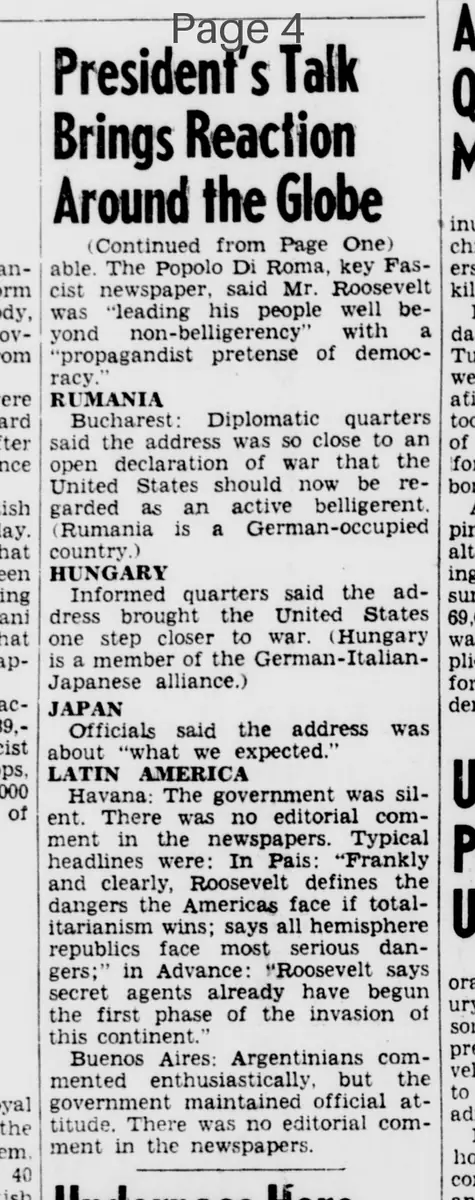
(Continued from Page One)
able. The Popolo Di Roma, key Fascist newspaper, said Mr. Roosevelt was "leading his people well beyond non-belligerency with a propagandist pretense of democracy."
RUMANIA
Bucharest: Diplomatic quarters said the address was so close to an open declaration of war that the United States should now be regarded as an active belligerent. (Rumania is a German-occupied country.)
HUNGARY
Informed quarters said the address brought the United States one step closer to war. (Hungary is a member of the German-Italian-Japanese alliance.)
JAPAN
Officials said the address was about "what we expected."
LATIN AMERICA
Havana: The government was silent. There was no editorial comment in the newspapers. Typical headlines were: In Pais: "Frankly and clearly, Roosevelt defines the dangers the Americas face if totalitarianism wins; says all hemisphere republics face most serious dangers;" in Advance: "Roosevelt says secret agents already have begun the first phase of the invasion of this continent."
Buenos Aires: Argentinians commented enthusiastically, but the government maintained official attitude. There was no editorial comment in the newspapers.
What sub-type of article is it?
What keywords are associated?
Foreign News Details
Event Details
Reactions to President Roosevelt's address from various countries: Popolo Di Roma in Italy criticizes it as leading beyond non-belligerency with propagandist pretense of democracy; diplomatic quarters in Bucharest, Rumania, regard US as active belligerent; informed quarters in Hungary see it as step closer to war; Japanese officials say it was expected; in Havana, government silent, newspapers highlight dangers from totalitarianism and invasion phases; in Buenos Aires, Argentinians enthusiastic but government maintains official attitude, no editorial comment.