Thank you for visiting SNEWPapers!
Sign up free
Literary
July 22, 1826
Literary Cadet, And Saturday Evening Bulletin
Providence, Providence County, Rhode Island
What is this article about?
A religious tale about Miriam, a Jewish girl who secretly embraced Christianity, who on her deathbed implores her father Imlah to read the Testament and accept Jesus as the Messiah, fulfilling his promise to grant her request.
Merged-components note: Continuation of the literary tale 'Miriam, or the Power of Truth' on page 4.
Clipping
OCR Quality
95%
Excellent
Full Text
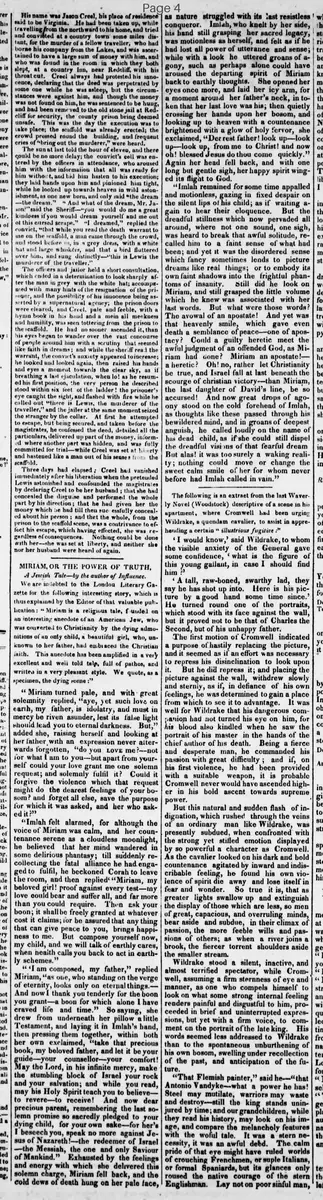
MIRIAM, OR THE POWER OF TRUTH,
A Jewish Tale—by the author of Influence.
We are indebted to the London Literary Gazette for the following interesting story, which is thus explained by the Editor of that valuable publication: "Miriam is a religious tale, founded on an interesting anecdote of an American Jew, who was converted to Christianity by the dying admonitions of an only child, a beautiful girl, who, unknown to her father, had embraced the Christian faith. This anecdote has been amplified in a very excellent and well told tale, full of pathos, and written in a very pleasant style. We quote, as a specimen, the dying scene:"
"Miriam turned pale, and with great solemnity replied, "aye, yet such love on earth, my father, is idolatry, and must in mercy be riven asunder, lest its false light should lead you to eternal darkness. But," added she, raising herself and looking at her father with an expression never afterwards forgotten, "do you love me?—not for what I am to you—but apart from yourself could your love grant me one solemn request; and solemnly fulfil it? Could it forgive the violence which that request might do the dearest feelings of your bosom? and forget all else, save the purpose for which it was asked, and her who asked it?"
"Imlah felt alarmed, for although the voice of Miriam was calm, and her countenance serene as a cloudless moonlight, he believed that her mind wandered in some delirious phantasy; till suddenly recollecting the fatal alliance he had engaged to fulfil, he beckoned Corah to leave the room, and then replied "Miriam, my beloved girl! proof against every test—my love could bear and suffer all, and far more than you could require. Thou ask your boon; it shall be freely granted at whatever cost it claims; for be assured that any thing that can give peace to you, brings happiness to me. But compose yourself now, my child, and we will talk of earthly cares, when health calls you back to act in earthly schemes."
"I am composed, my father," replied Miriam, "as one, who standing on the verge of eternity, looks only on eternal things.—And now I thank you tenderly for the boon you grant—a boon for which alone I have craved life and time." So saying, she drew from underneath her pillow a little Testament, and laying it in Imlah's hand, then pressing them together, within both her own exclaimed, "take that precious book, my beloved father, and let it be your guide—your counsellor—your comfort! May the Lord, in his infinite mercy, make the stumbling block of Israel your rock and your salvation; and while you read, may his Holy Spirit teach you to believe—to revere—to receive! And now dear precious parent, remembering the last solemn promise so sacredly pledged to your dying child, for your own sake—for hers I beseech you, speak no more against Jesus of Nazareth!—the redeemer of Israel—the Messiah, the one and only Saviour of Mankind." 'Exhausted by the feelings and energy with which she delivered this solemn charge, Miriam fell back, and the cold dews of death hung on her pale face,
as nature struggled with its last resistless conqueror. Imlah, who knelt by her side, his hand still grasping her sacred legacy, was motionless as herself, and felt as if he had lost all power of utterance and sense; while with a look he uttered groans of agony, such as perhaps alone could have aroused the departing spirit of Miriam back to earthly thoughts. She opened her eyes once more, and laid her icy arm, for a moment around her father's neck, in token that her last love was his; then quietly crossing her hands upon her bosom, and looking up to heaven with a countenance brightened with a glow of holy fervor, she exclaimed, "Dear rest father! look up—look up—look up, from me to Christ! and now oh! blessed Jesus do thou come quickly."
Again her head fell back, and with one long but gentle sigh, her happy spirit winged its flight to God.
"Imlah remained for some time appalled and motionless, gazing in fixed despair on the silent lips of his child; as if waiting again to hear their eloquence. But the dreadful stillness which now pervaded all around, where not one sound, one sigh, was heard to break that awful solitude, recalled him to a faint sense of what had been; and yet it was the disordered sense which fancy sometimes lends to picture dreams like real things; or to embody its own faint shadows into the frightful phantoms of insanity. Still did he look on Miriam, and still grasped the little volume which he knew was associated with her last words. But what were those words? The avowal of an apostate! And yet was that heavenly smile, which gave even death a semblance of peace—one of apostasy? Could a guilty heretic meet the awful judgment of an offended God, as Miriam had done? Miriam an apostate!— a heretic? Oh! no, rather let Christianity be true, and Israel fall at last beneath the scourge of christian victory—than Miriam, the last daughter of David's line, be so accursed! And now great drops of agony stood on the cold forehead of Imlah, as thoughts like these passed through his bewildered mind, and in groans of deepest anguish, he called loudly on the name of his dead child, as if she could still dispel the dreadful visions of that fearful dream But alas! it was too surely a waking reality; nothing could move or change the sweet calm smile of her for whom never before had Imlah called in vain."
A Jewish Tale—by the author of Influence.
We are indebted to the London Literary Gazette for the following interesting story, which is thus explained by the Editor of that valuable publication: "Miriam is a religious tale, founded on an interesting anecdote of an American Jew, who was converted to Christianity by the dying admonitions of an only child, a beautiful girl, who, unknown to her father, had embraced the Christian faith. This anecdote has been amplified in a very excellent and well told tale, full of pathos, and written in a very pleasant style. We quote, as a specimen, the dying scene:"
"Miriam turned pale, and with great solemnity replied, "aye, yet such love on earth, my father, is idolatry, and must in mercy be riven asunder, lest its false light should lead you to eternal darkness. But," added she, raising herself and looking at her father with an expression never afterwards forgotten, "do you love me?—not for what I am to you—but apart from yourself could your love grant me one solemn request; and solemnly fulfil it? Could it forgive the violence which that request might do the dearest feelings of your bosom? and forget all else, save the purpose for which it was asked, and her who asked it?"
"Imlah felt alarmed, for although the voice of Miriam was calm, and her countenance serene as a cloudless moonlight, he believed that her mind wandered in some delirious phantasy; till suddenly recollecting the fatal alliance he had engaged to fulfil, he beckoned Corah to leave the room, and then replied "Miriam, my beloved girl! proof against every test—my love could bear and suffer all, and far more than you could require. Thou ask your boon; it shall be freely granted at whatever cost it claims; for be assured that any thing that can give peace to you, brings happiness to me. But compose yourself now, my child, and we will talk of earthly cares, when health calls you back to act in earthly schemes."
"I am composed, my father," replied Miriam, "as one, who standing on the verge of eternity, looks only on eternal things.—And now I thank you tenderly for the boon you grant—a boon for which alone I have craved life and time." So saying, she drew from underneath her pillow a little Testament, and laying it in Imlah's hand, then pressing them together, within both her own exclaimed, "take that precious book, my beloved father, and let it be your guide—your counsellor—your comfort! May the Lord, in his infinite mercy, make the stumbling block of Israel your rock and your salvation; and while you read, may his Holy Spirit teach you to believe—to revere—to receive! And now dear precious parent, remembering the last solemn promise so sacredly pledged to your dying child, for your own sake—for hers I beseech you, speak no more against Jesus of Nazareth!—the redeemer of Israel—the Messiah, the one and only Saviour of Mankind." 'Exhausted by the feelings and energy with which she delivered this solemn charge, Miriam fell back, and the cold dews of death hung on her pale face,
as nature struggled with its last resistless conqueror. Imlah, who knelt by her side, his hand still grasping her sacred legacy, was motionless as herself, and felt as if he had lost all power of utterance and sense; while with a look he uttered groans of agony, such as perhaps alone could have aroused the departing spirit of Miriam back to earthly thoughts. She opened her eyes once more, and laid her icy arm, for a moment around her father's neck, in token that her last love was his; then quietly crossing her hands upon her bosom, and looking up to heaven with a countenance brightened with a glow of holy fervor, she exclaimed, "Dear rest father! look up—look up—look up, from me to Christ! and now oh! blessed Jesus do thou come quickly."
Again her head fell back, and with one long but gentle sigh, her happy spirit winged its flight to God.
"Imlah remained for some time appalled and motionless, gazing in fixed despair on the silent lips of his child; as if waiting again to hear their eloquence. But the dreadful stillness which now pervaded all around, where not one sound, one sigh, was heard to break that awful solitude, recalled him to a faint sense of what had been; and yet it was the disordered sense which fancy sometimes lends to picture dreams like real things; or to embody its own faint shadows into the frightful phantoms of insanity. Still did he look on Miriam, and still grasped the little volume which he knew was associated with her last words. But what were those words? The avowal of an apostate! And yet was that heavenly smile, which gave even death a semblance of peace—one of apostasy? Could a guilty heretic meet the awful judgment of an offended God, as Miriam had done? Miriam an apostate!— a heretic? Oh! no, rather let Christianity be true, and Israel fall at last beneath the scourge of christian victory—than Miriam, the last daughter of David's line, be so accursed! And now great drops of agony stood on the cold forehead of Imlah, as thoughts like these passed through his bewildered mind, and in groans of deepest anguish, he called loudly on the name of his dead child, as if she could still dispel the dreadful visions of that fearful dream But alas! it was too surely a waking reality; nothing could move or change the sweet calm smile of her for whom never before had Imlah called in vain."
What sub-type of article is it?
Prose Fiction
What themes does it cover?
Religious
Death Mortality
Moral Virtue
What keywords are associated?
Jewish Tale
Religious Conversion
Dying Admonition
Christian Testament
Pathos
What entities or persons were involved?
By The Author Of Influence
Literary Details
Title
Miriam, Or The Power Of Truth
Author
By The Author Of Influence
Subject
A Jewish Tale Of Conversion To Christianity By A Dying Daughter's Admonitions
Key Lines
"Take That Precious Book, My Beloved Father, And Let It Be Your Guide—Your Counsellor—Your Comfort! May The Lord, In His Infinite Mercy, Make The Stumbling Block Of Israel Your Rock And Your Salvation; And While You Read, May His Holy Spirit Teach You To Believe—To Revere—To Receive!"
"Dear Rest Father! Look Up—Look Up—Look Up, From Me To Christ! And Now Oh! Blessed Jesus Do Thou Come Quickly."
"Miriam An Apostate!— A Heretic? Oh! No, Rather Let Christianity Be True, And Israel Fall At Last Beneath The Scourge Of Christian Victory—Than Miriam, The Last Daughter Of David's Line, Be So Accursed!"