Thank you for visiting SNEWPapers!
Sign up free
Domestic News
December 31, 1885
The Valley Virginian
Clifton Forge, Staunton, Virginia
What is this article about?
Justice Miller opines that under the Tenure of Office Act, the President cannot remove officials without Senate consent, and suspended officials resume duties if successors are not confirmed. This view is shared by some Senators and critiques presidential appointment practices.
Clipping
OCR Quality
95%
Excellent
Full Text
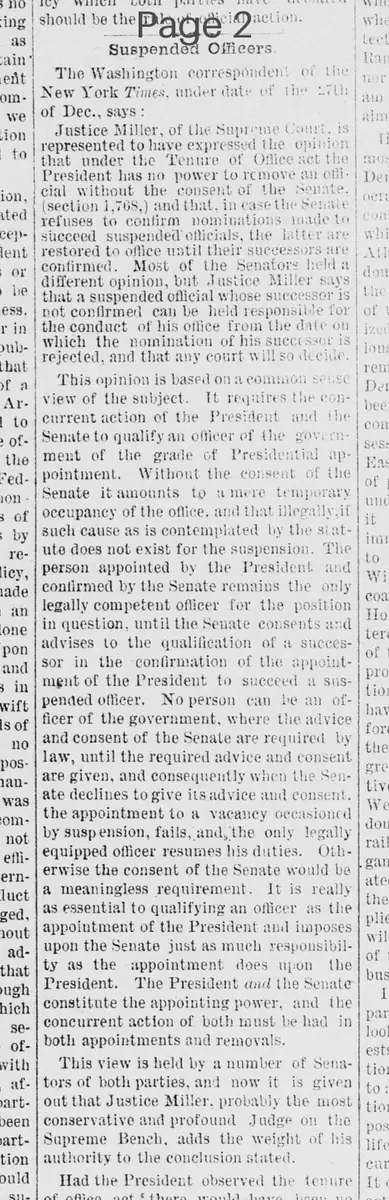
Suspended Officers
The Washington correspondent of the New York Times, under date of the 24th of Dec., says:
Justice Miller, of the Supreme Court, is represented to have expressed the opinion that under the Tenure of Office act the President has no power to remove an official without the consent of the Senate. (section 1769,) and that, in case the Senate refuses to confirm nominations made to succeed suspended officials, the latter are restored to office until their successors are confirmed. Most of the Senators held a different opinion, but Justice Miller says that a suspended official whose successor is not confirmed can be held responsible for the conduct of his office from the date on which the nomination of his successor is rejected, and that any court will so decide.
This opinion is based on a common sense view of the subject. It requires the concurrent action of the President and the Senate to qualify an officer of the government of the grade of Presidential appointment. Without the consent of the Senate it amounts to a mere temporary occupancy of the office, and that illegally, if such cause as is contemplated by the statute does not exist for the suspension. The person appointed by the President and confirmed by the Senate remains the only legally competent officer for the position in question, until the Senate consents and advises to the qualification of a successor in the confirmation of the appointment of the President to succeed a suspended officer. No person can be an officer of the government, where the advice and consent of the Senate are required by law, until the required advice and consent are given, and consequently when the Senate declines to give its advice and consent. the appointment to a vacancy occasioned by suspension, fails, and, the only legally equipped officer resumes his duties. Otherwise the consent of the Senate would be a meaningless requirement. It is really as essential to qualifying an officer as the appointment of the President and imposes upon the Senate just as much responsibility as the appointment does upon the President. The President and the Senate constitute the appointing power, and the concurrent action of both must be had in both appointments and removals.
This view is held by a number of Senators of both parties, and now it is given out that Justice Miller, probably the most conservative and profound Judge on the Supreme Bench, adds the weight of his authority to the conclusion stated.
Had the President observed the tenure of office act, there would have been no controversy over his appointments; for all recognize the policy of appointing political sympathizers of the administration where vacancies exist. But to make vacancies for the accommodation of partisan adherents, and generally the most offensive of partisans, is not what the law contemplates, nor what the Senate ought to approve.
The Washington correspondent of the New York Times, under date of the 24th of Dec., says:
Justice Miller, of the Supreme Court, is represented to have expressed the opinion that under the Tenure of Office act the President has no power to remove an official without the consent of the Senate. (section 1769,) and that, in case the Senate refuses to confirm nominations made to succeed suspended officials, the latter are restored to office until their successors are confirmed. Most of the Senators held a different opinion, but Justice Miller says that a suspended official whose successor is not confirmed can be held responsible for the conduct of his office from the date on which the nomination of his successor is rejected, and that any court will so decide.
This opinion is based on a common sense view of the subject. It requires the concurrent action of the President and the Senate to qualify an officer of the government of the grade of Presidential appointment. Without the consent of the Senate it amounts to a mere temporary occupancy of the office, and that illegally, if such cause as is contemplated by the statute does not exist for the suspension. The person appointed by the President and confirmed by the Senate remains the only legally competent officer for the position in question, until the Senate consents and advises to the qualification of a successor in the confirmation of the appointment of the President to succeed a suspended officer. No person can be an officer of the government, where the advice and consent of the Senate are required by law, until the required advice and consent are given, and consequently when the Senate declines to give its advice and consent. the appointment to a vacancy occasioned by suspension, fails, and, the only legally equipped officer resumes his duties. Otherwise the consent of the Senate would be a meaningless requirement. It is really as essential to qualifying an officer as the appointment of the President and imposes upon the Senate just as much responsibility as the appointment does upon the President. The President and the Senate constitute the appointing power, and the concurrent action of both must be had in both appointments and removals.
This view is held by a number of Senators of both parties, and now it is given out that Justice Miller, probably the most conservative and profound Judge on the Supreme Bench, adds the weight of his authority to the conclusion stated.
Had the President observed the tenure of office act, there would have been no controversy over his appointments; for all recognize the policy of appointing political sympathizers of the administration where vacancies exist. But to make vacancies for the accommodation of partisan adherents, and generally the most offensive of partisans, is not what the law contemplates, nor what the Senate ought to approve.
What sub-type of article is it?
Politics
Appointment
Legal Or Court
What keywords are associated?
Tenure Of Office Act
Justice Miller
Presidential Appointments
Senate Confirmation
Suspended Officials
What entities or persons were involved?
Justice Miller
Where did it happen?
Washington
Domestic News Details
Primary Location
Washington
Event Date
24th Of Dec.
Key Persons
Justice Miller
Event Details
Justice Miller expresses opinion that under Tenure of Office Act, President lacks power to remove officials without Senate consent; suspended officials restored if successors not confirmed; shared by some Senators; critiques presidential creation of vacancies for partisans.