Thank you for visiting SNEWPapers!
Sign up free
Alexandria Advertiser And Commercial Intelligencer
Alexandria, Virginia
What is this article about?
Political review critiquing France's aggressive ambitions under Bonaparte, including his role in the Italian Republic, Etruria monarchy as bribe for Louisiana, Le Clerc's expedition to St. Domingo, plundering of American vessels, and potential peace with England while preparing for future dominance in Europe and Americas.
Clipping
OCR Quality
Full Text
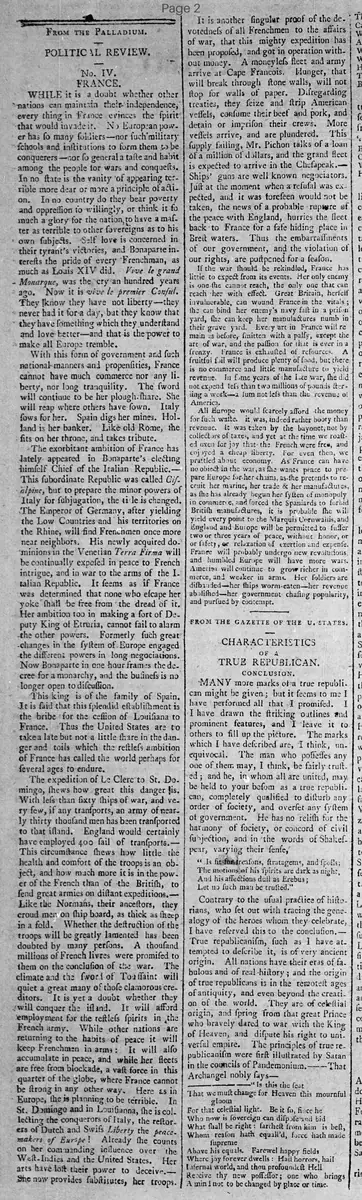
POLITICAL REVIEW.
No. IV.
FRANCE.
WHILE it is a doubt whether other nations can maintain their independence, every thing in France evinces the spirit that would invade it. No European power has so many soldiers--nor such military schools and institutions to form them to be conquerors--nor so general a taste and habit among the people for wars and conquests. In no state is the vanity of appearing terrible more dear or more a principle of action. In no country do they bear poverty and oppression so willingly, or think it so much a glory for the nation to have a master as terrible to other sovereigns as to his own subjects. Self love is concerned in their tyrant's victories, and Bonaparte interests the pride of every Frenchman, as much as Louis XIV did. Vive le grand Monarque, was the cry an hundred years ago. Now it is vive le premier Consul. They know they have not liberty--they never had it for a day, but they know that they have something which they understand and love better--and that is the power to make all Europe tremble.
With this form of government and such national manners and propensities, France cannot have much commerce nor any liberty, nor long tranquility. The sword will continue to be her ploughshare. She will reap where others have sown. Italy sows for her. Spain digs her mines. Holland is her banker. Like old Rome, she sits on her throne, and takes tribute.
The exorbitant ambition of France has lately appeared in Bonaparte's electing himself Chief of the Italian Republic. This subordinate Republic was called Cisalpine, but to prepare the minor powers of Italy for subjugation, the title is changed. The Emperor of Germany, after yielding the Low Countries and his territories on the Rhine, will find Frenchmen once more near neighbors. His newly acquired dominions in the Venetian Terra Firma will be continually exposed in peace to French intrigue, and in war to the arms of the Italian Republic. It seems as if France was determined that none who escape her yoke shall be free from the dread of it.
Her ambition too in making a sort of Deputy King of Etruria, cannot fail to alarm the other powers. Formerly such great changes in the system of Europe engaged the different powers in long negotiations. Now Bonaparte in one hour frames the decree for a monarchy, and the business is no longer open to discussion.
This king is of the family of Spain. It is said that this splendid establishment is the bribe for the cession of Louisiana to France. Thus the United States are to take a late but not a little share in the danger and toils which the restless ambition of France has called the world perhaps for several ages to endure.
The expedition of Le Clerc to St. Domingo, shews how great this danger is. With less than sixty ships of war, and very few, if any transports, an army of nearly thirty thousand men has been transported to that island. England would certainly have employed 400 sail of transports. This circumstance shews how little the health and comfort of the troops is an object, and how much more it is in the power of the French than of the British, to send great armies on distant expeditions. Like the Normans, their ancestors, they crowd men on ship board, as thick as sheep in a fold. Whether the destruction of the troops will be greatly lamented has been doubted by many persons. A thousand millions of French livres were promised to them on the conclusion of the war. The climate and the sword of Toussaint will quiet a great many of those clamorous creditors. It is yet a doubt whether they will conquer the island. It will afford employment for the restless spirits in the French army. While other nations are returning to the habits of peace it will keep Frenchmen in arms: It will also accumulate in peace, and while her fleets are free from blockade, a vast force in this quarter of the globe, where France cannot be strong in any other way. Here as in Europe, she is planning to be terrible. In St. Domingo and in Louisiana, she is collecting the conquerors of Italy, the restorers of Dutch and Swiss Liberty the peace-makers of Europe! Already she counts on her commanding influence over the West-Indies and the United States. Her arts have lost their power to deceive. She now provides substitutes, her troops.
It is another singular proof of the devotedness of all Frenchmen to the affairs of war, that this mighty expedition has been proposed, and got in operation without money. A moneyless fleet and army arrive at Cape Francois. Hunger, that will break through stone walls, will not stop for walls of paper. Disregarding treaties, they seize and strip American vessels, consume their beef and pork, and detain or imprison their crews. More vessels arrive, and are plundered. This supply failing, Mr. Pichon talks of a loan of a million of dollars, and the grand fleet is expected to arrive in the Chesapeake. Ships' guns are well known negotiators. Just at the moment when a refusal was expected, and it was foreseen would not be taken, the news of a probable rupture of the peace with England, hurries the fleet back to France for a safe hiding place in Breton waters. Thus the embarrassments of our government, and the violation of our rights, are postponed for a season.
If the war should be rekindled, France has little to expect from its events. Her only enemy is one she cannot reach, the only one that can reach her with effect. Great Britain, herself invulnerable, can wound France in the vitals; she can bind her enemy's navy fast in a prison yard, she can keep her manufactures numb in their grave yard. Every art in France will remain as before, smitten with a palsy, except the art of war, and the passion for that is ever in a frenzy. France is exhausted of resources. A fruitful soil will produce plenty of food, but there is no commerce and little manufacture to yield revenue. In some years of the late war, she did not expend less than two millions of pounds sterling a week--a sum not less than the revenue of America.
All Europe would scarcely afford the money for such waste. it was, indeed rather booty than revenue. it was taken by the bayonet, not by collectors of taxes, and yet at the time we roasted oxen for joy that the French were free, and enjoyed a cheap liberty. For even then, we prattled about economy. As France can have no object in the war, as she wants peace to prepare Europe for her chains, as she pretends to recruit her marine, her trade & her manufactures, as she has already begun her system of monopoly in commerce, and forced the Spaniards to forbid British manufactures, it is probable he will yield every point to the Marquis Cornwallis, and England and Europe will be permitted to suffer two or three years of peace, without honor, or safety, or relaxation of exertion and expense. France will probably undergo new revolutions, and humbled Europe will have more wars. America will continue to grow richer in commerce, and weaker in arms. Her soldiers are disbanded--her ships worm-eaten--her revenue abolished--her government chasing popularity, and pursued by contempt.
What sub-type of article is it?
What keywords are associated?
What entities or persons were involved?
Where did it happen?
Foreign News Details
Primary Location
France
Key Persons
Outcome
destruction of french troops in st. domingo expected from climate and toussaint's resistance; doubt over conquest of the island; violation of american rights postponed due to rumors of war with england.
Event Details
France under Bonaparte exhibits strong militaristic spirit and ambition, with Bonaparte electing himself Chief of the Italian Republic (formerly Cisalpine), creating a monarchy in Etruria as bribe for Spain's cession of Louisiana, and sending Le Clerc's expedition of nearly 30,000 men to St. Domingo without adequate transports, leading to plundering of American vessels for supplies; potential renewal of war with England discussed, with France exhausted but planning dominance over Europe, West Indies, and United States.