Thank you for visiting SNEWPapers!
Sign up free
Norfolk Gazette And Publick Ledger
Norfolk, Virginia
What is this article about?
Intelligence from Lisbon and Bayonne reports defeats of French forces under Marshal Soult in late July and early August 1813 during the Peninsular War, with allied army approaching Bayonne. A forged letter in a New York paper claiming a French victory is debunked as inconsistent and absurd.
Clipping
OCR Quality
Full Text
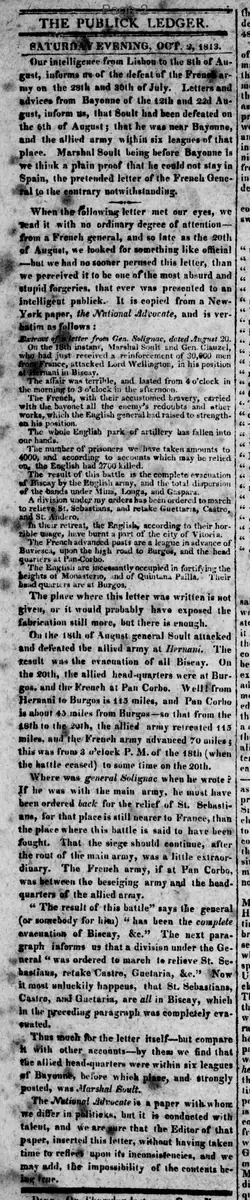
SATURDAY EVENING, OCT. 2, 1813.
Our intelligence from Lisbon to the 5th of August, informs us of the defeat of the French army on the 28th and 30th of July. Letters and advices from Bayonne of the 12th and 22d August, inform us, that Soult had been defeated on the 6th of August; that he was near Bayonne, and the allied army within six leagues of that place. Marshal Soult being before Bayonne is we think a plain proof that he could not stay in Spain, the pretended letter of the French General to the contrary notwithstanding.
When the following letter met our eyes, we read it with no ordinary degree of attention-- from a French general, and so late as the 20th of August, we looked for something like official --but we had no sooner perused this letter, than we perceived it to be one of the most absurd and stupid forgeries, that ever was presented to an intelligent publick. It is copied from a New-York paper, the National Advocate, and is verbatim as follows :
Extract of letter from Gen. Solignac, dated August 20
On the 18th instant, Marshal Soult and Gen. Clauzel, who had just received a reinforcement of 30,000 men from France, attacked Lord Wellington, in his position at Hernani in Biscay.
The affair was terrible, and lasted from 4 o'clock in the morning to 3 o'clock in the afternoon.
The French, with their accustomed bravery, carried with the bayonet all the enemy's redoubts and other works, which the English general had raised to strengthen his position.
The whole English park of artillery has fallen into our hands.
The number of prisoners we have taken amounts to 4000, and according to accounts which may be relied on the English had 2700 killed.
The result of this battle is the complete evacuation of Biscay by the English army, and the total dispersion of the bands under Mina, Longa, and Gaspara.
A division under my orders has been ordered to march to relieve St. Sebastians, and retake Guettaria, Castro, and St. Andero.
In their retreat, the English, according to their horrible usage, have burnt a part of the city of Vitoria.
The French advanced posts are a league in advance of Briviesca, upon the high road to Burgos, and the head quarters at Pan Corbo.
The English are incessantly occupied in fortifying the heights of Monasterio, and of Quintana Pailla. Their head quarters are at Burgos.
The place where this letter was written is not given, or it would probably have exposed the fabrication still more, but there is enough.
On the 18th of August general Soult attacked and defeated the allied army at Hernani. The result was the evacuation of all Biscay. On the 20th, the allied head-quarters were at Burgos, and the French at Pan Corbo. Well from Hernani to Burgos is 115 miles, and Pan Corbo is about 45 miles from Burgos-so that from the 18th to the 20th, the allied army retreated 115 miles, and the French army advanced 70 miles; this was from 3 o'clock P. M. of the 18th (when the battle ceased) to some time on the 20th.
Where was general Solignac when he wrote ? If he was with the main army, he must have been ordered back for the relief of St. Sebastians, or that place is still nearer to France, than the place where this battle is said to have been fought. That the siege should continue, after the rout of the main army, was a little extraordinary. The French army, if at Pan Corbo, was between the besieging army and the head-quarters of the allied army.
" The result of this battle" says the general (or somebody for him) " has been the complete evacuation of Biscay, &c." The next paragraph informs us that a division under the General " was ordered to march to relieve St. Sebastians, retake Castro, Guetaria, &c." Now it most unluckily happens, that St. Sebastians, Castro, and Guetaria, are all in Biscay, which in the preceding paragraph was completely evacuated.
Thus much for the letter itself --but compare it with other accounts--by them we find that the allied head-quarters were within six leagues of Bayonne, before which place, and strongly posted, was Marshal Soult.
The National Advocate is a paper with whom we differ in politicks, but it is conducted with talent, and we are sure that the Editor of that paper, inserted this letter, without having taken time to reflect upon its inconsistencies, and we may add, the impossibility of the contents being true.
What sub-type of article is it?
What keywords are associated?
What entities or persons were involved?
Where did it happen?
Foreign News Details
Primary Location
Bayonne
Event Date
28th And 30th Of July; 6th Of August 1813
Key Persons
Outcome
defeat of french army on 28th and 30th july and 6th august; soult near bayonne with allied army within six leagues; forged letter claims 4000 english prisoners and 2700 killed but debunked
Event Details
Intelligence from Lisbon to 5th August reports French defeat on 28th and 30th July. Advices from Bayonne of 12th and 22nd August state Soult defeated on 6th August, positioned near Bayonne with allied forces approaching. A forged letter from Gen. Solignac dated 20th August, published in New-York's National Advocate, falsely claims French victory over Wellington at Hernani on 18th August, capture of artillery, 4000 prisoners, 2700 English killed, evacuation of Biscay, but is exposed as inconsistent with real accounts and internal contradictions.