Thank you for visiting SNEWPapers!
Sign up free
The Enquirer
Richmond, Henrico County, Virginia
What is this article about?
In March 1807, the Haitian Senate, responding to Henry Christophe's revolt, elects General Pétion as President with 13 votes out of 16. He is inaugurated on March 10 in Port-au-Prince amid ceremony, takes the oath, and the Senate passes decrees granting him authority over foreign affairs and appointments.
Clipping
OCR Quality
Full Text
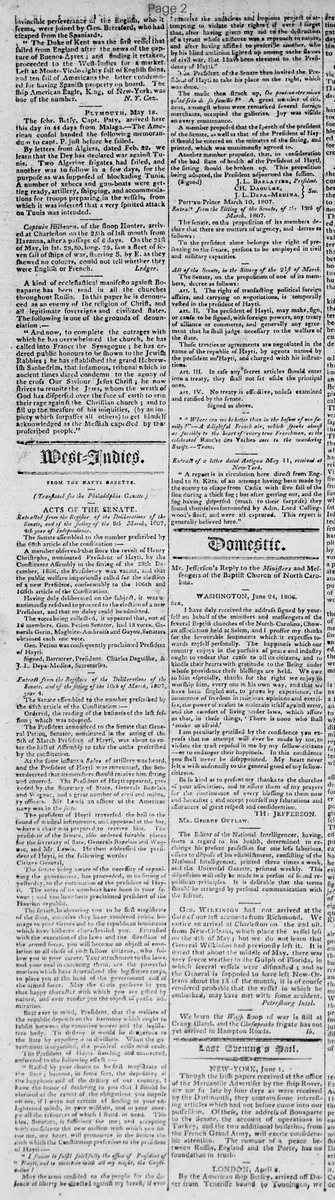
FROM THE HAITI GAZETTE.
(Translated for the Philadelphia Gazette)
ACTS OF THE SENATE.
Extracted from the Register of the Deliberations of the Senate, and of the sitting of the 9th March, 1807, 4th year of Independence.
The Senate assembled to the number prescribed by the 65th article of the constitution:
A member observed that since the revolt of Henry Christophe, nominated President of Hayti, by the Constituent Assembly in the sitting of the 28th December, 1806, the Presidency was vacant, and that the public welfare imperiously called for the election of a new President, conformably to the 100th and 101st article of the Constitution.
Having duly deliberated on the subject, it was unanimously resolved to proceed to the election of a new President, and that no delay could be admitted.
The votes being collected, it appeared that, out of 16 members, Gen. Petion Senator, had 13 votes. Generals Gerin, Magloire-Ambroise and Gayou, Senators obtained each one vote.
Gen. Petion was consequently proclaimed President of Hayti.
Signed, Barrateur, President. Charles Daguilhe, & J.L. Depa-Medina, Secretaries.
Extract from the Registers of the Deliberations of the Senate, and of the sitting of the 10th of March, 1807, year 4.
The Senate assembled to the number prescribed by the 65th article of the Constitution:
Ordered, the reading of the business of the last session; which was adopted.
The President announced to the Senate that General Petion, Senator, nominated in the sitting of the 9th of March President of Hayti, was about to enter the hall of Assembly to take the oaths prescribed by the constitution.
At the same instant a Salvo of artillery was heard and the President of Hayti was announced, the Senate decreed that its members should receive him sitting and covered. The President of Hayti appeared, preceded by the Secretary of State, Generals Bazelais and Wagnac, and a great number of civil and military officers. Mr. Lewis an officer of the American navy was in the suite.
The president of Hayti traversed the hall to the sound of musical instruments, and appeared at the bar, where a chair was prepared to receive him. The president of the Senate, also ordered suitable places for the secretary of state, Generals Bazelais and Wagnac, and Mr. Lewis. He then addressed the president of Hayti, in the following words:
Citizen General,
The senate being aware of the necessity of organizing the government, has proceeded, in its sitting of yesterday, to the nomination of the president of Hayti. The votes of its members have been in your favour; and you have been proclaimed president of the Haytian republic.
The senate, in elevating you to be first magistrate of the state, conceive they have rendered public homage to your virtues and to the republican sentiments which have hitherto characterized you. Entrusted with the execution of the laws and the direction of the armed force, you will become an object of emulation to all those of your fellow citizens, who follow you in your career. Your attachment to the laws, and your zeal in executing them, are the powerful motives which have determined the legislative corps, to place you at the head of the government and of the armed force. May the Gods preserve in you that happy character with which you are gifted by nature, and ever render you the object of public admiration.
Bear ever in mind, President, that the welfare of the republic depends on the harmony which ought to subsist between the executive power and the legislative body. To destroy it would be dangerous to the state by exposing it to divisions. When the government is organized, the political crisis must cease.
The President of Hayti stood up and uncovered, answered to the following effect:
"Raised by your choice to be first magistrate of the state; become, in some sort, the depository of the happiness and of the destiny of our country, have the honor of declaring to you that I should be alarmed at the extent of the obligations you impose on me, if I were not certain of finding in your enlightened minds, in your wisdom, and in your energy all the resources of which I stand in need. This idea, Senators, is sufficient for me; and accepting with confidence the new mission with which you honor me, my heart will pronounce in the Senate the oath which the Constitution prescribes to the president of Hayti:
"I swear to fulfil faithfully the office of President of Hayti, and to maintain with all my might, the Constitution"
May the arms confided to the people for the defence of liberty be directed against my breast, if ever I conceive the audacious and impious project of attempting to violate their rights; if ever I forget that, after having given my aid to the destruction of a tyrant whose existence was a reproach to nature, and after having assisted to proscribe another, who by his blind ambition lighted up among us the flames of civil war, that I have been elevated to the Presidency of Hayti."
The President of the Senate then invited the President of Hayti to take his place on the right, which was done.
The music then struck up, "O que nous sommes heureux quand frins de sa famille!" A great number of citizens, amongst whom were remarked several foreign merchants, occupied the galleries. Joy was visible on every countenance.
A member proposed that the speech of the president of the Senate, as well as that of the President of Hayti should be entered on the minutes of the sitting, and printed, which was unanimously agreed to.
Another member proposed, that, in consideration of the bad state of health of the President of Hayti, the sitting should be broken up. This proposition being adopted, the President adjourned the session.
(Signed)
J.L. BARRATIER, President.
CH. DAGUILHE,
Sec.
J.L. Depa-Medina, Sec.
Port-au-Prince March 10, 1807.
Extract from the Sitting of the Senate, of the 12th of March, 1807.
The senate, on the proposition of its members declare that there are matters of urgency, and decree as follows:
To the president alone belongs the right of presenting to the senate, persons to be employed in civil and military capacities.
Act of the Senate, in the Sitting of the 9th of March
The Senate, on the proposition of one of its members, decree as follows:
Art. I. The right of transacting political foreign affairs, and carrying on negotiations, is temporarily vested in the president of Hayti.
Art. II. The president of Hayti, may make, sign, or cause to be signed, with foreign powers, any treaty of alliance or commerce, and generally any agreement that he shall judge necessary to the welfare of the state.
These treaties or agreements are negotiated in the name of the republic of Hayti, by agents named by the president of Hayti, and charged with his instructions.
Art. III. In case any secret articles should enter into a treaty, they shall not set aside the principal ones.
Art. IV. No treaty is effective, unless examined and ratified by the senate.
Signed as above.
What sub-type of article is it?
What keywords are associated?
What entities or persons were involved?
Where did it happen?
Foreign News Details
Primary Location
Port Au Prince, Hayti
Event Date
9th 12th March 1807
Key Persons
Outcome
gen. petion proclaimed president of hayti with 13 votes; inaugurated and takes oath; decrees grant him authority over foreign negotiations and appointments, subject to senate ratification.
Event Details
Following Henry Christophe's revolt in December 1806, the Haitian Senate convenes on March 9, 1807, elects Gen. Petion as President, and proclaims him. On March 10, he is inaugurated with ceremony, speeches, and oath-taking in the Senate hall. On March 12, the Senate decrees the President's sole right to nominate civil and military officers. Additional acts from March 9 vest foreign affairs and treaty-making powers in the President, requiring Senate ratification.