Thank you for visiting SNEWPapers!
Sign up free
The National Intelligencer And Washington Advertiser
Washington, District Of Columbia
What is this article about?
Transcript of U.S. House of Representatives debate on March 22, 1802, continuing discussion on repealing internal taxes. Speakers including Dana, Griswold, Dennis, S. Smith, and T. Morris argue over bill amendments, state revenue proportions, tax burdens on luxuries vs. necessities, and fiscal prudence amid potential future obligations.
Merged-components note: Merged continuation of debate on internal taxes from page 2 to page 3, as indicated by 'Continued' and sequential reading order with matching topic.
Clippings
1 of 2
OCR Quality
Full Text
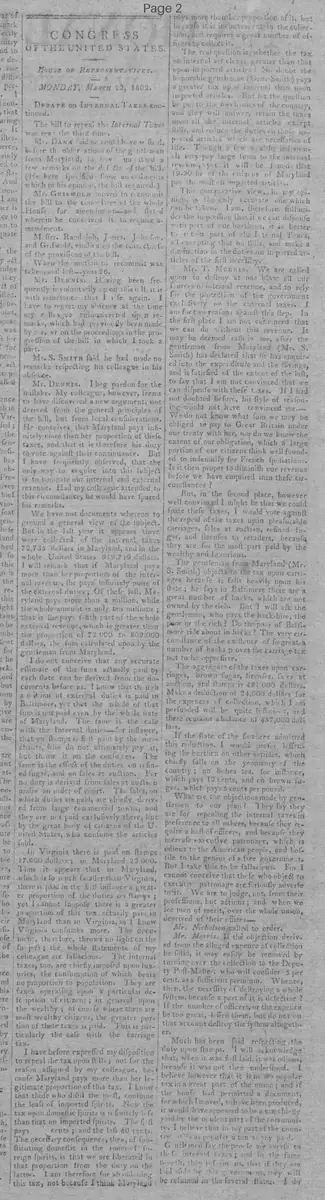
DEBATE ON INTERNAL TAXES Continued.
The bill to repeal the Internal Taxes was read the third time.
Mr. Dana said he could not have viewed the observations of the gentleman from Maryland, to have united a few remarks on the defects of the bill. (He here proposed some amendments which in his opinion, the bill required.)
Mr. Griswold moved to recommit the bill to the committee of the whole House for amendment--and stated wherein he conceived it to require amendment.
Messrs. Randolph, Jones, Hunter, and Griswold, vindicated the correctness of the provisions of the bill.
When the motion to recommit was taken, and lost--yeas 26.
Mr. Dennis. Having been frequently and involuntarily upon this bill, it is with reluctance that I rise again. I have to regret my absence at the time my colleague animadverted upon remarks, which had previously been made by me, or on the proceedings in the progression of the bill in which I took a part.
Mr. S. Smith said he had made no remarks respecting his colleague in his absence.
Mr. Dennis. I beg pardon for the mistake. My colleague, however, seems to have discovered a new argument, not derived from the general principles of the bill, but from local considerations. He conceives that Maryland pays infinitely more than her proportion of these taxes, and that it is therefore his duty to vote against their continuance. But I have frequently observed, that the only way to enquire into this subject is to compare our internal and external revenue. And my colleague attended to this circumstance, he would have spared his remarks. We have not documents whereon to ground a general view of the subject. But in the last year it appears there were collected of the internal taxes 72,735 dollars in Maryland, and in the whole United States 919,719 dollars. I will remark that if Maryland pays more than her proportion of the internal revenue, she pays infinitely more of the external duties; Of these last, Maryland pays more than a million, while the whole amount is only ten millions ; that is she pays 1-10th part of the whole external revenue, which is greater than the proportion of 72,000 to 809,000 dollars, the sum calculated upon by the gentleman from Maryland. I do not conceive that any accurate estimate of the sums actually paid by each state can be derived from the documents before us. I know that though a million of external duties is paid in Baltimore, yet that the whole of that sum is not paid even by the whole state of Maryland. The same is the case with the Internal duties-for instance, that on stamps is first paid by the merchants, who do not ultimately pay it, but throw it on the consumer. The same is the effect of the duties on refined sugar, and on sales at auction. For no duty is derived from sales at auction under an order of court. The sales, on which duties are paid, are chiefly derived from large commercial towns, and they are not paid exclusively there, but by the great body of citizens of the United States, who consume the articles sold. In Virginia there is paid on stamps 17,000 dollars; in Maryland 23,000. Thus it appears that in Maryland, which is so much smaller than Virginia, there is paid in the last instance a greater proportion of the duties on stamps ; yet I cannot suppose there is a greater proportion of this tax actually paid in Maryland than in Virginia, as I know Virginia consumes more. The documents, therefore, throws no light on the subject; the whole statements of my colleague are fallacious. The internal taxes, too, are chiefly imposed upon luxuries, the consumption of which bears no proportion to population. They are taxes operating upon a particular description of citizens; in general upon the wealthy ; of course where there are most wealthy citizens, the greater portion of these taxes is paid. This is particularly the case with the carriage tax. I have before expressed my disposition to repeal the tax upon stills ; not for the reason assigned by my colleague, because Maryland pays more than her legitimate proportion of this tax. I know that those who distill the most, consume the least of imported spirits. Now the tax upon domestic spirits is infinitely less than that on imported spirits. The first pays 8 cents ; and the last 40 cents. The necessary consequence, then, of substituting domestic in the room of foreign spirits, is that we are liberated in that proportion from the duty on the latter. I am therefore for abandoning this tax, not because I think Maryland pays more than her proportion of it, but because it is inconvenient in the collection, and requires a great number of officers to collect it. The real question is whether the tax on internal articles is greater than that upon imported articles? No doubt the honorable gentleman (Gen. Smith) says a greater tax upon internal than upon imported articles. But let the question be put to the mechanics of the country, and they will answer, retain the taxes upon all the internal articles except stills, and reduce the duties on those imported articles which are necessaries of life. Though a few wealthy individuals may pay large sums to the internal revenue, yet it will be found that 19-20ths of the citizens of Maryland pay the most on imported articles. This comparative view, in my opinion, is the only accurate one which can be taken. I am, therefore, still under the impression that if we can dispense with part of our burdens, it is better to it in part of the Internal Taxes, all excepting that on stills, and make a diminution in the duties on imported articles of the first necessity.
Mr. T. Morris. We are called upon to destroy at one blow all our sources of internal revenue, and to rely for the protection of the government exclusively on the external taxes. I am for two reasons against this step. In the first place I am not convinced that we can do without this revenue. It may be deemed rash in me, after the gentleman from Maryland (Mr. S. Smith) has declared that he has enquired into the expenditure and the savings, and is satisfied of the extent of the last, to say that I am not convinced that we can dispense with these taxes. If I had not doubted before, his style of reasoning would not have convinced me.-- We do not know what sum we may be obliged to pay to Great Britain under our treaty with her, nor do we know the extent of our obligation, which a large portion of our citizens think well founded to indemnify for French spoliations. Is it then proper to diminish our revenue before we have enquired into these circumstances? But, in the second place, however well convinced I might be that we could pare these taxes, I would vote against the repeal of the taxes upon pleasurable carriages, sales at auction, refined sugar, and licenses to retailers, because they are for the most part paid by the wealthy and luxurious. The gentleman from Maryland (Mr. S. Smith) objects to the tax upon carriages because it falls heavily upon his state; he says in Baltimore there are a great number of hacks, which are not owned by the rich. But I will ask the gentleman, who pays the hack-hire, the poor or the rich ? Do the poor of Baltimore ride about in hacks ? The very circumstance of the existence of so great a number of hacks proves the carriage tax not to be oppressive. The aggregate of the taxes upon carriages, brown sugar, licenses, sales at auction, and stamps is 481,000 dollars. Make a deduction of 24,000 dollars for the expenses of collection, which I am persuaded will be quite sufficient, and there remains a balance of 457,000 dollars. If the state of the finances admitted this reduction, I would prefer lessening the burthen on other articles, which chiefly falls on the yeomanry of the country; on hyson tea, for instance, which pays 12 cents, and on brown sugar, which pays 5 cents per pound. What are the objections made by gentlemen to our plan? They say they are for repealing the internal taxes in preference to all others, because they require a host of officers, and because they increase executive patronage, which is odious to the American people, and hostile to the genius of a free government. But I take this to be fallacious. For I cannot conceive that those who object to executive patronage are seriously adverse to it. We are to judge, not from their professions, but actions; and when we see men of merit, over the whole union, deprived of their offices--
Mr. Nicholson called to order.
Mr. Morris. If the objection derived from the alleged expense of collection be solid, it may easily be removed by turning over the collection to the Deputy Post-Master, who will consider 5 per cent. as a sufficient premium. Whence, then, the necessity of destroying a whole system, because a part of it is defective ? If the number of officers, or the expense be too great, I envy them, but do not on that account destroy the system altogether. Much has been said respecting the duty upon stamps. I will acknowledge that, when it was first laid, it was odious, because it was not then understood. I believe however that it is now a popular tax in a great part of the union; and if the house had permitted a document, for which I moved, to have been produced, it would have appeared to be a tax chiefly paid by the opulent part of the community. I believe that in my part of the country it is as popular a tax as any paid. Gentlemen say the people are averse to the internal taxes; and in the same breath, they inform us, that if they are laid aside by this government, they will be resumed in the several states. I do not know that in some of the states they are so little liked, that there is a double tax, one laid by the states, and the other by the United States. This of itself is sufficient to prove that the disposition of the country is not against them.
Had gentlemen convinced me that we could dispense with the tax on stills, I would have agreed to abandon it. But they have not convinced me, and I am not, therefore, in favour of abandoning it. But if they are willing to double the tax on the other five sources of internal revenue, I will join them in taking off the duty on stills.
A strange charge is brought by gentlemen. They accuse us with courting popularity. But how long is it, since in the estimation of gentlemen it has been a crime to appeal to the sentiments of their constituents? What! if it is deemed by a part of the House that a tax should be taken off of some articles, though the majority are for taking it off of others, are we to be called base courters of popularity, when we address our remarks, not only to the sober sense of this House, but also to that of the people? If the charge of courting popularity apply anywhere, it is to the President. Was it proper in him to designate any particular tax as a fit one to be removed? I must say that this was going beyond his duty. For as all revenue systems must originate in this house, it rested with us exclusively to originate as well as decide whatever relates to revenue.
I have another objection to the repeal; should war, or any other untoward event, occur, I ask what resource is there left to which we can resort? If such untoward events should occur, we cannot resort to our taxes on articles of luxury, for the means of indulgence will be gone. We must resort to excises. It is owing to the flourishing situation of the country, that we are now enabled to tax luxuries. But when they cease to be consumed, we must resort to objects of prime necessity. I ask, then, if the situation of the country is such as to warrant this abandonment of all our internal sources? Do we not know that a formidable foreign power is to settle on our frontier. Do we not know that a nation, not the most tranquil is to take possession of Louisiana and Florida? Are we then, in such critical circumstances, to squander away our revenues?
[Debate to be continued.]
What sub-type of article is it?
What keywords are associated?
What entities or persons were involved?
Where did it happen?
Story Details
Key Persons
Location
House Of Representatives
Event Date
Monday, March 22, 1802
Story Details
Debate on bill to repeal internal taxes; amendments proposed and rejected; arguments on state proportions of revenue, burdens on wealthy vs. poor, collection costs, and need for revenue amid potential international obligations.