Thank you for visiting SNEWPapers!
Sign up free
Letter to Editor
August 3, 1821
The Rhode Island American, And General Advertiser
Providence, Providence County, Rhode Island
What is this article about?
Rooke writes to defend Woodeson's legal commentary on replevin in Massachusetts against Amicus Justitiae's criticisms, affirming the accuracy of cited cases and warning of potential abuses in the process allowing property seizure and sale without full recourse.
Clipping
OCR Quality
98%
Excellent
Full Text
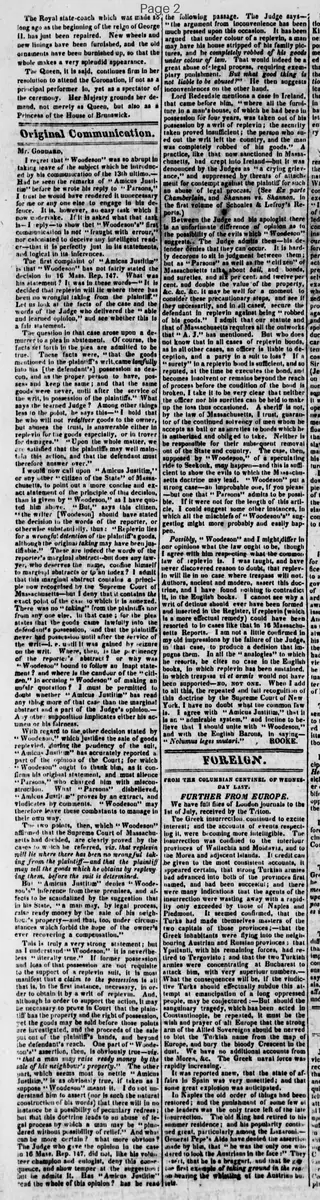
Original Communication.
Mr. GODDARD,
I regret that "Woodeson" was so abrupt in taking leave of the object which he introduced by his communication of the 13th ultimo. Had he seen the remarks of "Amicus Justitiae" before he wrote his reply to "Parsons," I trust he would have rendered it unnecessary for me or any one else to engage in his defence. It is, however, an easy task which now undertake. If it is asked what that task is—I reply—to show that "Woodeson's" first communication is not "fraught with error," nor calculated to deceive any intelligent reader—that it is perfectly just in its statements, and logical in its inferences.
The first complaint of "Amicus Justitiae" is that "Woodeson" has not fairly stated the decision in 16 Mass. Rep. 147. What was his statement? It was in these words—“It is decided that replevin will lie where there has been no wrongful taking from the plaintiff."
Let us look at the facts of the case and the words of the Judge who delivered the "able and learned opinion," and see whether this is a fair statement.
"The question in that case arose upon a demurrer to a plea in abatement. Of course, the facts set forth in the plea are admitted to be true. These facts were, "that the goods mentioned in the plaintiff's writ, came lawfully into his [the defendant's] possession as deacon, and as the proper person to have, possess and keep the same; and that the same goods were never, until after the service of the writ, in possession of the plaintiffs." What says the learned Judge? Among other things less to the point, he says this—“I hold that he who will not redeliver goods to the owner, but abuses the trust, is answerable either in replevin for the goods themselves, or in trover for damages." "Upon the whole matter, we are satisfied that the plaintiffs may well maintain this action, and that the defendant must therefore answer over."
I would now call upon "Amicus Justitiae," or any other "citizen of the State" of Massachusetts, to point out a more concise and exact statement of the principle of this decision, than is given by "Woodeson," as I have quoted him above. "But," says this citizen, "the writer [Woodeson] should have stated the decision in the words of the reporter, or otherwise substantially, thus: 'Replevin lies for a wrongful detention of the plaintiff's goods, although the original taking may have been justifiable.'" These are indeed the words of the reporter's marginal abstract—but does any lawyer, who deserves the name, confine himself to marginal abstracts or to an index? I admit that this marginal abstract contains a principle now recognised by the Supreme Court of Massachusetts—but I deny that it contains the exact point of the case to which it is annexed. There was no "taking" from the plaintiffs nor from any one else, in that case; for the plea states that the goods came lawfully into the defendant's possession, and that the plaintiffs never had possession until after the service of the writ—i.e. until it was gained by seizure on the writ. Where, then, is the pertinency of the reporter's abstract? or why was "Woodeson" bound to follow an inapt statement? and where is the candour of the "citizen," in accusing "Woodeson" of making an unfair quotation? I must be permitted to doubt whether "Amicus Justitiae" has read any thing more of that case than the marginal abstract and a part of the Judge's opinion. Any other supposition implicates either his acumen or his fairness.
With regard to the other decision stated by "Woodeson," which justifies the sale of goods replevied, during the pendency of the suit, "Amicus Justitiae" has accurately reported a part of the opinion of the Court; or which "Woodeson" ought to thank him, as it confirms his original statement, and must silence "Parsons," who charged him with misconstruing. What "Parsons" disbelieved, "Amicus Justitiae" proves by an extract, and vindicates by comments. "Woodeson" may therefore leave these combatants to manage in their own way.
The two points, then, which "Woodeson" affirmed that the Supreme Court of Massachusetts had decided, are clearly proved by the cases to which he referred, viz. that replevin will lie where there has been no wrongful taking from the plaintiff—and that the plaintiff may sell the goods which he obtains by replevying them, before the suit is determined.
But "Amicus Justitiae" denies "Woodeson's" inference from these premises, and affects to be scandalized by the suggestion that in his State, "a man may, by legal process, raise ready money by the sale of his neighbour's property—and that, too, under circumstances which forbid the hope of the owner's ever recovering a compensation."
This is truly a very strong statement; but as I understand—“Woodeson," it is nevertheless "literally true." If former possession and loss of that possession are not requisite to the support of a replevin suit, it is most manifest that a claim to the possession is all that is, in the first instance, necessary, in order to obtain it by a writ of replevin. And, although in order to support the action, it may be necessary to prove in Court that the plaintiff has the property and the right of possession, yet the goods may be sold before those points are investigated, and the proceeds of the sale put out of the plaintiff's hands, and beyond the defendant's reach. One part of "Woodeson's" assertion, then, is obviously true—viz. "that a man may raise ready money by the sale of his neighbour's property." The other part, which seems most to nettle "Amicus Justitiae," is as obviously true, if taken as I suppose "Woodeson" meant it. I do not understand him to assert (nor is such the natural construction of his words) that there will in no instance be a possibility of pecuniary redress; but that this doctrine leads to an abuse of legal process by which a man may be "plundered without possibility of relief." And what can be more certain? what more obvious?
The Judge who gave the opinion in the case 16 Mass. Rep. 147, did not, like his volunteer champion and eulogist, deny this consequence, and allow temper at the suggestion; but he admits it. Has "Amicus Justitiae" read the whole of this opinion? has he read the following passage. The Judge says—
"The argument from inconvenience has been much pressed upon this occasion. It has been argued that under colour of a replevin, a man may have his house stripped of his family pictures, and be completely robbed of his goods under colour of law. That would indeed be a great abuse of legal process, requiring exemplary punishment. But what good thing is not liable to be abused?" He then suggests inconveniences on the other hand.
Lord Redesdale mentions a case in Ireland, that came before him, "where all the furniture in a man's house, of which he had been in possession for four years, was taken out of his possession by a writ of replevin; the security taken proved insufficient; the person who sued out the writ left the country, and the man was completely robbed of his goods." A practice, like that now sanctioned in Massachusetts, had crept into Ireland—but it was denounced by the Judges as "a crying grievance," and suppressed by threats of attachment for contempt against the plaintiff or such an abuse of legal process. (See Ex parte Chamberlain, and Shannon vs. Shannon, in the first volume of Schoales & Lefroy's Reports.)
Between the Judge and his apologist there is an unfortunate difference of opinion as to the possibility of the evils which "Woodeson" suggests. The Judge admits them—his defender denies that they can occur. It is hardly decorous to sit in judgment between them; but as "Parsons" as well as the "citizen" of Massachusetts talk about bail, and bonds, and sureties, and six per cent. and twelve per cent. and double the value of the property, &c. &c. &c. it may be well for a moment to consider these precautionary steps, and see if they necessarily, and in all cases, secure the defendant in replevin against being "robbed of his goods." I admit that our statute and that of Massachusetts requires all the outworks that "A. J." has mentioned. But who does not know that in all cases of replevin bonds, as in all other cases, an officer is liable to deception, and a party in a suit to loss? If a "surety" in a replevin bond is sufficient, and so reputed, at the time he executes the bond, and becomes insolvent or removes beyond the reach of process before the condition of the bond is broken, I take it to be very clear that neither the officer nor his sureties can be held to make up the loss thus occasioned. A sheriff is not, by the law of Massachusetts, I trust, guarantor of the continued solvency of men whom he accepts as bail or as sureties to bonds which he is authorized and obliged to take. Neither is he responsible for their subsequent removal out of the State and country. The case, then, supposed by "Woodeson," of a speculating ride to Seekonk, may happen—and this is sufficient to show the evils to which the Massachusetts doctrine may lead. "Woodeson" put a strong case—an improbable one, if you please—but one that "Parsons" admits to be possible. If it were not for the length of this article, I could suggest some other instances, in which all the mischiefs of "Woodeson's" suggestion might more probably and easily happen.
Possibly, "Woodeson" and I might differ in our opinions what the law ought to be, though I agree with him respecting what the common law of replevin is. I was taught, and have never discovered reason to doubt, that replevin will lie in no case, where trespass will not. Authors, ancient and modern, assert this doctrine, and I have found nothing to contradict it, in the English books. I cannot see why a writ of detinue should ever have been formed and inserted in the Register, if replevin (which is a more effectual remedy) could have been resorted to in cases like that in 16 Massachusetts Reports. I am not a little confirmed in my old impressions by the failure of the Judge, in that case, to produce a decision that impugns them. In all the "analogies" to which he resorts, he cites no case in the English books, in which replevin has been sustained, in which trespass vi et armis would not have been supported—NO, NOT ONE. When I add to all this, the repeated and full recognition of this doctrine by the Supreme Court of New York, I have no doubt what the common law is. I agree with "Amicus Justitiae," that it is an "admirable system," and incline to believe that I should unite with "Woodeson," and with the English Barons, in saying—
"Nolumus leges mutari."
ROOKE.
Mr. GODDARD,
I regret that "Woodeson" was so abrupt in taking leave of the object which he introduced by his communication of the 13th ultimo. Had he seen the remarks of "Amicus Justitiae" before he wrote his reply to "Parsons," I trust he would have rendered it unnecessary for me or any one else to engage in his defence. It is, however, an easy task which now undertake. If it is asked what that task is—I reply—to show that "Woodeson's" first communication is not "fraught with error," nor calculated to deceive any intelligent reader—that it is perfectly just in its statements, and logical in its inferences.
The first complaint of "Amicus Justitiae" is that "Woodeson" has not fairly stated the decision in 16 Mass. Rep. 147. What was his statement? It was in these words—“It is decided that replevin will lie where there has been no wrongful taking from the plaintiff."
Let us look at the facts of the case and the words of the Judge who delivered the "able and learned opinion," and see whether this is a fair statement.
"The question in that case arose upon a demurrer to a plea in abatement. Of course, the facts set forth in the plea are admitted to be true. These facts were, "that the goods mentioned in the plaintiff's writ, came lawfully into his [the defendant's] possession as deacon, and as the proper person to have, possess and keep the same; and that the same goods were never, until after the service of the writ, in possession of the plaintiffs." What says the learned Judge? Among other things less to the point, he says this—“I hold that he who will not redeliver goods to the owner, but abuses the trust, is answerable either in replevin for the goods themselves, or in trover for damages." "Upon the whole matter, we are satisfied that the plaintiffs may well maintain this action, and that the defendant must therefore answer over."
I would now call upon "Amicus Justitiae," or any other "citizen of the State" of Massachusetts, to point out a more concise and exact statement of the principle of this decision, than is given by "Woodeson," as I have quoted him above. "But," says this citizen, "the writer [Woodeson] should have stated the decision in the words of the reporter, or otherwise substantially, thus: 'Replevin lies for a wrongful detention of the plaintiff's goods, although the original taking may have been justifiable.'" These are indeed the words of the reporter's marginal abstract—but does any lawyer, who deserves the name, confine himself to marginal abstracts or to an index? I admit that this marginal abstract contains a principle now recognised by the Supreme Court of Massachusetts—but I deny that it contains the exact point of the case to which it is annexed. There was no "taking" from the plaintiffs nor from any one else, in that case; for the plea states that the goods came lawfully into the defendant's possession, and that the plaintiffs never had possession until after the service of the writ—i.e. until it was gained by seizure on the writ. Where, then, is the pertinency of the reporter's abstract? or why was "Woodeson" bound to follow an inapt statement? and where is the candour of the "citizen," in accusing "Woodeson" of making an unfair quotation? I must be permitted to doubt whether "Amicus Justitiae" has read any thing more of that case than the marginal abstract and a part of the Judge's opinion. Any other supposition implicates either his acumen or his fairness.
With regard to the other decision stated by "Woodeson," which justifies the sale of goods replevied, during the pendency of the suit, "Amicus Justitiae" has accurately reported a part of the opinion of the Court; or which "Woodeson" ought to thank him, as it confirms his original statement, and must silence "Parsons," who charged him with misconstruing. What "Parsons" disbelieved, "Amicus Justitiae" proves by an extract, and vindicates by comments. "Woodeson" may therefore leave these combatants to manage in their own way.
The two points, then, which "Woodeson" affirmed that the Supreme Court of Massachusetts had decided, are clearly proved by the cases to which he referred, viz. that replevin will lie where there has been no wrongful taking from the plaintiff—and that the plaintiff may sell the goods which he obtains by replevying them, before the suit is determined.
But "Amicus Justitiae" denies "Woodeson's" inference from these premises, and affects to be scandalized by the suggestion that in his State, "a man may, by legal process, raise ready money by the sale of his neighbour's property—and that, too, under circumstances which forbid the hope of the owner's ever recovering a compensation."
This is truly a very strong statement; but as I understand—“Woodeson," it is nevertheless "literally true." If former possession and loss of that possession are not requisite to the support of a replevin suit, it is most manifest that a claim to the possession is all that is, in the first instance, necessary, in order to obtain it by a writ of replevin. And, although in order to support the action, it may be necessary to prove in Court that the plaintiff has the property and the right of possession, yet the goods may be sold before those points are investigated, and the proceeds of the sale put out of the plaintiff's hands, and beyond the defendant's reach. One part of "Woodeson's" assertion, then, is obviously true—viz. "that a man may raise ready money by the sale of his neighbour's property." The other part, which seems most to nettle "Amicus Justitiae," is as obviously true, if taken as I suppose "Woodeson" meant it. I do not understand him to assert (nor is such the natural construction of his words) that there will in no instance be a possibility of pecuniary redress; but that this doctrine leads to an abuse of legal process by which a man may be "plundered without possibility of relief." And what can be more certain? what more obvious?
The Judge who gave the opinion in the case 16 Mass. Rep. 147, did not, like his volunteer champion and eulogist, deny this consequence, and allow temper at the suggestion; but he admits it. Has "Amicus Justitiae" read the whole of this opinion? has he read the following passage. The Judge says—
"The argument from inconvenience has been much pressed upon this occasion. It has been argued that under colour of a replevin, a man may have his house stripped of his family pictures, and be completely robbed of his goods under colour of law. That would indeed be a great abuse of legal process, requiring exemplary punishment. But what good thing is not liable to be abused?" He then suggests inconveniences on the other hand.
Lord Redesdale mentions a case in Ireland, that came before him, "where all the furniture in a man's house, of which he had been in possession for four years, was taken out of his possession by a writ of replevin; the security taken proved insufficient; the person who sued out the writ left the country, and the man was completely robbed of his goods." A practice, like that now sanctioned in Massachusetts, had crept into Ireland—but it was denounced by the Judges as "a crying grievance," and suppressed by threats of attachment for contempt against the plaintiff or such an abuse of legal process. (See Ex parte Chamberlain, and Shannon vs. Shannon, in the first volume of Schoales & Lefroy's Reports.)
Between the Judge and his apologist there is an unfortunate difference of opinion as to the possibility of the evils which "Woodeson" suggests. The Judge admits them—his defender denies that they can occur. It is hardly decorous to sit in judgment between them; but as "Parsons" as well as the "citizen" of Massachusetts talk about bail, and bonds, and sureties, and six per cent. and twelve per cent. and double the value of the property, &c. &c. &c. it may be well for a moment to consider these precautionary steps, and see if they necessarily, and in all cases, secure the defendant in replevin against being "robbed of his goods." I admit that our statute and that of Massachusetts requires all the outworks that "A. J." has mentioned. But who does not know that in all cases of replevin bonds, as in all other cases, an officer is liable to deception, and a party in a suit to loss? If a "surety" in a replevin bond is sufficient, and so reputed, at the time he executes the bond, and becomes insolvent or removes beyond the reach of process before the condition of the bond is broken, I take it to be very clear that neither the officer nor his sureties can be held to make up the loss thus occasioned. A sheriff is not, by the law of Massachusetts, I trust, guarantor of the continued solvency of men whom he accepts as bail or as sureties to bonds which he is authorized and obliged to take. Neither is he responsible for their subsequent removal out of the State and country. The case, then, supposed by "Woodeson," of a speculating ride to Seekonk, may happen—and this is sufficient to show the evils to which the Massachusetts doctrine may lead. "Woodeson" put a strong case—an improbable one, if you please—but one that "Parsons" admits to be possible. If it were not for the length of this article, I could suggest some other instances, in which all the mischiefs of "Woodeson's" suggestion might more probably and easily happen.
Possibly, "Woodeson" and I might differ in our opinions what the law ought to be, though I agree with him respecting what the common law of replevin is. I was taught, and have never discovered reason to doubt, that replevin will lie in no case, where trespass will not. Authors, ancient and modern, assert this doctrine, and I have found nothing to contradict it, in the English books. I cannot see why a writ of detinue should ever have been formed and inserted in the Register, if replevin (which is a more effectual remedy) could have been resorted to in cases like that in 16 Massachusetts Reports. I am not a little confirmed in my old impressions by the failure of the Judge, in that case, to produce a decision that impugns them. In all the "analogies" to which he resorts, he cites no case in the English books, in which replevin has been sustained, in which trespass vi et armis would not have been supported—NO, NOT ONE. When I add to all this, the repeated and full recognition of this doctrine by the Supreme Court of New York, I have no doubt what the common law is. I agree with "Amicus Justitiae," that it is an "admirable system," and incline to believe that I should unite with "Woodeson," and with the English Barons, in saying—
"Nolumus leges mutari."
ROOKE.
What sub-type of article is it?
Persuasive
Informative
Historical
What themes does it cover?
Constitutional Rights
Morality
What keywords are associated?
Replevin
Massachusetts Law
Woodeson
Amicus Justitiae
Legal Process Abuse
Common Law
Property Rights
Court Decisions
What entities or persons were involved?
Rooke.
Mr. Goddard,
Letter to Editor Details
Author
Rooke.
Recipient
Mr. Goddard,
Main Argument
rooke defends woodeson's analysis of massachusetts replevin decisions as accurate and logical, refuting amicus justitiae's claims of error and unfair statements, and argues that the law allows potential abuse of process by enabling sale of goods without wrongful taking.
Notable Details
Cites 16 Mass. Rep. 147 Decision
Quotes Judge On Replevin Without Redelivery Of Goods
References Lord Redesdale's Irish Case On Replevin Abuse
Mentions New York Supreme Court Recognition Of Common Law Doctrine
Discusses Replevin Bonds And Sureties Limitations