Thank you for visiting SNEWPapers!
Sign up free
Norfolk Gazette And Publick Ledger
Norfolk, Virginia
What is this article about?
In August 1807, Denmark declares war on England after rejecting British demands for an offensive alliance and control of the Danish fleet, Copenhagen, and Cronenburg. The Prince Royal organizes defenses, escapes English cruisers, and rallies the population against the 'atrocious' aggression, with King Christian VII issuing a proclamation to seize English property and arrest subjects.
Clipping
OCR Quality
Full Text
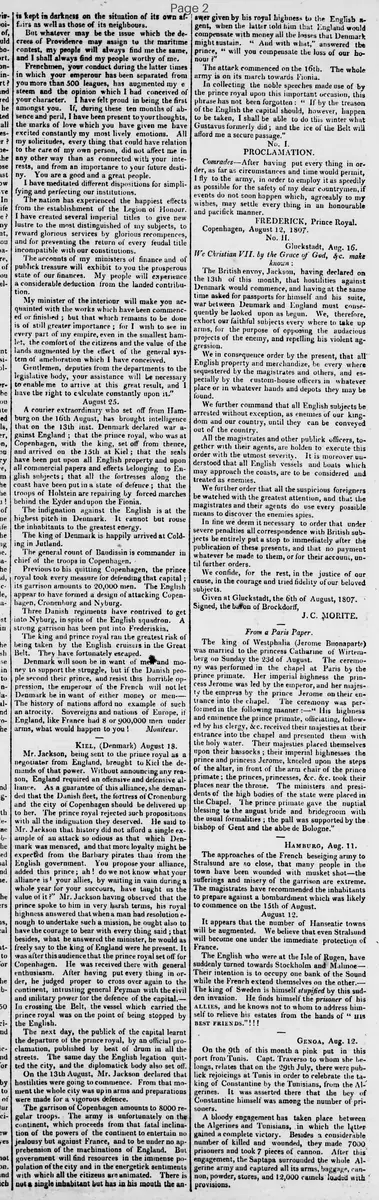
A courier extraordinary who set off from Hamburg on the 16th August, has brought intelligence that on the 13th inst. Denmark declared war against England; that the prince royal, who was at Copenhagen, with the king, set off from thence, and arrived on the 15th at Kiel; that the seals have been put upon all English property and upon all commercial papers and effects belonging to English subjects; that all the fortresses along the coast have been put in a state of defence; that the troops of Holstein are repairing by forced marches behind the Eyder and upon the Fionia.
The indignation against the English is at the highest pitch in Denmark. It cannot but rouse the inhabitants to the greatest energy.
The king of Denmark is happily arrived at Colding in Jutland.
The general count of Baudissin is commander in chief of the troops in Copenhagen.
Previous to his quitting Copenhagen, the prince royal took every measure for defending that capital; its garrison amounts to 20,000 men. The English appear to have formed a design of attacking Copenhagen, Cronenburg and Nyburg.
Three Danish regiments have contrived to get into Nyburg, in spite of the English squadron. A strong garrison has been put into Frederiksvaerk.
The king and prince royal ran the greatest risk of being taken by the English cruisers in the Great Belt. They have fortunately escaped.
Denmark will soon be in want of men and money to support the struggle, but if the Danish people second their prince, and resist this horrible oppression, the emperor of the French will not let Denmark be in want of either money or men---
The history of nations afford no example of such an atrocity. Sovereigns and nations of Europe, if England, like France had 8 or 900,000 men under arms, what would happen to you!
Moniteur.
KIEL, (Denmark) August 18.
Mr. Jackson, being sent to the prince royal as a negotiator from England, brought to Kiel the demands of that power. Without announcing any reason, England required an offensive and defensive alliance. As a guarantee of this alliance, she demanded that the Danish fleet, the fortress of Cronenburg and the city of Copenhagen should be delivered up to her. The prince royal rejected such propositions with all the indignation they deserved. He said to Mr. Jackson that history did not afford a single example of an attack so odious as that with which Denmark was menaced, and that more loyalty might be expected from the Barbary pirates than from the English government. You propose your alliance, added this prince; ah! do we not know what your alliance is? your allies, by waiting in vain during a whole year for your succours, have taught us the value of it? Mr. Jackson having observed that the prince spoke to him in very harsh terms, his royal highness answered that when a man had resolution enough to undertake such a mission, he ought also to have the courage to bear with every thing said; that besides, what he answered the minister, he would as freely say to the king of England were he present. It was after this audience that the prince royal set off for Copenhagen. He was received there with general enthusiasm. After having put every thing in order, he judged proper to cross over again to the continent, intrusting general Peyman with the civil and military power for the defence of the capital. In crossing the Belt, the vessel which carried the prince royal was on the point of being stopped by the English.
The next day, the public of the capital learnt the departure of the prince royal, by an official proclamation, published by beat of drum in all the streets. The same day the English legation quitted the city, and the diplomatic body also set off.
On the 13th August, Mr. Jackson declared that hostilities were going to commence. From that moment the whole city was up in arms and preparations were made for a vigorous defence.
The garrison of Copenhagen amounts to 8000 regular troops. The army is unfortunately on the continent, which proceeds from that fatal inclination of the powers of the continent to entertain no jealousy but against France, and to be under no apprehension of the machinations of England. But government will find resources in the immense population of the city and in the energetick sentiments with which all the citizens are animated. There is not a single inhabitant but has in his mouth the answer given by his royal highness to the English agent, when the latter told him that England would compensate with money all the losses that Denmark might sustain. "And with what," answered the prince, "will you compensate the loss of our honour?"
The attack commenced on the 16th. The whole army is on its march towards Fionia.
In collecting the noble speeches made use of by the prince royal upon this important occasion, this phrase has not been forgotten: "If by the treason of the English the capital should, however, happen to be taken, I shall be able to do this winter what Gustavus formerly did; and the ice of the Belt will afford me a secure passage."
No. I.
PROCLAMATION.
Comrades--After having put every thing in order, as far as circumstances and time would permit, I fly to the army, in order to employ it as speedily as possible for the safety of my dear countrymen, if events do not soon happen which, agreeably to my wishes, may settle every thing in an honourable and pacifick manner.
FREDERICK, Prince Royal.
Copenhagen, August 12, 1807.
No. II.
Gluckstadt, Aug. 16.
We Christian VII. by the Grace of God, &c. make known:
The British envoy, Jackson, having declared on the 13th of this month, that hostilities against Denmark would commence, and having at the same time asked for passports for himself and his suite, war between Denmark and England must consequently be looked upon as begun. We, therefore, exhort our faithful subjects every where to take up arms, for the purpose of opposing the audacious projects of the enemy, and repelling his violent aggression.
We in consequence order by the present, that all English property and merchandize, be every where sequestered by the magistrates and others, and especially by the custom-house officers in whatever place or in whatever hands and depots they may be found.
We further command that all English subjects be arrested without exception, as enemies of our kingdom and our country, until they can be conveyed out of the country.
All the magistrates and other publick officers, together with their agents, are holden to execute this order with the utmost severity. It is moreover understood that all English vessels and boats which may approach the coasts, are to be considered and treated as enemies.
We further order that all the suspicious foreigners be watched with the greatest attention, and that the magistrates and their agents do use every possible means to discover the enemies spies.
In fine we deem it necessary to order that under severe penalties all correspondence with British subjects be entirely put a stop to immediately after the publication of these presents, and that no payment whatever be made to them, or for their account, until further orders.
We confide, for the rest, in the justice of our cause, in the courage and tried fidelity of our beloved subjects.
Given at Gluckstadt, the 6th of August, 1807.
Signed, the baton of Brockdorff,
J.C. MORITE.
What sub-type of article is it?
What keywords are associated?
What entities or persons were involved?
Where did it happen?
Foreign News Details
Primary Location
Denmark
Event Date
August 1807
Key Persons
Outcome
denmark declares war on england; english property sequestered and subjects arrested; defenses prepared in copenhagen and other fortresses; prince royal and king escape english cruisers; attack on copenhagen commences on the 16th.
Event Details
A courier from Hamburg reports Denmark's declaration of war on England on August 13, 1807, following rejection of British demands for alliance and control of Danish fleet, Copenhagen, and Cronenburg. Prince Royal rejects propositions indignantly, organizes Copenhagen's defense with 8,000-20,000 troops, entrusts General Peyman, and escapes to the continent. King issues proclamation to seize English assets, arrest subjects, and prepare for hostilities. Public outrage high; French support anticipated.