Thank you for visiting SNEWPapers!
Sign up free
The Massachusetts Spy, And Worcester County Advertiser
Worcester, Worcester County, Massachusetts
What is this article about?
Hon. Austin E. Wing's letter to the Committee on Territories details the proposed Territory of Huron's population growth to 10-15,000, lead mining on Mississippi, Wisconsin, and Fever Rivers, agricultural and commercial settlements at Green Bay, and economic potential from land sales and minerals, advocating for its organization.
Clipping
OCR Quality
Full Text
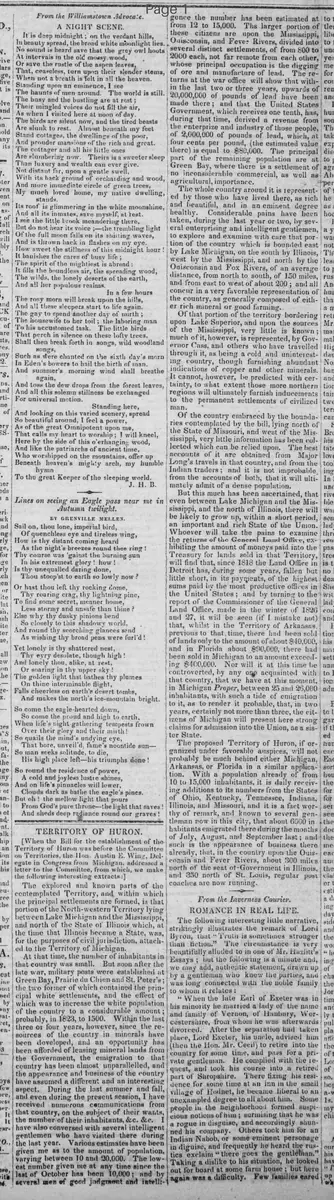
[When the Bill for the establishment of the Territory of Huron was before the Committee on Territories, the Hon. Austin E. Wing, Delegate in Congress from Michigan, addressed a letter to the Committee, from which, we make the following interesting extracts:]
The explored and known parts of the contemplated Territory, and within which the principal settlements are formed, is that portion of the North-western Territory lying between Lake Michigan and the Mississippi, and north of the State of Illinois which, at the time that Illinois became a State, was, for the purposes of civil jurisdiction, attached to the Territory of Michigan.
At that time, the number of inhabitants in that country was small. But soon after the late war, military posts were established at Green Bay, Prairie du Chien and St. Peter's; the two former of which contained the principal white settlements, and the effect of which was to increase the white population of the country to a considerable amount; probably, in 1823, to 1500. Within the last three or four years, however, since the resources of the country in minerals have been developed, and an opportunity has been afforded of leasing mineral lands from the Government, the emigration to that country has been almost unparallelled, and the appearance and business of the country have assumed a different and an interesting aspect. During the last summer and fall, and even during the present session, I have received numerous communications from that country, on the subject of their wants, the number of their inhabitants, &c. &c. I have also conversed with several intelligent gentlemen who have visited there during the last year. Various estimates have been given me as to the amount of population, varying between 10 and 20,000. The lowest number given me at any time since the last of October has been 10,000; and by several men of good judgment and intelligence the number has been estimated at from 12 to 15,000. The larger portion of these citizens are upon the Mississippi, Wisconsin, and Fever Rivers, divided into several distinct settlements, of from 800 to 2000 each, not far remote from each other, whose principal occupation is the digging of ore and manufacture of lead. The returns at the war office will show that within the last two or three years, upwards of 20,000,000 of pounds of lead have been made there; and that the United States Government, which receives one tenth, has, during that time, derived a revenue from the enterprize and industry of those people, of 2,000,000 of pounds of lead, which, at four cents per pound, (the estimated value there) is equal to $80,000. The principal part of the remaining population are at Green Bay, where there is a settlement of no inconsiderable commercial, as well as agricultural, importance.
The whole country around it is represented by those who have lived there, as rich and beautiful, and in an eminent degree healthy. Considerable pains have been taken, during the last year or two, by several enterprising and intelligent gentlemen, to explore and examine with care that portion of the country which is bounded east by Lake Michigan, on the south by Illinois, west by the Mississippi, and north by the Wisconsin and Fox Rivers, of an average distance, from north to south, of 150 miles, and from east to west of about 200; and all concur in a very favorable representation of the country, as generally composed of either rich mineral or good farming.
Of that portion of the territory bordering upon Lake Superior, and upon the sources of the Mississippi, very little is known: much of it, however, is represented, by Governor Cass, and others who have travelled through it, as being a cold and uninteresting country, though furnishing abundant indications of copper and other minerals. It cannot, however, be predicted with certainty, to what extent those more northern regions will ultimately furnish inducements to the permanent settlements of civilized man.
Of the country embraced by the boundaries contemplated by the bill, lying north of the State of Missouri, and west of the Mississippi, very little information has been collected which can be relied upon. The best accounts of it are obtained from Major Long's travels in that country, and from the Indian traders; and it is not improbable from the accounts of both, that it will ultimately admit of a dense population.
But this much has been ascertained, that even between Lake Michigan and the Mississippi, and north of Illinois, there will be likely to grow up, within a short period, an important and rich State of the Union. Whoever will take the pains to examine the returns of the General Land Office, exhibiting the amount of moneys paid into the Treasury for lands sold in that Territory, will find that, since 1818 the Land Office in Detroit has, during some years, fallen but little short, in its payments, of the highest sums paid by the most productive offices in the United States: and by turning to the report of the Commissioner of the General Land Office, made in the winter of 1826 and 27, it will be seen (if I mistake not) that, whilst in the Territory of Arkansas, previous to that time, there had been sold of lands only to the amount of about $40,000, and in Florida about $90,000, there had been sold in Michigan to an amount exceeding $400,000. Nor will it at this time be controverted, by any one acquainted with that country, that we have at this moment, in Michigan Proper, between 25 and 26,000 inhabitants, with such a tide of emigration to it, as to render it probable, that, in two years, certainly not more than three, the citizens of Michigan will present here strong claims for admission into the Union, as a sister State.
The proposed Territory of Huron, if organized under favorable auspices, will not probably be much behind either Michigan, Arkansas, or Florida in a similar application. With a population already of from 10 to 15,000 inhabitants, it is daily receiving additions to its numbers from the States of Ohio, Kentucky, Tennessee, Indiana, Illinois, and Missouri, and it is a fact worthy of remark, and known to several gentlemen now in this city, that about 6000 inhabitants emigrated there during the months of July, August, and September last; and such is the appearance of business there already, that, in the country upon the Wisconsin and Fever Rivers, about 300 miles north of the seat of Government in Illinois, and 350 north of St. Louis, regular post coaches are now running.
What sub-type of article is it?
What keywords are associated?
What entities or persons were involved?
Where did it happen?
Domestic News Details
Primary Location
Territory Of Huron
Key Persons
Outcome
population estimated at 10-15,000; over 20,000,000 pounds of lead produced in last 2-3 years, yielding $80,000 revenue to u.s. government; rapid emigration including 6,000 in july-september; potential for statehood in 2-3 years.
Event Details
Letter from Hon. Austin E. Wing to Committee on Territories advocating for Bill establishing Territory of Huron, describing settlements, population growth due to mineral leasing and lead mining on Mississippi, Wisconsin, and Fever Rivers, agricultural and commercial importance at Green Bay, land sales exceeding $400,000 since 1818, and favorable geography for farming and minerals.