Thank you for visiting SNEWPapers!
Sign up free
Richmond Enquirer
Richmond, Richmond County, Virginia
What is this article about?
Reports on U.S. House and Senate proceedings from Jan. 27 to Feb. 25, 1820, centered on debates and votes over admitting Maine and Missouri as states, including opposition to slavery restrictions in Missouri Territory; features speeches by Holmes and Randolph, rejection of Senate amendments linking the bills, and passage of the restriction (102-98); also covers minor resolutions on lands, boundaries, and expenses.
Merged-components note: Merged sequential components spanning pages 1-2 that form a continuous report on the congressional debate regarding the Missouri Bill.
Clippings
1 of 2
OCR Quality
Full Text
(Reported for the National Intelligencer,)
DEBATE in the HOUSE OF REPRESENTATIVES.
ON THE MISSOURI BILL,
THURSDAY, JANUARY 27.
(Mr. Holmes in continuation,)
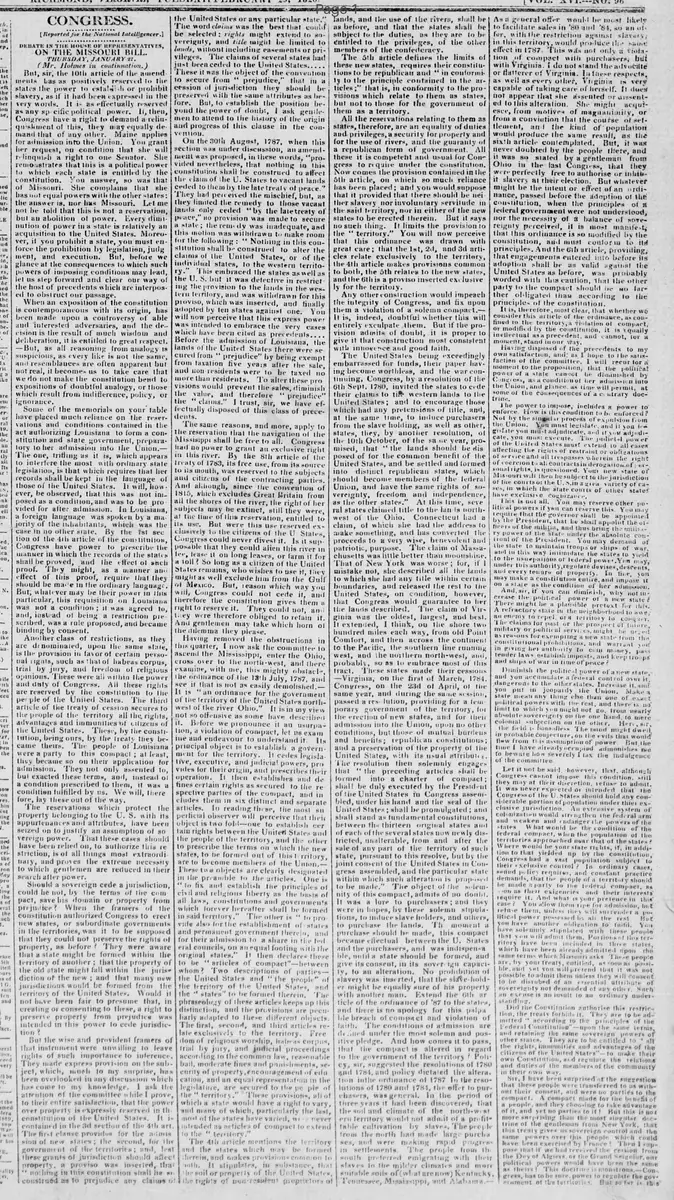
But, sir, the 10th article of the amendments has as positively reserved to the states the power to establish or prohibit slavery, as if it had been expressed in the very words. It is as effectually reserved as any specific political power. If, then, Congress have a right to demand a relinquishment of this, they may equally demand that of any other. Maine applies for admission into the Union. You grant her request, on condition that she will relinquish a right to one Senator. She remonstrates that this is a political power to which each state is entitled by the constitution. You answer, so was that of Missouri. She complains that she has no equal powers with the other states: the answer is, nor has Missouri. Let me not be told that this is not a reservation, but an abolition of power. Every diminution of power in a state is relatively an acquisition to the United States. Moreover, if you prohibit a state, you must enforce the prohibition by legislation, judgment, and execution. But, before we glance at the consequences to which such powers of imposing conditions may lead, let us step forward and clear our way of the host of precedents which are interposed to obstruct our passage.
When an exposition of the constitution is contemporaneous with its origin, has been made upon a controversy of able and interested adversaries, and the decision is the result of much wisdom and deliberation, it is entitled to great respect.—But, as all reasoning from analogy is suspicious, as every like is not the same, and resemblances are often apparent but not real, it becomes us to take care that we do not make the constitution bend to expositions of doubtful analogy, or those which result from indifference, policy, or ignorance.
Some of the memorials on your table have placed much reliance on the reservations and conditions contained in the act authorizing Louisiana to form a constitution and state government, preparatory to her admission into the Union.—The one, trifling as it is, which appears to interfere the most with ordinary state legislation, is that which requires that her records shall be kept in the language of those of the United States. It will, however, be observed, that this was not imposed as a condition, and was to be provided for after admission. In Louisiana, a foreign language was spoken by a majority of the inhabitants, which was the case in no other state. By the 1st section of the 4th article of the constitution, Congress have power to prescribe the manner in which the records of the states shall be proved, and the effect of such proof. They might, as a manner and effect of this proof, require that they should be made in the ordinary language. But, whatever may be their power in this particular, this requisition on Louisiana was not a condition; it was agreed to, and, instead of being a restriction prescribed, was a rule proposed, and became binding by consent.
Another class of restrictions, as they are denominated, upon the same state, is the provision in favor of certain personal rights, such as that of habeas corpus, trial by jury, and freedom of religious opinions. These were all within the power and duty of Congress. All these rights are reserved by the constitution to the people of the United States. The third article of the treaty of cession secures to the people of the territory all their rights, advantages and immunities of citizens of the United States. These, by the constitution, being ours, by the treaty they became theirs. The people of Louisiana were a party to this compact; at least, they became so on their application for admission. They not only assented to, but exacted these terms, and, instead of a condition prescribed to them, it was a condition fulfilled by us. We will, therefore, lay these out of the way.
The reservations which protect the property belonging to the U. S. with its appurtenances and attributes, have been seized onto justify an assumption of so sovereign power. That these cases should have been relied on, to authorize this restriction, is of all things most extraordinary, and proves the extreme necessity to which gentlemen are reduced in their search after power.
Should a sovereign cede a jurisdiction, could he not, by the terms of the compact, save his domain or property from prejudice? When the framers of the constitution authorized Congress to erect new states, or subordinate governments in the territories, was it to be supposed that they could not preserve their rights of property, as before? They were aware that a state might be formed within the territory of another; that the property of the old state might fall within the jurisdiction of the new; and that many new jurisdictions would be formed from the territory of the United States. Would it not have been fair to presume that, in creating or consenting to these, a right to preserve property from prejudice was intended in this power to cede jurisdiction?
But the wise and provident framers of that instrument were unwilling to leave rights of such importance to inference. They made express provision on the subject, which, much to my surprise, has been overlooked in any discussion which has come to my knowledge. I ask the attention of the committee while I prove, to their entire satisfaction, that the power over property is expressly reserved in the constitution of the United States. It is contained in the 3d section of the 4th art. The first clause provides for the admission of new states; the second, for the government of the territories: and, lest these grants of jurisdiction should affect property, a proviso was inserted, that "nothing in this constitution shall be so construed as to prejudice any claims of the United States or any particular state."
The word "claims" was the best that could be selected: rights might extend to sovereignty, and title might be limited to lands, without including easements or privileges. The claims of several states had just been ceded to the United States..... These it was the object of the convention to secure from "prejudice," that in a cession of jurisdiction they should be preserved with the same attributes as before. But, to establish the position beyond the power of doubt, I ask gentlemen to attend to the history of the origin and progress of this clause in the convention.
On the 30th August, 1787, when this section was under discussion, an amendment was proposed, in these words. "provided nevertheless, that nothing in this constitution shall be construed to affect the claim of the U. States to vacant lands ceded to them by the late treaty of peace." They had perceived the mischief, but, as they limited the remedy to those vacant lands only ceded "by the late treaty of peace," no provision was made to secure a state: the remedy was inadequate, and this motion was withdrawn to make room for the following: "Nothing in this constitution shall be construed to alter the claims of the United States, or of the individual states, to the western territory." This embraced the states as well as the U. S. but it was defective in restricting the provision to the lands in the western territory, and was withdrawn for this proviso, which was inserted, and finally adopted by ten states against one. You will now perceive that this express power was intended to embrace the very cases which have been cited as precedents....
Before the admission of Louisiana, the lands of the United States there were secured from "prejudice" by being exempt from taxation five years after the sale, and non-residents were to be taxed no more than residents. To alter these provisions would prevent the sales, diminish the value, and therefore "prejudice" the "claims." I trust, sir, we have effectually disposed of this class of precedents.
The same reasons, and more, apply to the reservation that the navigation of the Mississippi shall be free to all. Congress had no power to grant an exclusive right in this river. By the 5th article of the treaty of 1783, its free use, from its source to its mouth, was reserved to the subjects and citizens of the contracting parties. And although, since the convention of 1815, which excludes Great Britain from all the shores of the river, the right of her subjects may be extinct, still they were, at the time of this reservation, entitled to its use. But were this use reserved exclusively to the citizens of the U States, Congress could never divest it. Is it supposable that they could alien this river in fee, lease it on long leases, or farm it for a toll? So long as a citizen of the United States remains, who wishes to use it, they might as well exclude him from the Gulf of Mexico. But, reason which way you will, Congress could not cede it, and therefore the constitution gives them a right to reserve it. They could not, and they were therefore obliged to retain it. And gentlemen may take which horn of the dilemma they please.
Having removed the obstructions in this quarter, I now ask the committee to ascend the Mississippi, enter the Ohio, cross over to the north-west, and there examine, with me, this mighty obstacle, the ordinance of the 13th July, 1787, and see if that is not as easily demolished.—It is "an ordinance for the government of the territory of the United States north-west of the river Ohio." It is in my view not so offensive as some have described it. Before we pronounce it an usurpation, a violation of compact, let us examine and endeavour to understand it. Its principal object is to establish a government for the territory. It cedes legislative, executive, and judicial powers, provides for their origin, and prescribes their operation. It then establishes and defines certain rights as secured to the respective parties of the compact, and includes them in six distinct and separate articles. In reading these, the most superficial observer will perceive that their object is two fold—one to establish certain rights between the United States and the people of the territory, and the other to prescribe the terms on which the new states, to be formed out of this territory, are to become members of the Union.—These two objects are clearly designated in the preamble to the articles. One is "to fix and establish the principles of civil and religious liberty as the basis of all laws, constitutions and governments which forever hereafter shall be formed in said territory." The other is "to provide also for the establishment of states and permanent government therein, and for their admission to a share in the federal councils, on an equal footing with the original states." It then declares these to be "articles of compact"—between whom? Two descriptions of parties—the United States and "the people" of the territory of the United States, and the "states" to be formed therein. The phraseology of these articles keeps up this distinction, and the provisions are peculiarly adapted to these different objects.
The first, second, and third articles relate exclusively to the territory. Freedom of religious worship, habeas corpus, trial by jury, and judicial proceedings according to the common law, reasonable bail, moderate fines and punishments, security of property, encouragement of education, and an equal representation in the legislature, are secured to the people of the "territory." These provisions, all of which a state would have a right to vary, and many of which, particularly the last, most of the states have varied, were never intended as articles of compact to extend to the "states."
The 4th article mentions the territory and the states which may be formed herein, and makes provisions common to both. It stipulates, in substance, that the soil or property of the United States, the rights of any resident proprietors of lands, and the use of the rivers, shall be as before, and that the states shall be subject to the duties, as they are to be entitled to the privileges, of the other members of the confederacy.
The 5th article defines the limits of these new states, requires their constitutions to be republican and "in conformity to the principles contained in the articles:" that is, in conformity to the provisions which relate to them as states, but not to those for the government of them as a territory.
All the reservations relating to them as states, therefore, are an equality of duties and privileges, a security for property and for the use of rivers, and the guaranty of a republican form of government. All these it is competent and usual for Congress to require under the constitution.
Now comes the provision contained in the 6th article, on which so much reliance has been placed; and you would suppose that it provided that there should be neither slavery nor involuntary servitude in the said territory, nor in either of the new states to be erected therein. But it says no such thing. It limits the provision to the "territory." You will now perceive that this ordinance was drawn with great care; that the 1st, 2d, and 3d articles relate exclusively to the territory, the 4th article makes provisions common to both, the 5th relates to the new states, and the 6th is a proviso inserted exclusively for the territory.
Any other construction would impeach the integrity of Congress, and fix upon them a violation of a solemn compact.—It is, indeed, doubtful whether this will entirely exculpate them. But if the provision admits of doubt, it is proper to give it that construction most consistent with innocence and good faith.
The United States being "exceedingly embarrassed for funds, their paper having become worthless, and the war continuing, Congress, by a resolution of the 6th Sept, 1780, invited the states to cede their claims to the western lands to the United States; and to encourage those which had any pretensions of title, and, at the same time, to induce purchasers from the slaveholding, as well as other, states, they, by another resolution, of the 10th October, of the same year, promised, that "the lands should be disposed of for the common benefit of the United States, and be settled and formed into distinct republican states, which should become members of the federal Union, and have the same rights of sovereignty, freedom and independence, as the other states." At this time, several states claimed title to the lands north-west of the Ohio. Connecticut had a claim, of which she had the address to make something, and has converted the proceeds to a very wise, benevolent and patriotic purpose. The claim of Massachusetts was little better than moonshine. That of New York was worse; for, if I mistake not, she described all the lands to which she had any title within certain boundaries, and released the rest to the United States, on condition, however, that Congress would guarantee to her the lands described. The claim of Virginia was the oldest, largest, and best. It extended, I think, on the shore two hundred miles each way, from old Point Comfort, and then across the continent to the Pacific, the southern line running west, and the northern north-west, and, probably, so as to embrace most of this tract. These states made their cessions—Virginia, on the first of March, 1784. Congress, on the 23d of April, of the same year, and during the same session, passed a resolution, providing for a temporary government of the territory, for the erection of new states, and for their admission into the Union, upon no other conditions but those of mutual burdens and benefits; republican constitutions; and a preservation of the property of the United States, with its usual attributes. The resolution then solemnly engages that "the preceding articles shall be formed into a charter of compact: shall be duly executed by the President of the United States in Congress assembled, under his hand and the seal of the United States: shall be promulgated; and shall stand as fundamental constitutions, between the thirteen original states and of each of the several states now newly district ed, unalterable, from and after the sale of any part of the territory of such state, pursuant to this resolve, but by the joint consent of the United States in Congress assembled, and the particular state within which such alteration is proposed to be made." The object of the solemnity of this compact, admits of no doubt. It was a lure to purchasers; and they were in hopes, by these solemn stipulations, to induce slave holders, and others, to purchase the lands. The moment a purchase should be made, this compact became effectual between the U. States and the purchasers, and was indispensable, until a state should be formed, and give its consent, in its sovereign capacity, to an alteration. No prohibition of slavery was inserted, that the slave-holder might be equally sure of his property with another man. Extend the 6th article of the ordinance of '87 to the states, and there is no apology for this palpable breach of compact and violation of faith. The conditions of admission are defined under the most solemn and positive pledge. And how comes it to pass, that the compact is altered in regard to the government of the territory? Policy, sir, suggested the resolutions of 1780 and 1784, and policy dictated the alteration in the ordinance of 1787. In the resolutions of 1780 and 1784, the offer to purchasers, was general. In the period of three years it had been discovered, that the soil and climate of the north-western territory would not admit of a profitable cultivation by slaves. The people from the north had made large purchases, and were making rapid progress in settlements. The people from the south preferred emigrating with their slaves to the milder climates and more suitable soils of (what are now) Kentucky, Tennessee, Mississippi, and Alabama.
As a general offer would be most likely to facilitate sales in '80 and '84, so an offer, with the restriction against slavery; in this territory, would produce the same effect in 1787. This was not only a violation of compact with purchasers, but with Virginia. I do not stand the advocate or flatterer of Virginia. In these respects, as well as every other, Virginia is very capable of taking care of herself. It does not appear that she assented or dissented to this alteration. She might acquiesce, from motives of magnanimity, or from a conviction that the course of settlement, and the kind of population would produce the same result, as the sixth article contemplated. But, it was never doubted by the people there, and it was so stated by a gentleman from Ohio in the last Congress, that they were perfectly free to authorize or inhibit slavery at their election. But whatever might be the intent or effect of an ordinance, passed before the adoption of the constitution, when the principles of a federal government were not understood, nor the necessity of a balance of sovereignty perceived, it is most manifest, that this ordinance is so modified by the constitution, and must conform to its principles. And the 6th article, providing that engagements entered into before its adoption "shall be as valid against the United States as before, was probably worded with this caution, That the other party to the compact should be no farther obligated than according to the principles of the constitution.
It is, therefore, most clear, that whether we consider this article of the ordinance, as confined to the territory, a violation of compact, or modified by the constitution, it is equally ineffectual as a precedent, and cannot, for a moment, stand in our way.
Having disposed of the precedents to my own satisfaction, and, as I hope to the satisfaction of the committee, I will recur for a moment to the proposition, that the political power of a state cannot be diminished by Congress, as a condition of her admission into the Union, and glance, as time will permit, at some of the consequences of a contrary doctrine.
The power to impose, includes a power to enforce. How is this condition to be enforced? Not by the singular process of expulsion from the Union. You must legislate, and if you legislate you must adjudicate, and if you adjudicate, you must execute. The judicial power of the United States must extend to all cases affecting the rights of restraint or obligations of service and all trespasses wherein the right of coercion to all contracts in derogation of personal rights, is questioned. Your new state of Missouri will then be subject to the jurisdiction of the courts of the U. S. in a great variety of cases, in which the state courts of other states have exclusive cognizance.
This is not all. You may reserve other political powers if you can reserve this. You may require that the governor shall be appointed by the President, that he shall appoint the officers of the militia, and thus bring the military power of the state under the absolute control of the President. You may demand of the state to maintain troops or ships of war, and in this way intimidate the states to yield to the usurpations of federal power. You may, under this authority, regulate devises, descents, and every tenure of property. In fine, you may make a constitution entire, and impose it on a state as the condition of her admission.
And, sir, if you can diminish, why not increase the political power of a new state? There might be a plausible pretext for this. A refractory state in the neighborhood to awe, an enemy to repel, or a territory to conquer. The claims for past or the prospect of future, military or political services, might be urged as reasons for exempting a new state from the constitutional prohibitions, and warrant you in giving her authority to coin money, pass tender laws, establish imposts, and keep troops and ships of war in time of peace?
Diminish the political power of a new state, and you accumulate a federal control over it, dangerous to the other states. Increase it, and you put in jeopardy the Union. Make a state anything else than one of equal political powers with the rest, and there is no limit to which you might not go, from nearly absolute sovereignty on the one hand, to mere colonial subjection on the other. Here, sir, the field is boundless. The mind might dwell in probable conjecture, on the evils that would flow from this assumption of power. But the time I have already occupied admonishes me to beware how severely I tax the indulgence of the committee.
Let it not be said, however, that, although Congress cannot impose this condition, still they may at their discretion, refuse to admit. It was never expected or intended that the Congress of the U. States should hold any considerable portion of population under their exclusive jurisdiction. An extensive system of colonization would strengthen the federal arm and weaken and endanger the powers of the states. What would be the condition of the federal compact, when the population of the territories approached near that of the states? Where would be your state rights, if, in addition to that yielded up by the constitution, Congress had a vast population subject to their exclusive control? In ordinary cases, sound policy requires, and constant practice demands, that the people of a territory should be made a party to the federal compact, as soon as their exigencies and their interests require it. And what is your pretence in this case? You allow them ripe for admission, but refuse them, unless they will surrender a political power possessed by all the rest. But you have another obligation to fulfill. You have solemnly stipulated with these people that you will admit them. Portions of this territory have been included in three states, which have been already admitted upon the same terms which Missouri asks. These people are, by your treaty, entitled, as soon as possible, and set you will pretend that it was not possible to admit them unless they will consent to be disrobed of an essential attribute of sovereignty not demanded of any other. Such an excuse is an insult to an ordinary understanding.
Did the Constitution authorize this restriction, the treaty forbids it. They are to be admitted "according to the principles of the Federal Constitution"—upon the same terms, and retaining the same sovereign powers of other states. They are to be entitled to all the rights, immunities and advantages of the citizens of the United States"—to make their own Constitution, and regulate the relations and duties of the members of the community in their own way.
Sir, I have been surprised at the suggestion that these people were transferred to us without their consent, and were no parties to the compact. A compact made for the benefit of a people, and they choosing to take advantage of it, and yet no parties to it! But this is not more surprising than the most singular doctrine of the gentleman from New York, that this treaty gives us sovereign control and the same powers over this people which could have been exercised by France! Then I suppose that if we had received the cession from the Dey of Algiers, or the Grand Seignior, our political powers would have been the same as theirs! This doctrine is monstrous.—Congress, has, to be sure, power to regulate the government of the territories. But so far is this from giving sovereign power over the people, that it is limited to the organization of a government, and the prescription of its forms and officers.
It adds strength, stability, that it was destined to exercise.
Even then same regard to the rights of little liberty and property. Dis-citizens of a state are entitled to depend upon an thorough and are to Congress pledged.
At the time of the cession, the people held plenty in slaves. The act of said October is 1803, authorizes the President to take possession of Louisiana secures to them this right.
On the 26th March, 1804, Congress separated this District from that of Orleans, (now Louisiana) and established a territorial government with legislative powers, provided for the security of persons and property, and confirmed their existing laws; and, on the 2nd May 1804, further provision was made for their government, and their laws continued in force; and, on the 4th June, 1812, the present territorial government was established, with legislative, executive and judicial powers, the usual rights secured, and the existing laws continued and confirmed. These existing laws, during these several alterations of the government, regulated the right and title to slaves not only authorized but established by Congress. Whence, sir, do you derive the power to take it away? Their government is established by charter, which without their consent, it is not in your power to repeat.
What, sir, have we forgotten the doctrine of the sanctity of chartered rights? Would you pretend to greater power than the Parliament of England? You have read in her history of one of her kings who seized upon the franchises of corporations, and that these acts, even at that period, were deemed usurpations.
You cannot have forgotten the stands made by the colonies, in defence of their charters. Great Britain never, until the revolution came dated, ventured to vacate them without trial and judgment according to law. A prominent charge against the parent country, in your Declaration of Independence, is 'for taking away our chartered rights.'
But we are told, in a memorial on your table from Boston, that Congress has on this subject unlimited control; that they can impose any condition which their 'justice, wisdom, or policy may dictate.' Indeed! has it come to this? Absolute power of Congress, and from Boston too? Most of these gentlemen have changed their tone since 1813 and 14. Then their jealousy of Congress was such, that they would not allow them to determine when the country was in danger of invasion, but confined this power to the exclusive discretion of their governor. Now absolute power is conceded over the lives, liberties, and property of the people of your territories. Then from a jealousy of your powers, or an attachment to the then President they insisted, seriously insisted, that you should not have their militia, unless the President should command them in person, and obtained a judicial decision to fortify them in this sage and prudent constitutional stand. Now 'Parliament may bind the colonies in all cases whatsoever;' and by and by Parliament, with their colonies at their heels, will have the means to bind them in all cases whatsoever.
Your duties are most, to govern and protect them until they are ripe for admission, and then to receive them, with all the rights, privileges and immunities of citizens. You perform one most obligatory, and refuse the other, unless they will surrender the rights granted in lieu of the first. We say to Missouri, we admit we were under two obligations: we have performed one, and will perform the other if you will surrender the consideration paid for the first.
This is your humanity. You refuse to admit Missouri as a state, unless she will give up her slaves and yet you will permit her to keep them in as a territory. You negatived the resolution upon Arkansas, at the last session or, and as territories you have conceded the right in due time. Upon what principle of humanity, then do you now act? Is a territorial government, created by a Congress, having full pretensions to absolute power, more consistent with the dictates of humanity and compassion than one formed by the people?
I fear, sir, there is something of policy, as well as humanity in this business, and that the former comes disguised out in the garb of the latter.
The gentleman from New York has told us that a slave representation beyond the original states is unequal and contrary to the spirit of the compact. I know not where the gentleman derived his authority: surely not from the constitution. It is there agreed that the Representatives shall be apportioned according to the number of free persons, and three-fifths of the slaves—not in such states as then existed but in such as may be included within the union. The language is explicit and positive. Why is this spectre conjured up again, to frighten the people out of their rights? But it does not frighten me. I have seen the phantom before. I made it disappear once in Massachusetts in 1812, re-appeared in 1813, and in 1814 it became familiar; interposed in one schemes of policy; and as appears, dictated the instructions to the delegates of the Hartford Convention. (Here Mr. H. read part of the instructions from the Legislature of Massachusetts, which concluded thus: And also to take measures, if they think proper, for procuring a convention of delegates from all the U. states in order to revise the constitution thereof, and more effectually to secure the support and attachment of all the people, by placing all upon the basis of fair representation. You see what it was then, and this a sundries of that shadow.
[Debate to be continued.]
WEDNESDAY, FEB. 23.
[Amongst the papers presented to the House yesterday, was a representation, introduced by Mr. Holmes, signed by John Holmes, Martin Kinsley, Mark Langdon Hill, James Parker, Joshua Cushman, and Ezekiel Whitman, members of this House, from that part of Massachusetts heretofore known as 'the District of Maine,' respectfully urging Congress, for the reasons therein stated, as speedily as possible, to decide the question of the admission of the said District into the Union as a separate, sovereign, and independent state: which was read and ordered to lie on the table.]
Mr. Anderson, from the committee on public lands, reported a bill to authorize the President of the United States to appoint a Register and a Receiver for the district of Arkansas territory; which was read and passed. Ordered that it be engrossed, and read the third time to-morrow.
The Speaker laid before the House a letter from the Treasurer, transmitting statements of his accounts for the last year; which were ordered to be on the table.
Mr. Brush, of Ohio, offered the following resolution for consideration:
Resolved, That a committee be appointed to inquire into the expediency of providing by law for surveying, marking, and establishing the northern boundary of the state beginning at the most northern cape of the Miami Bay running thence due west to intersect the western line of said state.
Some conversation took place on this resolution: in which Mr. Cobb moved to amend it by adding 'and also of running the boundary line between Indiana and Illinois;' but, before any question was taken,
The resolution was, on motion of Mr. Archer, laid on the table.
The bill from the Senate to extend the duration of the existing charter of the City of Washington until 1841, (unless sooner repealed,) was read the several times, passed and returned to the Senate.
NEW STATES BILL.
The House then resumed the consideration of the amendments of the Senate to the bill for the admission of Maine to the Union.
Mr. Rhea spoke about an hour on this subject, particularly on the map, he said, and the legality of the ordinance of 1787 to the territory west of the Mississippi.
The question on disagreeing to the Senate's decision was severed. On motion of Mr. Taylor, so as to take first the sense of the House, substantially, on the question of disagreeing to the union of the Missouri Bill with that of Maine, and the question was decided by yeas and nays, as follows.
For disagreeing to the union of the two bills.
Messrs. Adams, Allen, Mass. Allen, N.Y. Beecher Boden, Brush, Botts, Butler, N. H. Campbell, Case, Clark, Coon, Crafts, Cushman, Darlington, Desha, Dickinson, Dowse, Eddy, Edwards, Con. Edwards, Penn. Fay, Folger, Forrest, Fuller, Fullerton, Gross, N. Y. Gross, Penn. Gavin, Hackley, Hall, N. Y. Hazard, Hempstead, Hendricks, Herrick, Hobson, Hill, Holmes, Hostetter, Kendall, Kisses, Kinsley, Lathrop, Lincoln, Linn, Livermore, Lyman, Maclay, McLane D.I. Mallory Marchand, Mason, Meigs, R. Moore, S. Moore, Monell Moseley. Murray, Nelson, Va. Parker, Mass. Patterson, Pue, Phips, Pitcher, Plumer, Rich, Richards, Richmond, Rogers, Ross, Sampson, Sargent, Sisbee, Sloan, Smith, N. J. Southard, Stevens, Storrs Street, Strong, Vt. Strong N.Y. Tarr, Taylor, Tompkins, Tracy, Upham, Van Rensselaer, Wallace, Wendover, Whitman Wood.
Against disagreeing to the union of the bills.
Messrs. Abbot, Alexander, Allen, of Tennessee, Anderson, Archer, Md. Archer, Va. Baldwin, Bail, Barbour, Davis, Bloomfield, Bryan, Brown, Brush, Bur on, Baldwin Butler, Loa, Cannon, Cobb, C. Coke Crawford, Cutpepper, Cuthbert, Davidson Earle, Edwards, N.C. Ervin, Fisher, Floyd, Gruet, Haiden, Hooks, Johnson, Jones, Va. Jones Tenn. Keet, Little, Lowndes, McCoy, McCreary MicLean Ken. Meigs, Mercer, Metcalf, Neale N.wv u. Overstreet, Parker, Va. Pinkney Rankin Reed, Rhea, Ruggel, Settle, Shaw, Simkins, Stockum Smith, Ma. B. Smith Va. A. Smith Va. Smith, N. C. Strother, Swearingen, Terrell, Trimble, Tucker Va. Tucker S. C. Walker, N. C. Warfield, Williams, Va. Williams, N.C.-73.
So the House disagreed to the amendment of the Senate which proposed to annex the Missouri bill to the Maine bill.
The question was then taken on disagreeing to the residue of the amendments of the Senate, (the details of the Missouri bill with the exception of that which embraces what is familiarly called the compromise amendment,) and decided also by yeas and nays, in the affirmative.
For disagreeing 102 Against it 68
The question was next taken on disagreeing to the 9th and last section of the amendments of the Senate, (being that which proposes to exclude slavery from all the territory west of the Mississippi, and north of 36 degrees 30 minutes north latitude, excepting within the limits of the proposed state of Missouri;) and was decided by yeas and nays in the affirmative, as follows:
For disagreeing 159 Against it 18
Thus the House rejected all the amendments of the Senate to the Maine bill.
MISSOURI BILL.
The House then again resolved itself into a committee of the whole, Mr. Baldwin in the chair, on this bill—the proposed restriction being still under consideration.
Mr. Edwards of Connecticut, resumed the argument which he commenced on Monday, in favor of the Restriction, and spoke about half an hour in continuation.
Mr. Jones of Tennessee, next took the floor and spoke some time against the Restriction; when,
The committee rose, by a close vote; and about three o'clock,
The House adjourned.
THURSDAY, FEB. 24.
Mr. Meigs made a motion that the Journal of the House should be amended, so as to place his name in the affirmative on the vote taken yesterday, upon disagreeing with the Senate in their amendment connecting Missouri with Maine, the same having been erroneously stated in the Journal (and of course in this paper) the other way. But the motion was declared not to be in order, as the Yeas and Nays cannot be altered, after they have been once recorded.
The Speaker laid before the House, a report from the Secretary of the Treasury made in obedience to the resolution of the House of Representatives of the 1st of March, 1819, 'directing him to transmit to Congress at an early period in the next session, a general statement of the condition of the Bank of the U.S. and its offices, similar to the return made to him by the Bank: and a statement exhibiting as nearly as may be practicable, the amount of capital, invested in the different chartered Banks in the several states, and the District of Columbia; the amount of notes issued and in circulation: the public and private deposits in them; the amount of loans and discounts made by them and remaining unpaid, and the total quantity of specie they possess; and also, to report such measures as, in his opinion, may be expedient to procure and retain a sufficient quantity of gold and silver coin in the United States, or to supply a circulating medium, in place of specie, adapted to the exigencies of the country and within the power of the government:' which was ordered to lie on the table. (Mr. Crawford is decidedly opposed to the establishment of a national currency.)
On motion of Mr. Strother, it was
Resolved that a committee be appointed to inquire into the circumstances under which powder and lead have been loaned by the War Department or by means of the other officers of the United States arms, to certain individuals: and into the causes and extent of delinquencies in the commissaries' and quartermasters' departments: and that they be authorized to report by bill or otherwise.
On motion of Mr. Tracy, it was
Resolved That the Secretary of the War Department be directed to communicate to this House copies of any agreements which may have been made with the firm of Stull & William, or their surety or sureties relative to the loan to the said Stull & Williams, of powder by the War Department, or the repayment thereof; and also to inform this House whether any moneys and what sums have been advanced to the said Stull & Williams, or to their surety or sureties on any contract or contracts made with them or either of them relative thereto; and also to state the fund from which such advances have been made.
Mr. Randolph rose to make a motion: which, he said, he should very much prefer to have made by any other member than himself; but such he felt it to be his duty to bring forward; and he trusted, that whatever others might think, or however others might act, he should never feel a disposition to shrink from the discharge of his duty. It was impossible, Mr. R. continued, for any man to see what was going on here—abuse reaped upon abuse, The Pension upon O—d, until 'twas impossible to tell where.' would end—threatened to reach the skies. This House, he said, was completely entrusted with the purse strings of the nation. He hoped it would not prove to be the case that the people, according to a well known maxim of law, trusted 'the lamb to the custody of the wolf.' He had said, this House was entrusted with the purse strings of the nation; and he believed it, as the grand inquest of the nation, also to enquire into abuses of every description, but first of all, to pluck the beam from its own eye before attempting to take out the mote from its brother's eye. It had been his fortune, Mr. R. said, especially since the agitation of this Missouri question, not to be able to sleep o'nights, and be consequently often rose before day break.
These early risings had been the means of putting him on the scent—he was not sure, of the true game—but of something like peculation, or abuses, in a very small way—in the contingent expenses of this House. It behoves us, said Mr. R. as the guardians of his imperium in imperio, if we are arraigned at the public bar—much more if we arraign others—that we appear with clean hands—that there be no blot or stain upon them. In the course of my incubations, I have sometimes started a question which, although we may approximate to the truth, is as impossible to be ascertained as the quadrature of the circle; and will no doubt be discovered with the solution of that opprobrium of geometry—with the philosopher's stone, the perpetual motion, or the grand arcana—the Elixir Vitae—when self-en men shall quaff immortality and joy—or rather misery—for death, sir, with all its terrors, is our best friend, if we know how to use it, and comes to deliver us from the vexation and strife of this transitory world.
I have, out of dud Mr. R. endeavored to ascertain the pay of a member of Congress: but, with all the means I have used, it has eluded my search, and will continue so to do, I have no doubt, to the end. Those who write circular letters, and keep up anonymous correspondence, and those who receive more letters than others, receive, through the privilege of franking and stationery, a greater compensation than others. He would mention one fact to show how it is the nature of abuse to grow on what it feeds on—and it may be ominous, it may 'cut love'—they had made him, for the first time in 20 years, a present at this session, of a knife; and the better he should carry it home as a spolia opima, and hand it down as a trophy of his obnoxious service of some twenty years, nearly fourteen of which—just double the time, Mr. R. said, that Jacob had served for Rachel—had been spent in opposition to what is called Government—he commenced' political apprenticeship in Jefferson's remarks of opposition; and, could he add one year more to them, he supposed some political Laban would double his servitude, and condemn him to toil in the barren field of opposition: for he despaired of seeing any man elected President whose conduct he should entirely approve—he should never be in favor at court, as he had, somehow, as great an alacrity at getting into a minority as honest Jack Falstaff had at s to king. He was perhaps the place he was best fitted for. Mr. R. said, as he had not strength to encounter the details and drudgery of business—habit had rendered him unfamiliar to him: and, after all, it was not without its sweets as well as its bitters, since it involved the glorious privilege of finding fault—one very dear to the depraved condition of poor human nature.
But in relation to the contingent fund of this House, said Mr. R. when he had the honor of belonging to the committee of Ways and Means, they were so incessantly pestered with accounts for candles, and wood, and molasses and water, and what not, that at last, at his suggestion, a committee was raised expressly to audit and settle the accounts of the contingent expenses of this House.
People were constantly coming to that committee and complaining that they could not get paid, although the clerk showed their receipts in full. They were asked how was this? Answered by these men, that they were obliged to give receipts in full to the Clerk, before they could get their contracts, and then he would not pay them, it being a personal engagement of his own. They were told by the committee that it was an affair between themselves and the Clerk—that they had bought the contracts by letting the Clerk have the use of their money, and that their security turned out a sour, they must make the best of a bargain detrimental to neither party, and made at our as well as their expense. Whether or not they ever got paid, Mr. R. said he did not know. He knew that that Clerk was a public defaulter, and he was not sure the balance due by him had been paid. Mr. R. cast no imputation on the present Clerk. The abuse to which he referred, was not under his control. Mr. R. then read the resolution, as follows:
Ordered, That the Clerk do prepare and lay before this House a statement of the annual amount of the contingent expenses thereof, from the commencement of the present government to the 30th of November last; distinguishing the expense of stationery, printing, the lights, furniture, attendants, and the assistants; with a statement of the amount and nature of the perquisites of each.
Mr. R. wished the accounts of the present session kept separate; for they would, he thought, constitute a curiosity, a volume in themselves. This, it would be observed, was not a joint resolution. He held too reverently of the honor of the other House, and knew too well what was due to courtesy and courtesy between the two Houses, to meddle with their affairs. Let them manage their affairs in their own way, said Mr. R.: it is a maxim very dear to me on other subjects, (mentioning the Missouri Question, it was understood.) as well as this.
The resolution was agreed to.
FRIDAY, FEB 25.
Mr. Cook, of Illinois, submitted the following resolution.
Resolved, That the committee on the Public Lands be instructed to inquire into the expediency of enabling those soldiers of the late war who are entitled to a land bounty, and who have not received the same, to obtain certificates in lieu thereof, for such sums as may be deemed reasonable, making such certificates receivable in payment for public lands now offered for sale by the United States.
The question was then put whether the House would now consider the resolution, and it was determined in the negative.
MISSOURI BILL
The Speaker having announced the orders of the day,
Mr. Hill, of Massachusetts, rose, and said he did not now wish to consume the time of the House when a subject, the progress of which seemed to be stamped with all the marks of defeat. But he rose merely to make that the committee of the whole be discharged from any further consideration of the Missouri bill.
Mr. Lowndes said, that if the gentleman from Massachusetts insisted on his motion being put, he would cheerfully vote in favor of it, yet, he would consent to withdraw his motion for the present to give two or three gentlemen an opportunity to speak to-day. He thought it might be a saving of time and the motion could be renewed again, if necessary. In his opinion it would then receive a decided support.
After some suggestion, the House went into a committee of the whole, and, Cobb in the chair, on the bill.
Mr. Ervin, of N. C. took the floor, and spoke at considerable length against the restriction.
Mr. Scott, of Missouri, next rose and spoke more than an hour on the same side.
Mr. Meigs, of New York, spoke some time also against the restriction.
Mr. Adams, of Massachusetts, made a few remarks in favor of the restriction; and
Mr. Tucker, of Virginia, spoke more than an hour against the amendment. When he concluded: (about 4 o'clock)
Mr. Smith, of Maryland, rose and observed that a large number of his constituents had expressed their opinion in opposition to the opinion which he was known to entertain on this subject, and it might be presumed that he desired to deliver his reasons for the vote which he should give. But Mr. S. said the public business was suffering by the procrastination of the debate; the members are weary of it; every one's opinion was made up on it; and he was unwilling to consume the time of the committee by any remarks on the question.
He therefore forbore, and he hoped the question would be taken.
Mr. Walker, of North Carolina, rose then to address the committee on the question: but the question was called for so clamorously and so perseveringly, that Mr. W. could proceed no farther than to move that the committee rise.
The committee refused to rise, by almost a unanimous vote.
Mr. Beecher, of Ohio, then stated that it was his wish to be heard on the question; and, if not allowed an opportunity of speaking in committee, he should do so in the House, unless prevented by force; and he moved that the committee should then rise.
This motion was negatived by a very large majority.
Mr. Smith of North Carolina, said the course he was about to propose was unusual and perhaps without precedent—that was to call the previous question in committee of the whole; but, as he conceived the motion would be sustained by the rules and orders of the House, and to put an end to any further debate on the amendment, he moved for the previous question thereon.
The Chair conceived that the motion was not in order.
Mr. Randolph asked leave of the mover of this course, to suggest to him a less invidious mode of getting at his object. If the committee should consent to rise and the House would refuse it leave to sit again the question would then be in the House; and that was the only way, Mr. R. said, that the committee, worn down by what was called a discussion, could be relieved from it. He hoped, wherever possible, that the previous question should be dispensed with: but if some mode were not devised of getting clear of this debate, he believed he should become reconciled to it—though a man convinced against his will was of the same opinion still.
Mr. Clay (Speaker) observed that the previous question would not effect the object of the gentleman who moved it; because its effect would be to put aside the question on the amendment altogether: and though that might be a very happy effect, yet it was not, he presumed, desired by the committee, and he thought it fair to warn gentlemen of an effect that he supposed was not anticipated.
Mr. Smith of North Carolina, though he had felt himself at entire liberty to make a motion intended to stop the debate inasmuch as he had not troubled the committee with a speech on the subject, yet as the effect would be what had been alluded to by the Speaker he would withdraw his motion.
The question was then taken on Mr. Taylor's proposed restriction, and agreed to, by from 102 to 98, [the reporter was not able to ascertain the precise number.]
Mr. Taylor then moved that the committee rise, as he presumed it was not prepared to go into the various details of the bill this evening, several of which were important, and would give rise to many questions.
This motion was opposed by Mr. Scott and Mr. Strother, and supported by Mr. Sergeant.
It, however, finally prevailed, and
The committee obtained leave—ayes 90—to sit again; and, about 5 o'clock,
The House adjourned.
IN SENATE.
FRIDAY, FEBRUARY 25.
The Senate resumed the consideration of the report of the committee of Finance, on the memorial of sundry sufferers by the late fire at Savannah, praying a remission of duties on goods destroyed, &c. and of the motion relative thereto, made by Mr. Elliot, of Georgia, as before stated.
This motion was further supported by Mr. Elliot and Mr. Walker, of Missouri, and opposed by Mr. Barbour & Mr. Macon.
The question thereon being taken, it was decided in the affirmative, by 21 votes to 18.
On motion of Mr. Burrill, the Senate then proceeded to the consideration of
THE MAINE BILL.
The question being on the motion of Mr. Burrill, to RECEDE from the amendments of the Senate, which embrace provisions for the admission of Missouri, and for excluding slaves from the Territories—
A discussion arose on a point of order, respecting the division of this question, (as yesterday directed,) so as to separate the question respecting Missouri from that respecting the Territories: it being contended by Mr. Burrill, that the whole amendment save one, the second part depending on the first, and therefore indivisible.
The President, (Mr. Gaillard,) availed himself of a rule of the Senate, to submit the question to the decision of the Senate. And after debate, in which Messrs. Burrill, Otis, Barbour, Walker, of Alabama, Lowrie, Macon, Roberts, King, of N. Y. Smith and Morril, took part, the question apparently becoming more difficult in the course of the discussion, was at length determined, on the third call, that the further consideration of the subject be postponed to to-morrow.
What sub-type of article is it?
What keywords are associated?
What entities or persons were involved?
Where did it happen?
Domestic News Details
Primary Location
Washington
Event Date
January 27 To February 25, 1820
Key Persons
Outcome
house disagreed to the union of the maine and missouri bills (yeas 102, nays 73); rejected residue of senate amendments to maine bill (102-68); rejected 9th section excluding slavery north of 36°30' (159-18); restriction amendment on missouri bill agreed to (102-98); other motions and resolutions passed or tabled as noted.
Event Details
Continuation of debate in House of Representatives on Missouri Bill restricting slavery, including Mr. Holmes' speech arguing against congressional power to impose conditions on state admission; proceedings on February 23 including presentation of Maine district representation, passage of Arkansas territory bill, boundary resolution tabled, Washington city charter extended; votes rejecting Senate amendments linking Maine and Missouri admissions and slavery exclusion; further debate on February 24-25 with speeches by various members for and against restriction; Mr. Randolph's motion on contingent expenses passed; resolution on soldier land bounties not considered; Senate consideration of Maine bill postponed.