Thank you for visiting SNEWPapers!
Sign up free
Story
January 18, 1828
Delaware Patriot & American Watchman
Wilmington, New Castle County, Delaware
What is this article about?
Thomas W. Gilmer responds to Edward Coles' publication of Jefferson's opinions on Gen. Jackson and Mr. Adams as presidential candidates, clarifying Jefferson's relative preferences and historical context from 1824-1827 discussions.
Clipping
OCR Quality
95%
Excellent
Full Text
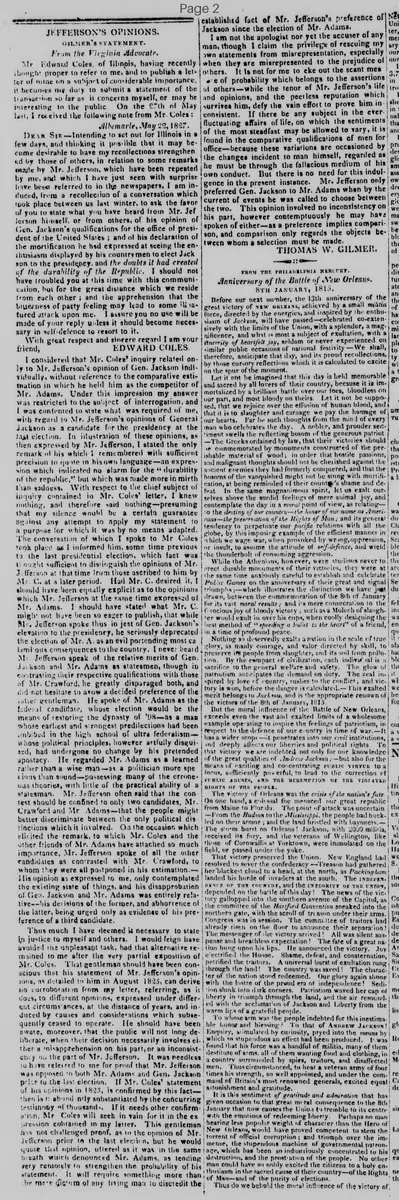
JEFFERSON'S OPINIONS.
GILMER'S STATEMENT.
From the Virginia Advocate.
Mr. Edward Coles, of Illinois, having recently thought proper to refer to me, and to publish a letter of mine on a subject of considerable importance, it becomes my duty to submit a statement of the transaction so far as it concerns myself, or may be interesting to the public. On the 25th of May last, I received the following note from Mr. Coles:
Albemarle, May 22, 1827.
Dear Sir—Intending to set out for Illinois in a few days, and thinking it possible that it may become desirable to have my recollections strengthened by those of others, in relation to some remarks made by Mr. Jefferson, which have been repeated by me, and which I have just seen with surprise have been referred to in the newspapers, I am induced, from a recollection of a conversation which took place between us last winter, to ask the favor of you to state what you have heard from Mr. Jefferson himself, or from others, of his opinion of Gen. Jackson's qualifications for the office of president of the United States: and of his declaration of the mortification he had expressed at seeing the enthusiasm displayed by his countrymen to elect Jackson to the presidency, and the doubts it had created of the durability of the Republic. I should not have troubled you at this time with this communication, but for the great distance which we reside from each other; and the apprehension that the bitterness of party feeling may lead to some ill-natured attack upon me. I assure you no use will be made of your reply unless it should become necessary in self-defence to resort to it.
With great respect and sincere regard, I am your friend,
EDWARD COLES.
I considered that Mr. Coles' inquiry related only to Mr. Jefferson's opinion of Gen. Jackson individually, without reference to the comparative estimation in which he held him as the competitor of Mr. Adams. Under this impression my answer was restricted to the subject of interrogation, and I was contented to state what was required of me, with regard to Mr. Jefferson's opinions of General Jackson as a candidate for the presidency at the last election. In illustration of these opinions, as then expressed by Mr. Jefferson, I stated the only remark of his which I remembered with sufficient precision to quote in his own language—an expression which indicated no alarm for the 'durability of the republic,' but which was made more in mirth than sadness. With respect to the chief subject of inquiry contained in Mr. Coles' letter, I knew nothing, and therefore said nothing—presuming that my silence would be a certain guarantee against any attempt to apply my statement to a purpose for which it was by no means adapted.
The conversation of which I spoke to Mr. Coles took place as I informed him, some time previous to the last presidential election, which fact was thought sufficient to distinguish the opinions of Mr. Jefferson at that time from those ascribed to him by Mr. C. at a later period. Had Mr. C. desired it, I should have been equally explicit as to the opinions which Mr. Jefferson at the same time expressed of Mr. Adams. I should have stated what Mr. C. might not have been so eager to publish, that while Mr. Jefferson spoke thus in jest of Gen. Jackson's elevation to the presidency, he seriously deprecated the election of Mr. A. as an evil portending most calamitous consequences to the country. I never heard Mr. Jefferson speak of the relative merits of Gen. Jackson and Mr. Adams as statesmen, though in contrasting their respective qualifications with those of Mr. Crawford, he greatly disparaged both, and did not hesitate to avow a decided preference of the latter gentleman. He spoke of Mr. Adams as the Federal candidate, whose election would be the means of restoring the dynasty of '98—as a man whose earliest and strongest predilections had been imbibed in the high school of ultra federalism—whose political principles, however artfully disguised, had undergone no change by his pretended apostasy. He regarded Mr. Adams as a learned rather than a wise man—as a politician more specious than sound—possessing many of the erroneous theories, with little of the practical ability of a statesman. Mr. Jefferson often said that the contest should be confined to only two candidates. Mr. Crawford and Mr. Adams—that the people might better discriminate between the only political distinctions which it involved. On the occasion which elicited the remark, to which Mr. Coles and the other friends of Mr. Adams have attached so much importance, Mr. Jefferson spoke of all the other candidates as contrasted with Mr. Crawford, to whom they were all postponed in his estimation.—His opinion as expressed to me, only contemplated the existing state of things, and his disapprobation of Gen. Jackson and Mr. Adams was entirely relative—his derisions of the former, and abhorrence of the latter, being urged only as evidence of his preference of a third candidate.
Thus much I have deemed it necessary to state in justice to myself and others. I would fain have avoided the unpleasant task, had that alternative remained to me after the very partial exposition of Mr. Coles. That gentleman should have been conscious that his statement of Mr. Jefferson's opinions, as detailed to him in August 1825, can derive no corroboration from my letter, referring, as it does, to different opinions, expressed under different circumstances, at the distance of years, and induced by causes and considerations which subsequently ceased to operate. He should have been aware, moreover, that the public will not long deliberate, when their decision necessarily involves either a misapprehension on his part, or an inconsistency on the part of Mr. Jefferson. It was needless to have referred to me for proof that Mr. Jefferson was opposed to both Mr. Adams and Gen. Jackson prior to the last election. If Mr. Coles' statement of his opinions in 1825, is confirmed by this fact—then it is abundantly substantiated by the concurring testimony of thousands. If it needs other confirmation, Mr. Coles will seek in vain for it in the expression contained in my letter. This gentleman has not challenged proof, as to the opinion of Mr. Jefferson prior to the last election, but he would quote that opinion, uttered as it was in the same breath which denounced Mr. Adams, as tending very remotely to strengthen the probability of his statement. It will require something more than the mere dictum of any living man to discredit the established fact of Mr. Jefferson's preference of Jackson since the election of Mr. Adams.
I am not the apologist nor yet the accuser of any man, though I claim the privilege of rescuing my own statements from misrepresentation, especially when they are misrepresented to the prejudice of others. It is not for me to eke out the scant measure of probability which belongs to the assertions of others—while the tenor of Mr. Jefferson's life and opinions, and the peerless reputation which survives him, defy the vain effort to prove him inconsistent. If there be any subject in the ever-fluctuating affairs of life, on which the sentiments of the most steadfast may be allowed to vary, it is found in the comparative qualifications of men for office—because these variations are occasioned by the changes incident to man himself, regarded as he must be through the fallacious medium of his own conduct. But there is no need for this indulgence in the present instance. Mr. Jefferson only preferred Gen. Jackson to Mr. Adams when by the current of events he was called to choose between the two. This opinion involved no inconsistency on his part, however contemptuously he may have spoken of either—as a preference implies comparison, and comparison only regards the objects between whom a selection must be made.
THOMAS W. GILMER.
GILMER'S STATEMENT.
From the Virginia Advocate.
Mr. Edward Coles, of Illinois, having recently thought proper to refer to me, and to publish a letter of mine on a subject of considerable importance, it becomes my duty to submit a statement of the transaction so far as it concerns myself, or may be interesting to the public. On the 25th of May last, I received the following note from Mr. Coles:
Albemarle, May 22, 1827.
Dear Sir—Intending to set out for Illinois in a few days, and thinking it possible that it may become desirable to have my recollections strengthened by those of others, in relation to some remarks made by Mr. Jefferson, which have been repeated by me, and which I have just seen with surprise have been referred to in the newspapers, I am induced, from a recollection of a conversation which took place between us last winter, to ask the favor of you to state what you have heard from Mr. Jefferson himself, or from others, of his opinion of Gen. Jackson's qualifications for the office of president of the United States: and of his declaration of the mortification he had expressed at seeing the enthusiasm displayed by his countrymen to elect Jackson to the presidency, and the doubts it had created of the durability of the Republic. I should not have troubled you at this time with this communication, but for the great distance which we reside from each other; and the apprehension that the bitterness of party feeling may lead to some ill-natured attack upon me. I assure you no use will be made of your reply unless it should become necessary in self-defence to resort to it.
With great respect and sincere regard, I am your friend,
EDWARD COLES.
I considered that Mr. Coles' inquiry related only to Mr. Jefferson's opinion of Gen. Jackson individually, without reference to the comparative estimation in which he held him as the competitor of Mr. Adams. Under this impression my answer was restricted to the subject of interrogation, and I was contented to state what was required of me, with regard to Mr. Jefferson's opinions of General Jackson as a candidate for the presidency at the last election. In illustration of these opinions, as then expressed by Mr. Jefferson, I stated the only remark of his which I remembered with sufficient precision to quote in his own language—an expression which indicated no alarm for the 'durability of the republic,' but which was made more in mirth than sadness. With respect to the chief subject of inquiry contained in Mr. Coles' letter, I knew nothing, and therefore said nothing—presuming that my silence would be a certain guarantee against any attempt to apply my statement to a purpose for which it was by no means adapted.
The conversation of which I spoke to Mr. Coles took place as I informed him, some time previous to the last presidential election, which fact was thought sufficient to distinguish the opinions of Mr. Jefferson at that time from those ascribed to him by Mr. C. at a later period. Had Mr. C. desired it, I should have been equally explicit as to the opinions which Mr. Jefferson at the same time expressed of Mr. Adams. I should have stated what Mr. C. might not have been so eager to publish, that while Mr. Jefferson spoke thus in jest of Gen. Jackson's elevation to the presidency, he seriously deprecated the election of Mr. A. as an evil portending most calamitous consequences to the country. I never heard Mr. Jefferson speak of the relative merits of Gen. Jackson and Mr. Adams as statesmen, though in contrasting their respective qualifications with those of Mr. Crawford, he greatly disparaged both, and did not hesitate to avow a decided preference of the latter gentleman. He spoke of Mr. Adams as the Federal candidate, whose election would be the means of restoring the dynasty of '98—as a man whose earliest and strongest predilections had been imbibed in the high school of ultra federalism—whose political principles, however artfully disguised, had undergone no change by his pretended apostasy. He regarded Mr. Adams as a learned rather than a wise man—as a politician more specious than sound—possessing many of the erroneous theories, with little of the practical ability of a statesman. Mr. Jefferson often said that the contest should be confined to only two candidates. Mr. Crawford and Mr. Adams—that the people might better discriminate between the only political distinctions which it involved. On the occasion which elicited the remark, to which Mr. Coles and the other friends of Mr. Adams have attached so much importance, Mr. Jefferson spoke of all the other candidates as contrasted with Mr. Crawford, to whom they were all postponed in his estimation.—His opinion as expressed to me, only contemplated the existing state of things, and his disapprobation of Gen. Jackson and Mr. Adams was entirely relative—his derisions of the former, and abhorrence of the latter, being urged only as evidence of his preference of a third candidate.
Thus much I have deemed it necessary to state in justice to myself and others. I would fain have avoided the unpleasant task, had that alternative remained to me after the very partial exposition of Mr. Coles. That gentleman should have been conscious that his statement of Mr. Jefferson's opinions, as detailed to him in August 1825, can derive no corroboration from my letter, referring, as it does, to different opinions, expressed under different circumstances, at the distance of years, and induced by causes and considerations which subsequently ceased to operate. He should have been aware, moreover, that the public will not long deliberate, when their decision necessarily involves either a misapprehension on his part, or an inconsistency on the part of Mr. Jefferson. It was needless to have referred to me for proof that Mr. Jefferson was opposed to both Mr. Adams and Gen. Jackson prior to the last election. If Mr. Coles' statement of his opinions in 1825, is confirmed by this fact—then it is abundantly substantiated by the concurring testimony of thousands. If it needs other confirmation, Mr. Coles will seek in vain for it in the expression contained in my letter. This gentleman has not challenged proof, as to the opinion of Mr. Jefferson prior to the last election, but he would quote that opinion, uttered as it was in the same breath which denounced Mr. Adams, as tending very remotely to strengthen the probability of his statement. It will require something more than the mere dictum of any living man to discredit the established fact of Mr. Jefferson's preference of Jackson since the election of Mr. Adams.
I am not the apologist nor yet the accuser of any man, though I claim the privilege of rescuing my own statements from misrepresentation, especially when they are misrepresented to the prejudice of others. It is not for me to eke out the scant measure of probability which belongs to the assertions of others—while the tenor of Mr. Jefferson's life and opinions, and the peerless reputation which survives him, defy the vain effort to prove him inconsistent. If there be any subject in the ever-fluctuating affairs of life, on which the sentiments of the most steadfast may be allowed to vary, it is found in the comparative qualifications of men for office—because these variations are occasioned by the changes incident to man himself, regarded as he must be through the fallacious medium of his own conduct. But there is no need for this indulgence in the present instance. Mr. Jefferson only preferred Gen. Jackson to Mr. Adams when by the current of events he was called to choose between the two. This opinion involved no inconsistency on his part, however contemptuously he may have spoken of either—as a preference implies comparison, and comparison only regards the objects between whom a selection must be made.
THOMAS W. GILMER.
What sub-type of article is it?
Biography
Historical Event
What themes does it cover?
Justice
Deception
What keywords are associated?
Jefferson Opinions
Presidential Election
Jackson
Adams
Crawford
Political Clarification
What entities or persons were involved?
Thomas Jefferson
Edward Coles
Thomas W. Gilmer
Gen. Jackson
Mr. Adams
Mr. Crawford
Where did it happen?
Albemarle, Virginia; Illinois
Story Details
Key Persons
Thomas Jefferson
Edward Coles
Thomas W. Gilmer
Gen. Jackson
Mr. Adams
Mr. Crawford
Location
Albemarle, Virginia; Illinois
Event Date
1824 1827
Story Details
Gilmer clarifies Jefferson's pre-1824 election opinions favoring Crawford over Jackson and Adams, and post-1824 preference for Jackson over Adams, responding to Coles' partial use of his letter to support claims of Jefferson's ongoing opposition to Jackson.