Thank you for visiting SNEWPapers!
Sign up free
The Weekly Corinthian
Corinth, Alcorn County, Mississippi
What is this article about?
Profile of Archduke Franz Ferdinand d'Este, heir to the Austrian throne, discussing his background, education under Jesuit influence, correction by the emperor, and the daunting task of ruling a diverse empire with rival nationalities and ideologies.
Clipping
OCR Quality
Full Text
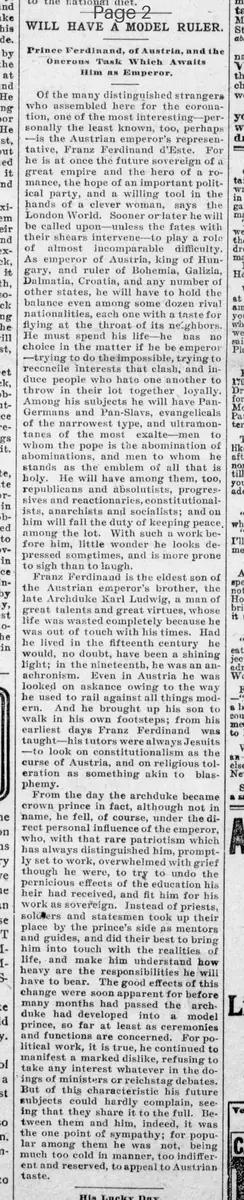
Prince Ferdinand, of Austria, and the Onerous Task Which Awaits Him as Emperor.
Of the many distinguished strangers who assembled here for the coronation, one of the most interesting-personally the least known, too, perhaps-is the Austrian emperor's representative, Franz Ferdinand d'Este. For he is at once the future sovereign of a great empire and the hero of a romance, the hope of an important political party, and a willing tool in the hands of a clever woman, says the London World. Sooner or later he will be called upon-unless the fates with their shears intervene-to play a role of almost incomparable difficulty.
As emperor of Austria, king of Hungary, and ruler of Bohemia, Galizia, Dalmatia, Croatia, and any number of other states, he will have to hold the balance even among some dozen rival nationalities, each one with a taste for flying at the throat of its neighbors. He must spend his life-he has no choice in the matter if he be emperor-trying to do the impossible, trying to reconcile interests that clash, and induce people who hate one another to throw in their lot together loyally.
Among his subjects he will have Pan-Germans and Pan-Slavs, evangelicals of the narrowest type, and ultramontanes of the most exalted-men to whom the pope is the abomination of abominations, and men to whom he stands as the emblem of all that is holy. He will have among them, too, republicans and absolutists, progressives and reactionaries, constitutionalists, anarchists and socialists; and on him will fall the duty of keeping peace among the lot. With such a work before him, little wonder he looks depressed sometimes, and is more prone to sigh than to laugh.
Franz Ferdinand is the eldest son of the Austrian emperor's brother, the late Archduke Karl Ludwig, a man of great talents and great virtues, whose life was wasted completely because he was out of touch with his times. Had he lived in the fifteenth century he would, no doubt, have been a shining light; in the nineteenth, he was an anachronism. Even in Austria he was looked on askance owing to the way he used to rail against all things modern. And he brought up his son to walk in his own footsteps; from his earliest days Franz Ferdinand was taught-his tutors were always Jesuits-to look on constitutionalism as the curse of Austria, and on religious toleration as something akin to blasphemy.
From the day the archduke became crown prince in fact, although not in name, he fell, of course, under the direct personal influence of the emperor, who, with that rare patriotism which has always distinguished him, promptly set to work, overwhelmed with grief though he were, to try to undo the pernicious effects of the education his heir had received, and fit him for his work as sovereign. Instead of priests, soldiers and statesmen took up their place by the prince's side as mentors and guides, and did their best to bring him into touch with the realities of life, and make him understand how heavy are the responsibilities he will have to bear. The good effects of this change were soon apparent for before many months had passed the archduke had developed into a model prince, so far at least as ceremonies and functions are concerned. For political work, it is true, he continued to manifest a marked dislike, refusing to take any interest whatever in the doings of ministers or reichstag debates. But of this characteristic his future subjects could hardly complain, seeing that they share it to the full. Between them and him, indeed, it was the one point of sympathy; for popular among them he was not, being much too cold in manner, too indifferent and reserved, to appeal to Austrian taste.
What sub-type of article is it?
What keywords are associated?
What entities or persons were involved?
Where did it happen?
Foreign News Details
Primary Location
Austria
Key Persons
Event Details
Archduke Franz Ferdinand d'Este, heir to the Austrian throne, faces the challenge of ruling a multi-ethnic empire with rival nationalities including Pan-Germans, Pan-Slavs, and various political ideologies. Educated under Jesuit influence by his father Archduke Karl Ludwig to oppose constitutionalism and religious toleration, his education was later corrected by the emperor through soldiers and statesmen. He has become a model prince in ceremonies but shows disinterest in politics, remaining unpopular due to his reserved manner.