Thank you for visiting SNEWPapers!
Sign up free
Poem
October 3, 1829
Republican Herald
Providence, Providence County, Rhode Island
What is this article about?
The poem contrasts sorrow's gentle touch in palaces with its harsh burden on the poor. The narrator describes an autumn evening visit to a widow's cottage after her husband's funeral, highlighting the family's immediate return to labor without respite for grief.
Clipping
OCR Quality
95%
Excellent
Full Text
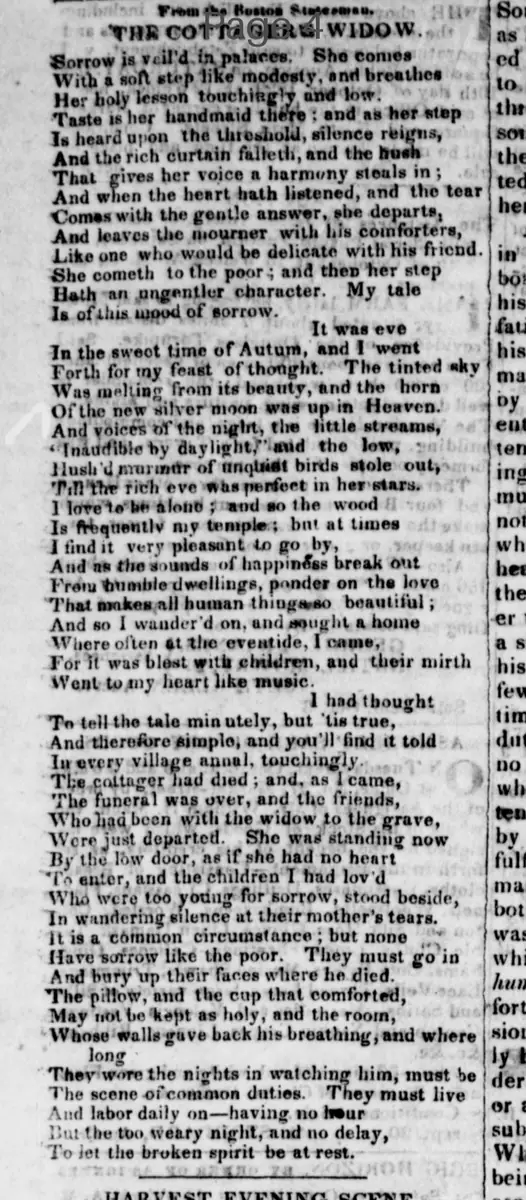
Sorrow is veil'd in palaces. She comes
With a soft step like modesty, and breathes
Her holy lesson touchingly and low.
Taste is her handmaid there; and as her step
Is heard upon the threshold, silence reigns,
And the rich curtain falleth, and the hush
That gives her voice a harmony steals in;
And when the heart hath listened, and the tear
Comes with the gentle answer, she departs,
And leaves the mourner with his comforters,
Like one who would be delicate with his friend.
She cometh to the poor; and then her step
Hath an ungentler character. My tale
Is of this mood of sorrow.
It was eve
In the sweet time of Autumn, and I went
Forth for my feast of thought. The tinted sky
Was melting from its beauty, and the horn
Of the new silver moon was up in Heaven.
And voices of the night, the little streams,
Inaudible by daylight, laid the low,
Hush'd murmurings of unquiet birds stole out,
Till in the rich eve was perfect in her stars.
I love to be alone; and so the wood
Is frequently my temple; but at times
I find it very pleasant to go by,
And as the sounds of happiness break out
From humble dwellings, ponder on the love
That makes all human things so beautiful;
And so I wander'd on, and sought a home
Where often at the eventide, I came,
For it was blest with children, and their mirth
Went to my heart like music.
I had thought
To tell the tale minutely, but 'tis true,
And therefore simple, and you'll find it told
In every village annal, touchingly.
The cottager had died; and, as I came,
The funeral was over, and the friends,
Who had been with the widow to the grave,
Were just departed. She was standing now
By the low door, as if she had no heart
To enter, and the children I had lov'd
Who were too young for sorrow, stood beside,
In wondering silence at their mother's tears.
It is a common circumstance; but none
Have sorrow like the poor. They must go in
And bury up their aces where he died.
The pillow, and the cup that comforted,
May not be kept as holy, and the room,
Whose walls gave back his breathing, and where
They wore the nights in watching him, must be
The scene of common duties. They must live
And labor daily on—having no hour
But the too weary night, and no delay,
To let the broken spirit be at rest.
With a soft step like modesty, and breathes
Her holy lesson touchingly and low.
Taste is her handmaid there; and as her step
Is heard upon the threshold, silence reigns,
And the rich curtain falleth, and the hush
That gives her voice a harmony steals in;
And when the heart hath listened, and the tear
Comes with the gentle answer, she departs,
And leaves the mourner with his comforters,
Like one who would be delicate with his friend.
She cometh to the poor; and then her step
Hath an ungentler character. My tale
Is of this mood of sorrow.
It was eve
In the sweet time of Autumn, and I went
Forth for my feast of thought. The tinted sky
Was melting from its beauty, and the horn
Of the new silver moon was up in Heaven.
And voices of the night, the little streams,
Inaudible by daylight, laid the low,
Hush'd murmurings of unquiet birds stole out,
Till in the rich eve was perfect in her stars.
I love to be alone; and so the wood
Is frequently my temple; but at times
I find it very pleasant to go by,
And as the sounds of happiness break out
From humble dwellings, ponder on the love
That makes all human things so beautiful;
And so I wander'd on, and sought a home
Where often at the eventide, I came,
For it was blest with children, and their mirth
Went to my heart like music.
I had thought
To tell the tale minutely, but 'tis true,
And therefore simple, and you'll find it told
In every village annal, touchingly.
The cottager had died; and, as I came,
The funeral was over, and the friends,
Who had been with the widow to the grave,
Were just departed. She was standing now
By the low door, as if she had no heart
To enter, and the children I had lov'd
Who were too young for sorrow, stood beside,
In wondering silence at their mother's tears.
It is a common circumstance; but none
Have sorrow like the poor. They must go in
And bury up their aces where he died.
The pillow, and the cup that comforted,
May not be kept as holy, and the room,
Whose walls gave back his breathing, and where
They wore the nights in watching him, must be
The scene of common duties. They must live
And labor daily on—having no hour
But the too weary night, and no delay,
To let the broken spirit be at rest.
What sub-type of article is it?
Elegy
Pastoral
What themes does it cover?
Death Mourning
Satire Society
What keywords are associated?
Sorrow
Mourning
Poverty
Widow
Children
Autumn
Rural Life
Class Difference
Poem Details
Key Lines
Sorrow Is Veil'd In Palaces. She Comes
With A Soft Step Like Modesty, And Breathes
Her Holy Lesson Touchingly And Low.
It Is A Common Circumstance; But None
Have Sorrow Like The Poor.
They Must Live
And Labor Daily On—Having No Hour
But The Too Weary Night, And No Delay,
To Let The Broken Spirit Be At Rest.