Thank you for visiting SNEWPapers!
Sign up free
Editorial
August 31, 1849
New Hampshire Statesman
Concord, Merrimack County, New Hampshire
What is this article about?
This editorial reflects on the passage of time and urges readers to act on Christian love by comforting the sorrowful, supporting the fallen, and showing sympathy to those in need, rather than scorning them, to redeem and uplift their spirits.
Clipping
OCR Quality
98%
Excellent
Full Text
Where is thy Brother?
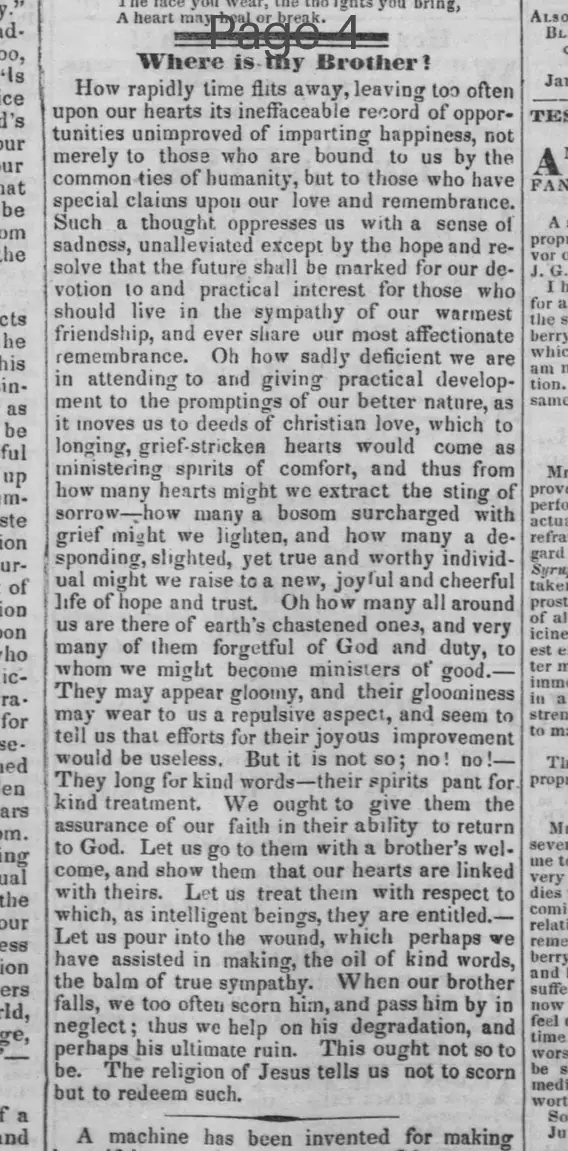
How rapidly time flits away, leaving too often upon our hearts its ineffaceable record of opportunities unimproved of imparting happiness, not merely to those who are bound to us by the common ties of humanity, but to those who have special claims upon our love and remembrance. Such a thought oppresses us with a sense of sadness, unalleviated except by the hope and resolve that the future shall be marked for our devotion to and practical interest for those who should live in the sympathy of our warmest friendship, and ever share our most affectionate remembrance. Oh how sadly deficient we are in attending to and giving practical development to the promptings of our better nature, as it moves us to deeds of christian love, which to longing, grief-stricken hearts would come as ministering spirits of comfort, and thus from how many hearts might we extract the sting of sorrow—how many a bosom surcharged with grief might we lighten, and how many a desponding, slighted, yet true and worthy individual might we raise to a new, joyful and cheerful life of hope and trust. Oh how many all around us are there of earth's chastened ones, and very many of them forgetful of God and duty, to whom we might become ministers of good.—They may appear gloomy, and their gloominess may wear to us a repulsive aspect, and seem to tell us that efforts for their joyous improvement would be useless. But it is not so; no! no!—They long for kind words—their spirits pant for kind treatment. We ought to give them the assurance of our faith in their ability to return to God. Let us go to them with a brother's welcome, and show them that our hearts are linked with theirs. Let us treat them with respect to which, as intelligent beings, they are entitled.—Let us pour into the wound, which perhaps we have assisted in making, the oil of kind words, the balm of true sympathy. When our brother falls, we too often scorn him, and pass him by in neglect; thus we help on his degradation, and perhaps his ultimate ruin. This ought not so to be. The religion of Jesus tells us not to scorn but to redeem such.
How rapidly time flits away, leaving too often upon our hearts its ineffaceable record of opportunities unimproved of imparting happiness, not merely to those who are bound to us by the common ties of humanity, but to those who have special claims upon our love and remembrance. Such a thought oppresses us with a sense of sadness, unalleviated except by the hope and resolve that the future shall be marked for our devotion to and practical interest for those who should live in the sympathy of our warmest friendship, and ever share our most affectionate remembrance. Oh how sadly deficient we are in attending to and giving practical development to the promptings of our better nature, as it moves us to deeds of christian love, which to longing, grief-stricken hearts would come as ministering spirits of comfort, and thus from how many hearts might we extract the sting of sorrow—how many a bosom surcharged with grief might we lighten, and how many a desponding, slighted, yet true and worthy individual might we raise to a new, joyful and cheerful life of hope and trust. Oh how many all around us are there of earth's chastened ones, and very many of them forgetful of God and duty, to whom we might become ministers of good.—They may appear gloomy, and their gloominess may wear to us a repulsive aspect, and seem to tell us that efforts for their joyous improvement would be useless. But it is not so; no! no!—They long for kind words—their spirits pant for kind treatment. We ought to give them the assurance of our faith in their ability to return to God. Let us go to them with a brother's welcome, and show them that our hearts are linked with theirs. Let us treat them with respect to which, as intelligent beings, they are entitled.—Let us pour into the wound, which perhaps we have assisted in making, the oil of kind words, the balm of true sympathy. When our brother falls, we too often scorn him, and pass him by in neglect; thus we help on his degradation, and perhaps his ultimate ruin. This ought not so to be. The religion of Jesus tells us not to scorn but to redeem such.
What sub-type of article is it?
Moral Or Religious
Social Reform
What keywords are associated?
Christian Love
Sympathy For Sorrowful
Redeeming The Fallen
Moral Duty
Kind Treatment
Religious Exhortation
What entities or persons were involved?
Jesus
God
Editorial Details
Primary Topic
Duty To Comfort And Redeem The Sorrowful And Fallen
Stance / Tone
Exhortative Urging Of Christian Sympathy And Redemption
Key Figures
Jesus
God
Key Arguments
Time Passes Quickly, Leaving Regrets For Unimproved Opportunities To Help Others.
We Must Devote Ourselves To Practical Acts Of Christian Love For The Grieving And Despondent.
Many Around Us Need Ministers Of Good, Despite Their Gloomy Appearance.
Offer Kind Words, Sympathy, And Assurance Of Faith In Their Return To God.
Treat The Fallen With Respect And Brother's Welcome, Not Scorn.
Religion Of Jesus Calls Us To Redeem, Not Scorn, The Fallen.