Thank you for visiting SNEWPapers!
Sign up free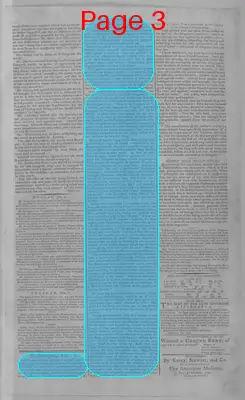
Editorial
February 2, 1791
Gazette Of The United States
New York, New York County, New York
What is this article about?
This Philadelphia editorial critiques Antifederalist arguments for state sovereignty, arguing that Congress, deriving power from the people, should handle national affairs without interference from state legislatures like those in Virginia, Pennsylvania, and North Carolina, which risk creating disunity akin to the Tower of Babel.
Clipping
OCR Quality
95%
Excellent
Full Text
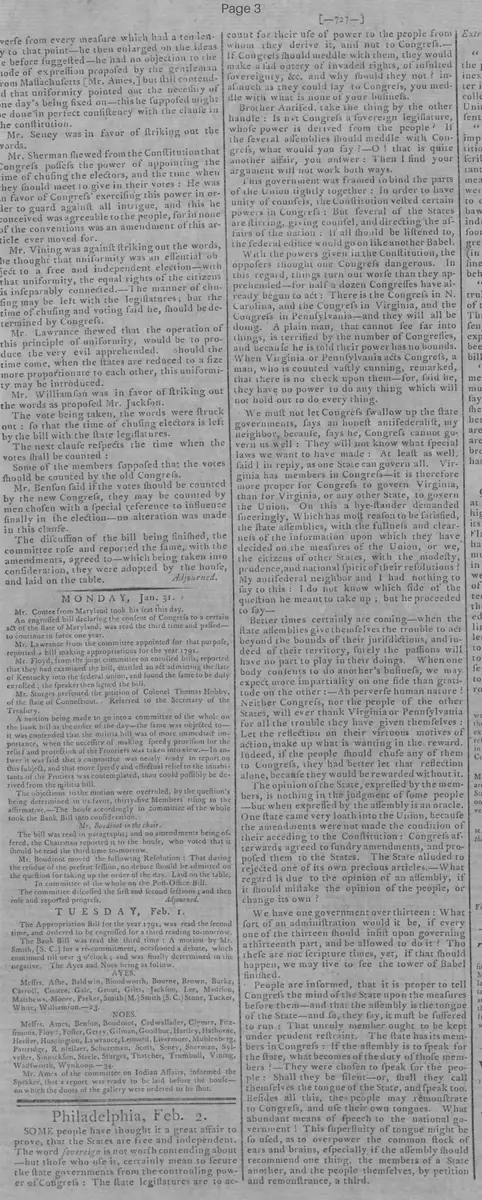
Philadelphia, Feb. 2.
SOME people have thought it a great affair to prove, that the States are free and independent. The word Sovereign is not worth contending about—but those who use it, certainly mean to secure the state governments from the controlling power of Congress: The state legislatures are to account for their use of power to the people from whom they derive it, and not to Congress.—
If Congress should meddle with them, they would make a sad outcry of invaded rights, of insulted sovereignty, &c. and why should they not? inasmuch as they could say to Congress, you meddle with what is none of your business.
Brother Antifederalist, take the thing by the other handle: Is not Congress a sovereign legislature, whose power is derived from the people? If the several assemblies should meddle with Congress, what would you say?—O! that is quite another affair, you answer: Then I find your argument will not work both ways.
This government was framed to bind the parts of the Union tightly together: In order to have unity of councils, the Constitution vested certain powers in Congress: But several of the States are stirring, giving counsel, and directing the affairs of the nation: If all should be listened to, the federal edifice would go on like another Babel.
With the powers given in the Constitution, the opposers thought one Congress dangerous. In this regard, things turn out worse than they apprehended—for half a dozen Congresses have already begun to act: There is the Congress in N. Carolina, and the Congress in Virginia, and the Congress in Pennsylvania—and they will all be doing. A plain man, that cannot see far into things, is terrified by the number of Congresses, and because he is told their power has no bounds.
When Virginia or Pennsylvania acts Congress, a man, who is counted vastly cunning, remarked, that there is no check upon them—for, said he, they have no power to do any thing which will not hold good to do every thing.
We must not let Congress swallow up the state governments, says an honest antifederalist, my neighbor, because, says he, Congress cannot govern us well: They will not know what special laws we want to have made: At least as well, said I in reply, as one State can govern all. Virginia has members in Congress—it is therefore more proper for Congress to govern Virginia, than for Virginia, or any other State, to govern the Union. On this a by-stander demanded sneeringly, Which has most reason to be satisfied, the state assemblies, with the fullness and clearness of the information upon which they have decided on the measures of the Union, or we, the citizens of other States, with the modesty, prudence, and national spirit of their resolutions?
My antifederal neighbor and I had nothing to say to this: I do not know which side of the question he meant to take up; but he proceeded to say—
Better times certainly are coming—when the state assemblies give themselves the trouble to act beyond the bounds of their jurisdictions, and indeed of their territory, surely the passions will have no part to play in their doings. When one body consents to do another's business, we may expect more impartiality on one side than gratitude on the other:—Ah perverse human nature!
Neither Congress, nor the people of the other States, will ever thank Virginia or Pennsylvania for all the trouble they have given themselves: Let the reflection on their virtuous motives of action, make up what is wanting in the reward.
Indeed, if the people should choose any of them to Congress, they had better let that reflection alone, because they would be rewarded without it.
The opinion of the State, expressed by the members, is nothing in the judgment of some people—but when expressed by the assembly is an oracle.
One state came very loath into the Union, because the amendments were not made the condition of their acceding to the Constitution: Congress afterwards agreed to sundry amendments, and proposed them to the States. The State alluded to rejected one of its own precious articles.—What regard is due to the opinion of an assembly, if it should mistake the opinion of the people, or change its own?
We have one government over thirteen: What sort of an administration would it be, if every one of the thirteen should insist upon governing a thirteenth part, and be allowed to do it? Those are not scripture times, yet, if that should happen, we may live to see the tower of Babel finished.
People are informed, that it is proper to tell Congress the mind of the State upon the measures before them—and that the assembly is the tongue of the State—and so, they say, it must be suffered to run: That unruly member ought to be kept under prudent restraint. The state has its members in Congress: If the assembly is to speak for the state, what becomes of the duty of those members?—They were chosen to speak for the people: Shall they be silent—or, shall they call themselves the tongue of the State, and speak too.
Besides all this, the people may remonstrate to Congress, and use their own tongues. What abundant means of speech to the national government! This superfluity of tongue might be so used, as to overpower the common stock of ears and brains, especially if the assembly should recommend one thing, the members of a State another, and the people themselves, by petition and remonstrance, a third.
SOME people have thought it a great affair to prove, that the States are free and independent. The word Sovereign is not worth contending about—but those who use it, certainly mean to secure the state governments from the controlling power of Congress: The state legislatures are to account for their use of power to the people from whom they derive it, and not to Congress.—
If Congress should meddle with them, they would make a sad outcry of invaded rights, of insulted sovereignty, &c. and why should they not? inasmuch as they could say to Congress, you meddle with what is none of your business.
Brother Antifederalist, take the thing by the other handle: Is not Congress a sovereign legislature, whose power is derived from the people? If the several assemblies should meddle with Congress, what would you say?—O! that is quite another affair, you answer: Then I find your argument will not work both ways.
This government was framed to bind the parts of the Union tightly together: In order to have unity of councils, the Constitution vested certain powers in Congress: But several of the States are stirring, giving counsel, and directing the affairs of the nation: If all should be listened to, the federal edifice would go on like another Babel.
With the powers given in the Constitution, the opposers thought one Congress dangerous. In this regard, things turn out worse than they apprehended—for half a dozen Congresses have already begun to act: There is the Congress in N. Carolina, and the Congress in Virginia, and the Congress in Pennsylvania—and they will all be doing. A plain man, that cannot see far into things, is terrified by the number of Congresses, and because he is told their power has no bounds.
When Virginia or Pennsylvania acts Congress, a man, who is counted vastly cunning, remarked, that there is no check upon them—for, said he, they have no power to do any thing which will not hold good to do every thing.
We must not let Congress swallow up the state governments, says an honest antifederalist, my neighbor, because, says he, Congress cannot govern us well: They will not know what special laws we want to have made: At least as well, said I in reply, as one State can govern all. Virginia has members in Congress—it is therefore more proper for Congress to govern Virginia, than for Virginia, or any other State, to govern the Union. On this a by-stander demanded sneeringly, Which has most reason to be satisfied, the state assemblies, with the fullness and clearness of the information upon which they have decided on the measures of the Union, or we, the citizens of other States, with the modesty, prudence, and national spirit of their resolutions?
My antifederal neighbor and I had nothing to say to this: I do not know which side of the question he meant to take up; but he proceeded to say—
Better times certainly are coming—when the state assemblies give themselves the trouble to act beyond the bounds of their jurisdictions, and indeed of their territory, surely the passions will have no part to play in their doings. When one body consents to do another's business, we may expect more impartiality on one side than gratitude on the other:—Ah perverse human nature!
Neither Congress, nor the people of the other States, will ever thank Virginia or Pennsylvania for all the trouble they have given themselves: Let the reflection on their virtuous motives of action, make up what is wanting in the reward.
Indeed, if the people should choose any of them to Congress, they had better let that reflection alone, because they would be rewarded without it.
The opinion of the State, expressed by the members, is nothing in the judgment of some people—but when expressed by the assembly is an oracle.
One state came very loath into the Union, because the amendments were not made the condition of their acceding to the Constitution: Congress afterwards agreed to sundry amendments, and proposed them to the States. The State alluded to rejected one of its own precious articles.—What regard is due to the opinion of an assembly, if it should mistake the opinion of the people, or change its own?
We have one government over thirteen: What sort of an administration would it be, if every one of the thirteen should insist upon governing a thirteenth part, and be allowed to do it? Those are not scripture times, yet, if that should happen, we may live to see the tower of Babel finished.
People are informed, that it is proper to tell Congress the mind of the State upon the measures before them—and that the assembly is the tongue of the State—and so, they say, it must be suffered to run: That unruly member ought to be kept under prudent restraint. The state has its members in Congress: If the assembly is to speak for the state, what becomes of the duty of those members?—They were chosen to speak for the people: Shall they be silent—or, shall they call themselves the tongue of the State, and speak too.
Besides all this, the people may remonstrate to Congress, and use their own tongues. What abundant means of speech to the national government! This superfluity of tongue might be so used, as to overpower the common stock of ears and brains, especially if the assembly should recommend one thing, the members of a State another, and the people themselves, by petition and remonstrance, a third.
What sub-type of article is it?
Constitutional
Partisan Politics
What keywords are associated?
Federalism
State Sovereignty
Antifederalist
Constitution
Congressional Power
Union Unity
What entities or persons were involved?
Congress
State Legislatures
Virginia
Pennsylvania
North Carolina
Antifederalists
Editorial Details
Primary Topic
Critique Of State Legislatures Interfering In Federal Affairs
Stance / Tone
Pro Federalist, Sarcastic Towards Antifederalists
Key Figures
Congress
State Legislatures
Virginia
Pennsylvania
North Carolina
Antifederalists
Key Arguments
States Derive Power From People, Not Congress, But Congress Is Sovereign Legislature From The People
State Interference In National Affairs Risks Disunity Like Babel
Arguments Against Federal Power Are Inconsistent
State Assemblies Overstep Jurisdictions By Directing National Policy
People And State Members In Congress Can Represent State Views Adequately
Assemblies May Mistake Or Change Public Opinion