Thank you for visiting SNEWPapers!

Sign up free
Page thumbnail for Vermont Phœnix
Domestic News September 28, 1838

Vermont Phœnix

Brattleboro, Bellows Falls, Ludlow, Windham County, Windsor County, Vermont

What is this article about?

In 1830, Vermont's legislature passed a resolution requesting the Governor to estimate costs for a geological and topographical survey of the state, estimated at $10,600 over two or four years. Correspondence with Prof. Benedict highlighted mineral resources like iron, manganese, copperas, gypsum, and a recent gold vein in Waterbury. Advocacy urges funding to develop these treasures, noting benefits seen in other states like Pennsylvania's coal discovery.

Clipping
OCR Quality

100% Excellent

Full Text

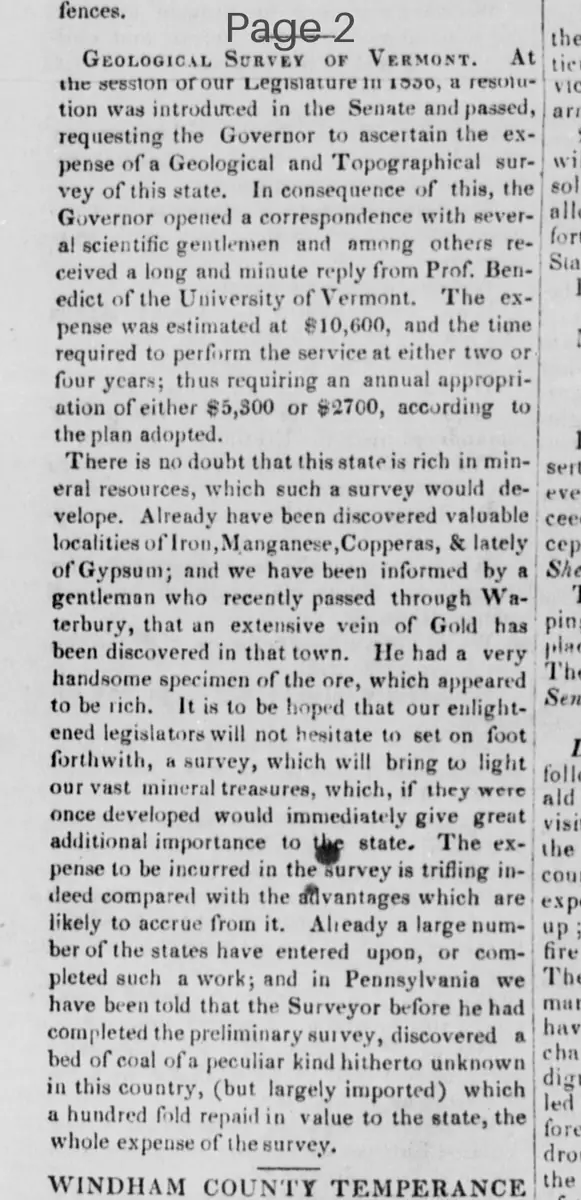
Geological Survey of Vermont. At the session of our Legislature in 1830, a resolution was introduced in the Senate and passed, requesting the Governor to ascertain the expense of a Geological and Topographical survey of this state. In consequence of this, the Governor opened a correspondence with several scientific gentlemen and among others received a long and minute reply from Prof. Benedict of the University of Vermont. The expense was estimated at $10,600, and the time required to perform the service at either two or four years: thus requiring an annual appropriation of either $5,300 or $2,700, according to the plan adopted. There is no doubt that this state is rich in mineral resources, which such a survey would develop. Already have been discovered valuable localities of Iron, Manganese, Copperas, & lately of Gypsum; and we have been informed by a gentleman who recently passed through Waterbury, that an extensive vein of Gold has been discovered in that town. He had a very handsome specimen of the ore, which appeared to be rich. It is to be hoped that our enlightened legislators will not hesitate to set on foot forthwith, a survey, which will bring to light our vast mineral treasures, which, if they were once developed would immediately give great additional importance to the state. The expense to be incurred in the survey is trifling indeed compared with the advantages which are likely to accrue from it. Already a large number of the states have entered upon, or completed such a work: and in Pennsylvania we have been told that the Surveyor before he had completed the preliminary survey, discovered a bed of coal of a peculiar kind hitherto unknown in this country, (but largely imported) which a hundred fold repaid in value to the state, the whole expense of the survey.

What sub-type of article is it?

Politics Economic Infrastructure

What keywords are associated?

Geological Survey Vermont Legislature Mineral Resources Gold Discovery Waterbury Vein

What entities or persons were involved?

Prof. Benedict Governor

Where did it happen?

Vermont

Domestic News Details

Primary Location

Vermont

Event Date

1830

Key Persons

Prof. Benedict Governor

Event Details

At the 1830 legislative session, a Senate resolution passed requesting the Governor to estimate costs for a geological and topographical survey. The Governor corresponded with scientific gentlemen, including Prof. Benedict of the University of Vermont, who estimated $10,600 over two or four years. The state has mineral resources like iron, manganese, copperas, gypsum, and a recent gold vein in Waterbury. Advocacy for the survey to develop these resources, comparing to Pennsylvania's coal discovery.

Are you sure?