Thank you for visiting SNEWPapers!
Sign up free
Literary
May 24, 1902
Democratic Messenger
Snow Hill, Worcester County, Maryland
What is this article about?
Sermon by Rev. J. Wilbur Chapman titled 'Pilate's Question,' based on Matthew 27:22, examines Pontius Pilate's failure to accept Jesus Christ despite recognizing his divinity. It emphasizes the personal necessity to decide on Christ, outlining implications for acceptance (justification, sonship, peace, joy, eternal life) versus rejection, using scriptural references.
Clipping
OCR Quality
95%
Excellent
Full Text
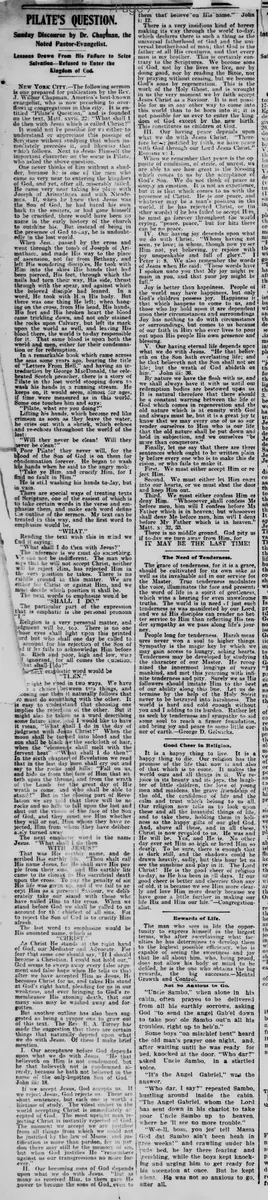
PILATE'S QUESTION.
Sunday Discourse by Dr. Chapman, the Noted Pastor-Evangelist.
Lessons Drawn From His Failure to Seize Salvation—Refused to Enter the Kingdom of God.
New York City.—The following sermon is one prepared for publication by the Rev. J. Wilbur Chapman, America's best-known evangelist, who is now preaching to overflowing congregations in this city. It is entitled "Pilate's Question," and is founded on the text, Matt. xxvii. 22: "What shall I do then with Jesus which is called Christ?"
It would not be possible for us either to understand or appreciate this passage of Scripture without studying that which immediately precedes it, and likewise that which follows. Next to Jesus Himself the important character on the scene is Pilate, who asked the above question.
One never thinks of him without a shudder, because he is one of the men who came so very near to entering the kingdom of God, and yet, after all, miserably failed.
He came very near taking his place with Joseph of Arimathea and with Nicodemus. If, when he knew that Jesus was the Son of God, he had bared his own back to the smiters, or had gone himself to be crucified, there would have been no name in the early history of the church to outshine his. But instead of being in the presence of God to-day, he is undoubtedly in the lost world.
When Jesus passed by the cross and went through the tomb of Joseph of Arimathea, and made His way to the place of ascension, not far from Bethany, and left His wondering disciples, He took with Him into the skies His hands that had been pierced, His feet, through which the nails had torn their way, His side, thrust through with the spear, and against which the beloved disciple had leaned. In a word, He took with Him His body. But there was one thing He left; when hanging on the cross, from His head, His hands, His feet and His broken heart the blood came trickling down, and not only stained the rocks upon Calvary, but left its mark upon the world as well, and leaving His blood there, the world is to-day responsible for it. That same blood is upon both the world and men, either for their condemnation or for redemption.
In a remarkable book which came across the seas some years ago, bearing the title of "Letters From Hell," and having an introduction by George MacDonald, the celebrated Scotch preacher, there is a story of Pilate in the lost world stooping down to wash his hands in a running stream. He keeps on, it would seem, almost for ages, if time were measured as in this world. Some one touches him and says: "Pilate, what are you doing?"
Lifting his hands, which become red like crimson as soon as they leave the water, he cries out with a shriek, which echoes and re-echoes throughout the world of the lost: "Will they never be clean! Will they never be clean!"
Poor Pilate! they never will, for the blood of the Son of God is on them for condemnation forever. He began to wash his hands when he said to the angry mob: "Take ye Him, and crucify Him, for I find no fault in Him."
He is still washing his hands to-day, but in vain.
There are special ways of treating texts of Scripture, one of the easiest of which is to take certain words in the verse and emphasize them, and make each word define the outline of the sermon. My text can be treated in this way, and the first word to emphasize would be, "WHAT."
Reading the text with this in mind we find it saying: "What shall I do then with Jesus?"
The inference is we must do something. We can not be indifferent. The man who says that he will not accept Christ, neither will he reject Him, has rejected Him in the very position he takes. There is no middle ground in this matter. We are either for Christ or against Him, and we must decide which position it shall be.
The next words to emphasize would be "SHALL I DO."
The particular part of the expression that is emphatic is the personal pronoun "I."
Religion is a very personal matter, and judgment will be, too. There is no one whose eyes shall light upon this printed word but who shall one day be called to account for his rejection of the Son of God if he fails to acknowledge Him before men. Rich and poor, high and low, wise and ignorant, for all comes the question, "What shall I do?"
The next emphatic word would be "THEN."
It might be used in two ways. We have a choice between two things, and choosing one then it naturally follows that we must do something with the other. It is easy to understand that choosing one implies the rejection of the other. But it might also be taken as a word describing some future time, and I would like to have it read, "What shall I do in the day of judgment with Jesus Christ?" When the moon shall be turned into blood and the sun shall be black as the sackcloth of hair, when the "elements shall melt with the fervent heat" What shall I do then?
In the sixth chapter of Revelation we read that in the last day men shall cry out and say to the rocks and hills: "Fall on us and hide us from the face of Him that sitteth upon the throne, and from the wrath of the Lamb: for the great day of His wrath is come, and who shall be able to stand?" But in the closing part of Revelation we are told that there will be no rocks and no hills to fall upon the lost and shut out the vision of the face of the Son of God, and they must see Him whether they will or not, Him whom they have rejected, Him from whom they have deliberately turned away.
The next emphatic word is the name Jesus. "What shall I do then WITH JESUS?"
That was His earthly name, and described His earthly life "Thou shalt call His name Jesus, for He shall save His people from their sins," and His earthly life came to its climax in His sacrificial death upon the cross. To pay the penalty of sin His life was given up, and if we fail to accept Him as a personal Saviour, we deliberately take our stand with those who have nailed Him to the cross. When we stand before God we shall be called to an account for the chiefest of all sins. For to reject the Son of God is to crucify Him afresh.
The last word to emphasize would be His anointed name, which is "CHRIST."
As Christ He stands at the right hand of God, our Mediator and Advocate. For fear that some one should say, "If I should become a Christian, I could not hold out," God seems to sweep away every false argument and false hope when He tells us that: after we have accepted Him as Jesus, He becomes Christ for us, and takes His stand at God's right hand, pleading for us in our weakness, and ever bringing to God's remembrance His atoning death, that our many sins may be washed away and forgotten.
But another outline has also been suggested as being a proper one to grow out of this text. The Rev. R. A. Torrey has made the suggestion that there are certain things that naturally depend upon what we do with Jesus. Of these I make brief mention.
I. Our acceptance before God depends upon what we do with Jesus. "He that believeth on Him is not condemned, but he that believeth not is condemned already, because he hath not believed in the name of the only-begotten Son of God." John iii: 18.
If we accept Jesus, God accepts us. If we reject Jesus, God rejects us "These are short sentences, but each one is worth a lifetime of study. The vilest sinner in the world accepting Christ is immediately accepted of God. The most upright man rejecting Christ is instantly rejected of God The moment we accept we are justified from all things from which we could not be justified by the law of Moses; and justification is more than pardon, for in pardon there may still be the memory of sin, but when God justifies He remembers against us our transgressions no more forever."
II. Our becoming sons of God depend upon what we do with Jesus. "But as many as received Him, to them gave He power to become the sons of God, even to them that believe on His name."—John i: 12.
There is a very insidious kind of heresy making its way through the world to-day, which declares there is such a thing as the universal fatherhood of God and the universal brotherhood of man: that God is the father of all His creatures, and that every man is my brother. This is certainly contrary to the Scriptures. We become sons of God, not by the lives we live, nor by doing good, nor by reading the Bible, nor by praying without ceasing, but we become God's sons by regeneration. This is the work of the Holy Ghost, and is wrought in us the very moment we by faith accept Jesus Christ as a Saviour. It is not possible for us in any other way to come into this world than to be born into it; it is not possible for us ever to enter the kingdom of God except by the new birth.
This constitutes us children of God.
III. Our having peace depends upon what we do with Jesus Christ. "Therefore being justified by faith, we have peace with God through our Lord Jesus Christ." Romans v: 1.
When we remember that peace is the opposite of confusion, of strife, of unrest, we are able to see how great is the blessing which comes to us by the acceptance of God's Son. We do not think of peace as simply an emotion. It is not an experience, but it is that which comes to us with the presence of Christ. He is our peace, and whatever may be a man's position in this world, if he has rejected Christ, or (in other words) if he has failed to accept Him he must go forever throughout the world crying, "peace, peace," but for him there can be no peace.
IV. Our having joy depends upon what we do with Christ. "Whom having not seen, ye love; in whom, though now ye see Him not, yet believing, ye rejoice with joy unspeakable and full of glory." I Peter i: 8. We also remember the words of Jesus when He said: "These things have I spoken unto you that My joy might remain in you, and that your joy might be full."
Joy is better than happiness. People of the world may have happiness, but only God's children possess joy. Happiness is that which happens to come to us, and those who lay hold upon it are dependent upon their circumstances and surroundings Joy has nothing to do with circumstance or surroundings, but comes to us because of our faith in Him who ever lives to pour out upon His people His own presence and blessing.
V. Our having eternal life depends upon what we do with Jesus. "He that believeth on the Son hath everlasting life; and he that believeth not the Son shall not see life: but the wrath of God abideth on him." John iii: 36.
By nature we have the flesh within us, and we shall always have it with us until our redemption bodies are bestowed upon us. It is natural therefore that there should be a constant warring between the life of God which comes in regeneration and the old nature which is at enmity with God and always must be, but it is a great joy to know that we may every one of us so surrender ourselves to Him who is our life that the old nature shall be put down and held in subjection, and we ourselves "be more than conquerors."
Finally, let me say that there are three sentences which ought to be written plainly before every one who is to make this decision, or who fails to make it.
First. We must either accept Him or reject Him.
Second. We must either let Him come into our hearts, or we must shut the door and keep Him out.
Third. We must either confess Him or deny Him. "Whosoever shall confess Me before men, him will I confess before My Father which is in heaven; but whosoever shall deny Me before men, him will I deny before My Father which is in heaven." Matt. x: 32, 33.
There is no middle ground. God pity us if to-day we turn away from Him, for IT MAY BE THE LAST TIME!
Sunday Discourse by Dr. Chapman, the Noted Pastor-Evangelist.
Lessons Drawn From His Failure to Seize Salvation—Refused to Enter the Kingdom of God.
New York City.—The following sermon is one prepared for publication by the Rev. J. Wilbur Chapman, America's best-known evangelist, who is now preaching to overflowing congregations in this city. It is entitled "Pilate's Question," and is founded on the text, Matt. xxvii. 22: "What shall I do then with Jesus which is called Christ?"
It would not be possible for us either to understand or appreciate this passage of Scripture without studying that which immediately precedes it, and likewise that which follows. Next to Jesus Himself the important character on the scene is Pilate, who asked the above question.
One never thinks of him without a shudder, because he is one of the men who came so very near to entering the kingdom of God, and yet, after all, miserably failed.
He came very near taking his place with Joseph of Arimathea and with Nicodemus. If, when he knew that Jesus was the Son of God, he had bared his own back to the smiters, or had gone himself to be crucified, there would have been no name in the early history of the church to outshine his. But instead of being in the presence of God to-day, he is undoubtedly in the lost world.
When Jesus passed by the cross and went through the tomb of Joseph of Arimathea, and made His way to the place of ascension, not far from Bethany, and left His wondering disciples, He took with Him into the skies His hands that had been pierced, His feet, through which the nails had torn their way, His side, thrust through with the spear, and against which the beloved disciple had leaned. In a word, He took with Him His body. But there was one thing He left; when hanging on the cross, from His head, His hands, His feet and His broken heart the blood came trickling down, and not only stained the rocks upon Calvary, but left its mark upon the world as well, and leaving His blood there, the world is to-day responsible for it. That same blood is upon both the world and men, either for their condemnation or for redemption.
In a remarkable book which came across the seas some years ago, bearing the title of "Letters From Hell," and having an introduction by George MacDonald, the celebrated Scotch preacher, there is a story of Pilate in the lost world stooping down to wash his hands in a running stream. He keeps on, it would seem, almost for ages, if time were measured as in this world. Some one touches him and says: "Pilate, what are you doing?"
Lifting his hands, which become red like crimson as soon as they leave the water, he cries out with a shriek, which echoes and re-echoes throughout the world of the lost: "Will they never be clean! Will they never be clean!"
Poor Pilate! they never will, for the blood of the Son of God is on them for condemnation forever. He began to wash his hands when he said to the angry mob: "Take ye Him, and crucify Him, for I find no fault in Him."
He is still washing his hands to-day, but in vain.
There are special ways of treating texts of Scripture, one of the easiest of which is to take certain words in the verse and emphasize them, and make each word define the outline of the sermon. My text can be treated in this way, and the first word to emphasize would be, "WHAT."
Reading the text with this in mind we find it saying: "What shall I do then with Jesus?"
The inference is we must do something. We can not be indifferent. The man who says that he will not accept Christ, neither will he reject Him, has rejected Him in the very position he takes. There is no middle ground in this matter. We are either for Christ or against Him, and we must decide which position it shall be.
The next words to emphasize would be "SHALL I DO."
The particular part of the expression that is emphatic is the personal pronoun "I."
Religion is a very personal matter, and judgment will be, too. There is no one whose eyes shall light upon this printed word but who shall one day be called to account for his rejection of the Son of God if he fails to acknowledge Him before men. Rich and poor, high and low, wise and ignorant, for all comes the question, "What shall I do?"
The next emphatic word would be "THEN."
It might be used in two ways. We have a choice between two things, and choosing one then it naturally follows that we must do something with the other. It is easy to understand that choosing one implies the rejection of the other. But it might also be taken as a word describing some future time, and I would like to have it read, "What shall I do in the day of judgment with Jesus Christ?" When the moon shall be turned into blood and the sun shall be black as the sackcloth of hair, when the "elements shall melt with the fervent heat" What shall I do then?
In the sixth chapter of Revelation we read that in the last day men shall cry out and say to the rocks and hills: "Fall on us and hide us from the face of Him that sitteth upon the throne, and from the wrath of the Lamb: for the great day of His wrath is come, and who shall be able to stand?" But in the closing part of Revelation we are told that there will be no rocks and no hills to fall upon the lost and shut out the vision of the face of the Son of God, and they must see Him whether they will or not, Him whom they have rejected, Him from whom they have deliberately turned away.
The next emphatic word is the name Jesus. "What shall I do then WITH JESUS?"
That was His earthly name, and described His earthly life "Thou shalt call His name Jesus, for He shall save His people from their sins," and His earthly life came to its climax in His sacrificial death upon the cross. To pay the penalty of sin His life was given up, and if we fail to accept Him as a personal Saviour, we deliberately take our stand with those who have nailed Him to the cross. When we stand before God we shall be called to an account for the chiefest of all sins. For to reject the Son of God is to crucify Him afresh.
The last word to emphasize would be His anointed name, which is "CHRIST."
As Christ He stands at the right hand of God, our Mediator and Advocate. For fear that some one should say, "If I should become a Christian, I could not hold out," God seems to sweep away every false argument and false hope when He tells us that: after we have accepted Him as Jesus, He becomes Christ for us, and takes His stand at God's right hand, pleading for us in our weakness, and ever bringing to God's remembrance His atoning death, that our many sins may be washed away and forgotten.
But another outline has also been suggested as being a proper one to grow out of this text. The Rev. R. A. Torrey has made the suggestion that there are certain things that naturally depend upon what we do with Jesus. Of these I make brief mention.
I. Our acceptance before God depends upon what we do with Jesus. "He that believeth on Him is not condemned, but he that believeth not is condemned already, because he hath not believed in the name of the only-begotten Son of God." John iii: 18.
If we accept Jesus, God accepts us. If we reject Jesus, God rejects us "These are short sentences, but each one is worth a lifetime of study. The vilest sinner in the world accepting Christ is immediately accepted of God. The most upright man rejecting Christ is instantly rejected of God The moment we accept we are justified from all things from which we could not be justified by the law of Moses; and justification is more than pardon, for in pardon there may still be the memory of sin, but when God justifies He remembers against us our transgressions no more forever."
II. Our becoming sons of God depend upon what we do with Jesus. "But as many as received Him, to them gave He power to become the sons of God, even to them that believe on His name."—John i: 12.
There is a very insidious kind of heresy making its way through the world to-day, which declares there is such a thing as the universal fatherhood of God and the universal brotherhood of man: that God is the father of all His creatures, and that every man is my brother. This is certainly contrary to the Scriptures. We become sons of God, not by the lives we live, nor by doing good, nor by reading the Bible, nor by praying without ceasing, but we become God's sons by regeneration. This is the work of the Holy Ghost, and is wrought in us the very moment we by faith accept Jesus Christ as a Saviour. It is not possible for us in any other way to come into this world than to be born into it; it is not possible for us ever to enter the kingdom of God except by the new birth.
This constitutes us children of God.
III. Our having peace depends upon what we do with Jesus Christ. "Therefore being justified by faith, we have peace with God through our Lord Jesus Christ." Romans v: 1.
When we remember that peace is the opposite of confusion, of strife, of unrest, we are able to see how great is the blessing which comes to us by the acceptance of God's Son. We do not think of peace as simply an emotion. It is not an experience, but it is that which comes to us with the presence of Christ. He is our peace, and whatever may be a man's position in this world, if he has rejected Christ, or (in other words) if he has failed to accept Him he must go forever throughout the world crying, "peace, peace," but for him there can be no peace.
IV. Our having joy depends upon what we do with Christ. "Whom having not seen, ye love; in whom, though now ye see Him not, yet believing, ye rejoice with joy unspeakable and full of glory." I Peter i: 8. We also remember the words of Jesus when He said: "These things have I spoken unto you that My joy might remain in you, and that your joy might be full."
Joy is better than happiness. People of the world may have happiness, but only God's children possess joy. Happiness is that which happens to come to us, and those who lay hold upon it are dependent upon their circumstances and surroundings Joy has nothing to do with circumstance or surroundings, but comes to us because of our faith in Him who ever lives to pour out upon His people His own presence and blessing.
V. Our having eternal life depends upon what we do with Jesus. "He that believeth on the Son hath everlasting life; and he that believeth not the Son shall not see life: but the wrath of God abideth on him." John iii: 36.
By nature we have the flesh within us, and we shall always have it with us until our redemption bodies are bestowed upon us. It is natural therefore that there should be a constant warring between the life of God which comes in regeneration and the old nature which is at enmity with God and always must be, but it is a great joy to know that we may every one of us so surrender ourselves to Him who is our life that the old nature shall be put down and held in subjection, and we ourselves "be more than conquerors."
Finally, let me say that there are three sentences which ought to be written plainly before every one who is to make this decision, or who fails to make it.
First. We must either accept Him or reject Him.
Second. We must either let Him come into our hearts, or we must shut the door and keep Him out.
Third. We must either confess Him or deny Him. "Whosoever shall confess Me before men, him will I confess before My Father which is in heaven; but whosoever shall deny Me before men, him will I deny before My Father which is in heaven." Matt. x: 32, 33.
There is no middle ground. God pity us if to-day we turn away from Him, for IT MAY BE THE LAST TIME!
What sub-type of article is it?
Essay
What themes does it cover?
Religious
Moral Virtue
What keywords are associated?
Pilate Question
Jesus Christ
Salvation
Rejection
Acceptance
Eternal Life
Sermon
Evangelist
Scripture
What entities or persons were involved?
Rev. J. Wilbur Chapman
Literary Details
Title
Pilate's Question.
Author
Rev. J. Wilbur Chapman
Subject
Lessons Drawn From His Failure To Seize Salvation—Refused To Enter The Kingdom Of God.
Form / Style
Sunday Discourse Sermon On Matthew 27:22
Key Lines
What Shall I Do Then With Jesus Which Is Called Christ?
We Must Either Accept Him Or Reject Him.
There Is No Middle Ground In This Matter. We Are Either For Christ Or Against Him, And We Must Decide Which Position It Shall Be.
The Blood Of The Son Of God Is On Them For Condemnation Forever.
God Pity Us If To Day We Turn Away From Him, For It May Be The Last Time!