Thank you for visiting SNEWPapers!
Sign up free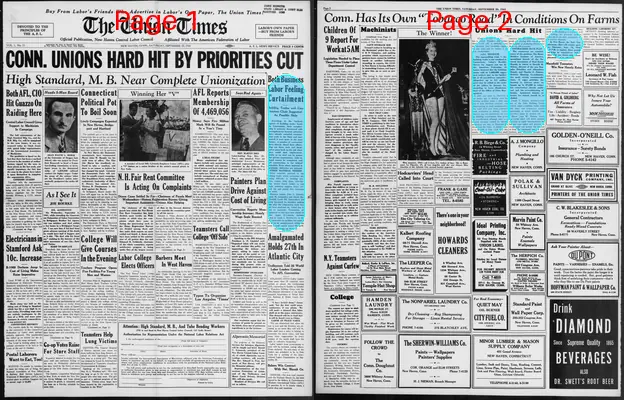
The Union Times
New Haven, New Haven County, Connecticut
What is this article about?
Building trades in Connecticut face unemployment due to wartime priorities curtailing construction materials like steel and lumber. Contractors close offices; labor leaders seek solutions via clinics. A.F.L. predicts crisis for 1.6M workers nationwide, with up to 2.5M jobless by Jan. 1. Recommendations include priorities for defense housing.
Merged-components note: Merged article on business and labor curtailment due to priorities with its continuation on page 2.
Clippings
1 of 2
OCR Quality
Full Text
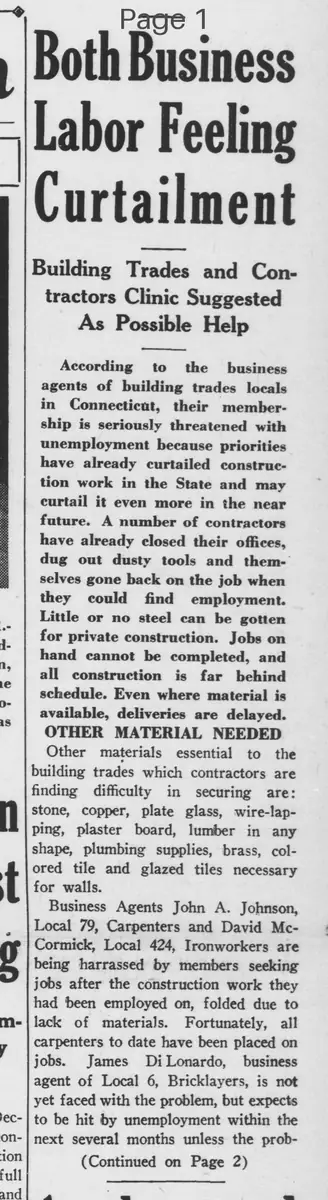
Labor Feeling
Curtailment
Building Trades and Contractors Clinic Suggested
As Possible Help
According to the business agents of building trades locals in Connecticut, their membership is seriously threatened with unemployment because priorities have already curtailed construction work in the State and may curtail it even more in the near future. A number of contractors have already closed their offices, dug out dusty tools and themselves gone back on the job when they could find employment.
Little or no steel can be gotten for private construction. Jobs on hand cannot be completed, and all construction is far behind schedule. Even where material is available, deliveries are delayed.
OTHER MATERIAL NEEDED
Other materials essential to the building trades which contractors are finding difficulty in securing are: stone, copper, plate glass, wire-lapping, plaster board, lumber in any shape, plumbing supplies, brass, colored tile and glazed tiles necessary for walls.
Business Agents John A. Johnson, Local 79, Carpenters and David McCormick, Local 424, Ironworkers are being harassed by members seeking jobs after the construction work they had been employed on, folded due to lack of materials. Fortunately, all carpenters to date have been placed on jobs. James Di Lonardo, business agent of Local 6, Bricklayers, is not yet faced with the problem, but expects to be hit by unemployment within the next several months unless the problem is solved. Plumbers and Steamfitters, Local 349, is suffering from the shortage since plumbing supplies for new work and for repairs is almost unobtainable.
A.F.L. ESTIMATE
The approaching crisis in the building trades is not confined to Connecticut. Labor's Monthly Survey for August, put out by the American Federation of Labor, declared that the building trades with its 1,600,000 organized workers may be the hardest hit of all non-defense industries.
Altogether up to 2.5 million more may be added to the ranks of the jobless by January 1st, according to Leon Henderson, head of the Office of Price Management.
A start was made in Hartford a few weeks ago in dealing with the priorities problem when a clinic was held to help distribute contracts and subcontracting to small manufacturers who could shift over from consumer goods production to defense. Labor however, was not represented, nor was the building construction field given any consideration although there is a housing shortage created by defense production not only in Hartford but throughout the State. A similar clinic is to be held in New York City this month. In New Haven several small factories hitherto producing consumer goods are pooling their resources for the purpose of producing defense products on sub-contracts.
CONTRACTORS HAVE PLAN
The contractors are certainly aware of the problem. The Home Builders Institute of America, specialized branch of the National Association of Real Estate Boards, in letters to Donald M. Nelson, director of the new Supplies Priorities and Allocations Board; and Charles F. Palmer, Defense Housing Co-ordinator, has made certain recommendations. It urges priorities for housing in defense areas on homes up to $7,500 in value; for construction already under way and for re-conditioning of homes. Apartment houses, or homes for rentals should be included.
Joseph T. Rourke, secretary-treasurer of the State Building Trades Council, urges a building trades clinic with labor and contractors equally represented, at which feasible steps and plans might be worked out.
Mayor John W. Murphy favors any action which will divert essential materials to small manufacturers and business men which will prevent unemployment and protect the interests of both the community and the small business men. He feels strongly that many preventable mistakes have been made in the awarding of contracts and in handling the priorities problem, which are in the main responsible for the present situation.
In New Haven, the State Employment office will remain open on Thursday, Sept. 18, from 7-9 P.M. to register those people working in non-defense industries who are faced with unemployment due to priorities.
What sub-type of article is it?
What themes does it cover?
What keywords are associated?
What entities or persons were involved?
Where did it happen?
Story Details
Key Persons
Location
Connecticut, Hartford, New Haven
Event Date
August; By January 1st; Thursday, Sept. 18
Story Details
Building trades unions in Connecticut report severe unemployment threats from wartime priorities limiting construction materials, halting projects, and delaying deliveries. Contractors revert to manual labor; specific shortages in steel, stone, copper, etc. National A.F.L. survey predicts crisis for 1.6M workers. Proposals include clinics for labor-contractor collaboration and priorities for defense housing to mitigate job losses.