Thank you for visiting SNEWPapers!
Sign up free
Editorial
August 11, 1878
The Morning Star And Catholic Messenger
New Orleans, Orleans County, Louisiana
What is this article about?
Editorial critiques the National Party's unclear identity and foolish monetary policy of unbacked government notes, while agreeing on the need for tax exemptions for the poor and protection from labor market fluctuations, but opposing graduated taxes as unjust.
Clipping
OCR Quality
95%
Excellent
Full Text
The National Party.
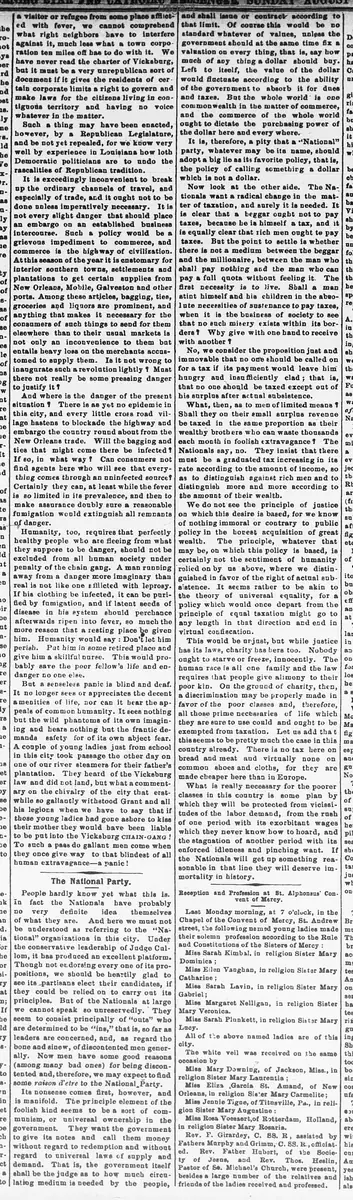
People hardly know yet what this is. In fact the Nationals have probably no very definite idea themselves of what they are. And here we must not be understood as referring to the "National" organizations in this city. Under the conservative leadership of Judge Callom, it has produced an excellent platform. Though not endorsing every one of its propositions, we should be heartily glad to see its partisans elect their candidates, if they could be relied on to carry out its principles. But of the Nationals at large we cannot speak so unreservedly. They seem to consist principally of "outs" who are determined to be "ins," that is, so far as leaders are concerned, and, as regard the bone and sinew, of discontented men generally. Now men have some good reasons (among many bad ones) for being discontented and, therefore, we may expect to find some raison d’être to the National Party.
Its nonsense comes first, however, and is manifold. The principle element of the foolish kind seems to be a sort of communism, or universal ownership in the government. They want the government to give its notes and call them money without regard to redemption and without regard to universal laws of supply and demand. That is, the government itself shall be the judge as to how much circulating medium is needed by the people, and shall issue or contract according to that limit. Of course this would be no standard whatever of values, unless the government should at the same time fix a valuation on every thing, that is, say how much of any thing a dollar should buy. Left to itself, the value of the dollar would fluctuate according to the ability of the government to absorb it for dues and taxes. But the whole world is one commonwealth in the matter of commerce, and the commerce of the whole world ought to dictate the purchasing power of the dollar here and everywhere.
It is, therefore, a pity that a National party, whatever may be its name, should adopt a big lie as its favorite policy, that is, the policy of calling something a dollar which is not a dollar.
Now look at the other side. The Nationals want a radical change in the matter of taxation, and surely it is needed. It is clear that a beggar ought not to pay taxes, because he is himself a tax, and it is equally clear that rich men ought to pay taxes. But the point to settle is whether there is not a medium between the beggar and the millionaire, between the man who shall pay nothing and the man who can pay a full quota without feeling it. The first necessity is to live. Shall a man stint himself and his children in the absolute necessities of sustenance to pay taxes, when it is the business of society to see that no such misery exists within its borders? Why give with one hand to receive with another?
No, we consider the proposition just and immovable that no one should be called on for a tax if its payment would leave him hungry and insufficiently clad; that is, that no one should be taxed except out of his surplus after actual subsistence. What, then, as to men of limited means? Shall they on their small surplus revenue be taxed in the same proportion as their wealthy brothers who can waste thousands each month in foolish extravagance? The Nationals say, no. They insist that there must be a graduated tax increasing in its rate according to the amount of income, so as to distinguish against rich men and to distinguish more and more according to the amount of their wealth.
We do not see the principle of justice on which this desire is based, for we know of nothing immoral or contrary to public policy in the honest acquisition of great wealth. The principle, whatever that may be, on which this policy is based, is certainly not the sentiment of humanity relied on by us above, where we distinguished in favor of the right of actual subsistence. It seems rather to be akin to the theory of universal equality, for a policy which would once depart from the principle of equal taxation might go to any length in that direction and end in virtual confiscation.
This would be unjust, but while justice has its laws, charity has hers too. Nobody ought to starve or freeze, innocently. The human race is all one family and the law requires that people give alimony to their poor kin. On the ground of charity, then, a discrimination may be properly made in favor of the poor classes and, therefore, all those prime necessaries of life which they are sure to use could and ought to be exempted from taxation. Let us add that this seems to be pretty much the case in this country already. There is no tax here on bread and meat and virtually none on common shoes and cloths, for they are made cheaper here than in Europe.
What is really necessary for the poorer classes in this country is some plan by which they will be protected from vicissitudes of the labor demand, from the rush of one period with its exorbitant wages which they never know how to hoard, and the stagnation of another period with its enforced idleness and pinching want. If the Nationals will get up something reasonable in that line they will deserve immortality in history.
People hardly know yet what this is. In fact the Nationals have probably no very definite idea themselves of what they are. And here we must not be understood as referring to the "National" organizations in this city. Under the conservative leadership of Judge Callom, it has produced an excellent platform. Though not endorsing every one of its propositions, we should be heartily glad to see its partisans elect their candidates, if they could be relied on to carry out its principles. But of the Nationals at large we cannot speak so unreservedly. They seem to consist principally of "outs" who are determined to be "ins," that is, so far as leaders are concerned, and, as regard the bone and sinew, of discontented men generally. Now men have some good reasons (among many bad ones) for being discontented and, therefore, we may expect to find some raison d’être to the National Party.
Its nonsense comes first, however, and is manifold. The principle element of the foolish kind seems to be a sort of communism, or universal ownership in the government. They want the government to give its notes and call them money without regard to redemption and without regard to universal laws of supply and demand. That is, the government itself shall be the judge as to how much circulating medium is needed by the people, and shall issue or contract according to that limit. Of course this would be no standard whatever of values, unless the government should at the same time fix a valuation on every thing, that is, say how much of any thing a dollar should buy. Left to itself, the value of the dollar would fluctuate according to the ability of the government to absorb it for dues and taxes. But the whole world is one commonwealth in the matter of commerce, and the commerce of the whole world ought to dictate the purchasing power of the dollar here and everywhere.
It is, therefore, a pity that a National party, whatever may be its name, should adopt a big lie as its favorite policy, that is, the policy of calling something a dollar which is not a dollar.
Now look at the other side. The Nationals want a radical change in the matter of taxation, and surely it is needed. It is clear that a beggar ought not to pay taxes, because he is himself a tax, and it is equally clear that rich men ought to pay taxes. But the point to settle is whether there is not a medium between the beggar and the millionaire, between the man who shall pay nothing and the man who can pay a full quota without feeling it. The first necessity is to live. Shall a man stint himself and his children in the absolute necessities of sustenance to pay taxes, when it is the business of society to see that no such misery exists within its borders? Why give with one hand to receive with another?
No, we consider the proposition just and immovable that no one should be called on for a tax if its payment would leave him hungry and insufficiently clad; that is, that no one should be taxed except out of his surplus after actual subsistence. What, then, as to men of limited means? Shall they on their small surplus revenue be taxed in the same proportion as their wealthy brothers who can waste thousands each month in foolish extravagance? The Nationals say, no. They insist that there must be a graduated tax increasing in its rate according to the amount of income, so as to distinguish against rich men and to distinguish more and more according to the amount of their wealth.
We do not see the principle of justice on which this desire is based, for we know of nothing immoral or contrary to public policy in the honest acquisition of great wealth. The principle, whatever that may be, on which this policy is based, is certainly not the sentiment of humanity relied on by us above, where we distinguished in favor of the right of actual subsistence. It seems rather to be akin to the theory of universal equality, for a policy which would once depart from the principle of equal taxation might go to any length in that direction and end in virtual confiscation.
This would be unjust, but while justice has its laws, charity has hers too. Nobody ought to starve or freeze, innocently. The human race is all one family and the law requires that people give alimony to their poor kin. On the ground of charity, then, a discrimination may be properly made in favor of the poor classes and, therefore, all those prime necessaries of life which they are sure to use could and ought to be exempted from taxation. Let us add that this seems to be pretty much the case in this country already. There is no tax here on bread and meat and virtually none on common shoes and cloths, for they are made cheaper here than in Europe.
What is really necessary for the poorer classes in this country is some plan by which they will be protected from vicissitudes of the labor demand, from the rush of one period with its exorbitant wages which they never know how to hoard, and the stagnation of another period with its enforced idleness and pinching want. If the Nationals will get up something reasonable in that line they will deserve immortality in history.
What sub-type of article is it?
Economic Policy
Partisan Politics
Taxation
What keywords are associated?
National Party
Currency Policy
Graduated Taxation
Tax Reform
Economic Discontent
Labor Protection
What entities or persons were involved?
National Party
Judge Callom
Nationals
Editorial Details
Primary Topic
Critique Of The National Party's Platform On Currency And Taxation
Stance / Tone
Critical Of Monetary Policy, Supportive Of Tax Reform For The Poor But Opposed To Graduated Income Tax
Key Figures
National Party
Judge Callom
Nationals
Key Arguments
Nationals Lack Clear Identity And Consist Of Discontented 'Outs' Seeking Power
Opposition To Nationals' Communist Like Idea Of Government Issued Unbacked Currency
Government Should Not Fix Values Or Issue Money Without Regard To World Commerce
Agreement On Need For Tax Reform To Exempt The Poor From Taxation
Taxes Should Only Be On Surplus After Subsistence
Opposition To Graduated Taxation As Unjust And Potentially Leading To Confiscation
Support For Exempting Necessaries Of Life From Taxation On Charitable Grounds
Need For Protection Of Laborers From Economic Vicissitudes