Thank you for visiting SNEWPapers!
Sign up free
Literary
April 1, 1788
The Daily Advertiser
New York, New York County, New York
What is this article about?
This 1787 essay, attributed to the author of Common Sense, examines the causes and consequences of political issues for Parliament, critiquing England's national debt, funding schemes, paper currency, and taxation. It compares England's finances unfavorably to France's, warning of party divisions, credit erosion, and war risks under Pitt's plan.
Clipping
OCR Quality
95%
Excellent
Full Text
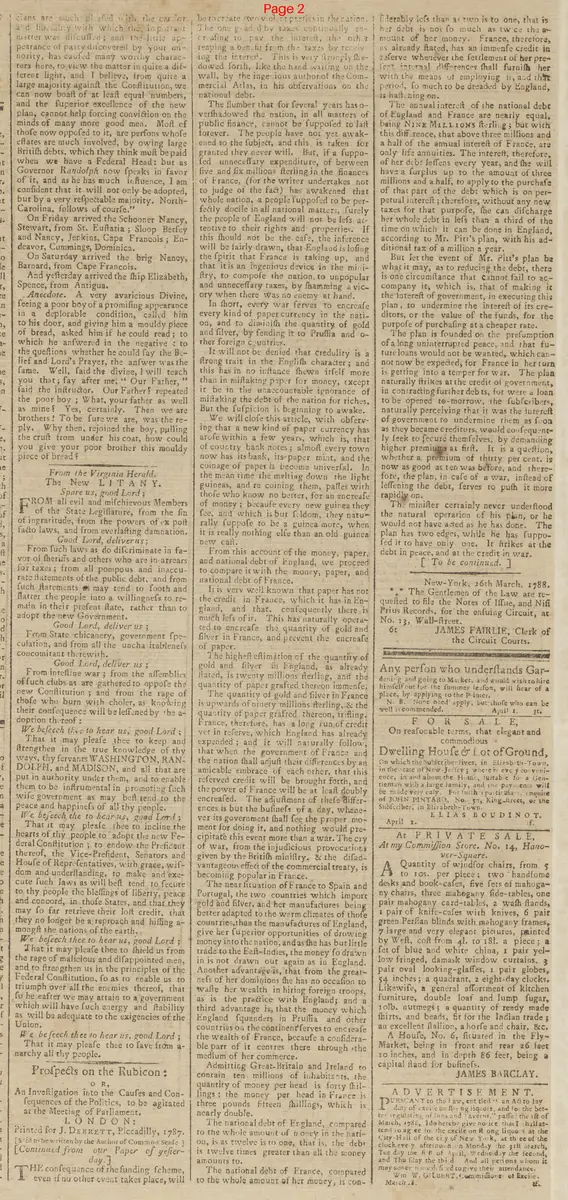
Prospects on the Rubicon:
OR,
An Investigation into the Causes and Consequences of the Politics, to be agitated at the Meeting of Parliament.
LONDON:
Printed for J. Debrett, Piccadilly, 1787.
[Said to be written by the Author of Common Sense]
[Continued from our Paper of yesterday.]
The consequence of the funding scheme, even if no other event takes place, will be to create two violent parties in the nation. The one goaded by taxes continually encroaching to pay the interest, the other reaping a benefit from the taxes by receiving the interest. This is very strongly shadowed forth, like the hand writing on the wall, by the ingenious author of the Commercial Atlas, in his observations on the national debt.
The slumber that for several years has overshadowed the nation, in all matters of public finance, cannot be supposed to last forever. The people have not yet awakened to the subject, and this is taken for granted they never will. But, if a supposed unnecessary expenditure, of between five and six millions sterling in the finances of France, (for the writer undertakes not to judge of the fact) has awakened that whole nation, a people supposed to be perfectly docile in all national matters, surely the people of England will not be less attentive to their rights and properties. If this should not be the case, the inference will be fairly drawn, that England is losing the spirit that France is taking up, and that it is an ingenious device in the ministry, to compose the nation, to unpopular and unnecessary taxes, by hammering a victory when there was no enemy at hand.
In short, every war serves to increase every kind of paper currency in the nation, and to diminish the quantity of gold and silver, by sending it to Prussia and other foreign countries.
It will not be denied that credulity is a strong trait in the English character; and this has in no instance shewn itself more than in mistaking paper for money, except it be in the unaccountable ignorance of mistaking the debt of the nation for riches. But the suspicion is beginning to awake.
We will close this article, with observing that a new kind of paper currency has arose within a few years, which is, that of country bank notes; almost every town now has its bank, its paper mint, and the coinage of paper is become universal. In the mean time the melting down the light guineas, and re-coining them, passes with those who know no better, for an increase of money; because every new guinea they see, and which is but seldom, they naturally suppose to be a guinea more, when it is really nothing else than an old guinea new cast.
From this account of the money, paper, and national debt of England, we proceed to compare it with the money, paper, and national debt of France.
It is very well known that paper has not the credit in France, which it has in England, and that, consequently there is much less of it. This has naturally operated to increase the quantity of gold and silver in France, and prevent the increase of paper.
The highest estimation of the quantity of gold and silver in England, as already stated, is twenty millions sterling, and the quantity of paper grafted thereon immense.
The quantity of gold and silver in France is upwards of ninety millions sterling, & the quantity of paper grafted thereon, trifling.
France, therefore, has a long run of credit yet in reserve, which England has already expended; and it will naturally follow, that when the government of France and the nation shall adjust their differences by an amicable embrace of each other, that this reserved credit will be brought forth, and the power of France will be at least doubly increased. The adjustment of these differences is but the business of a day, whenever its government shall see the proper moment for doing it, and nothing would precipitate this event more than a war. The cry of war, from the injudicious provocations given by the British ministry, & the disadvantageous effect of the commercial treaty, is becoming popular in France.
The near situation of France to Spain and Portugal, the two countries which import gold and silver, and her manufactures being better adapted to the warm climates of those countries, than the manufactures of England, give her superior opportunities of drawing money into the nation, and as she has but little trade to the East-Indies, the money so drawn in is not drawn out again as in England.
Another advantage is, that from the greatness of her dominions she has no occasion to waste her wealth in hiring foreign troops, as is the practice with England; and a third advantage is, that the money which England squanders in Prussia and other countries on the continent serves to increase the wealth of France, because a considerable part of it centers there through the medium of her commerce.
Admitting Great-Britain and Ireland to contain ten millions of inhabitants, the quantity of money per head is forty shillings: the money per head in France is three pounds fifteen shillings, which is nearly double.
The national debt of England, compared to the whole amount of money in the nation, is as twelve is to one. that is. the debt is twelve times greater than all the money amounts to.
The national debt of France, compared to the whole amount of her money, is considerably less than as two is to one, that is her debt is not so much as twice the amount of her money. France, therefore, as already stated, has an immense credit in reserve whenever the settlement of her present internal differences shall furnish her with the means of employing it all, and that period, so much to be dreaded by England, is hastening on.
The annual interest of the national debt of England and France are nearly equal, being Nine Millions sterling; but with this difference, that above three millions and a half of the annual interest of France, are only life annuities. The interest, therefore, of her debt lessens every year, and she will have a surplus up to the amount of three millions and a half, to apply to the purchase of that part of the debt which is on perpetual interest; therefore, without any new taxes for that purpose, she can discharge her whole debt in less than a third of the time on which it can be done in England, according to Mr. Pitt's plan, with his additional tax of a million a year.
But let the event of Mr. Pitt's plan be what it may, as to reducing the debt, there is one circumstance that Cannot fail to accompany it, which is, that of making it the interest of government, in executing this plan, to undermine the interest of its creditors, or the value of the funds, for the purpose of purchasing at a cheaper rate.
The plan is founded on the presumption of a long uninterrupted peace, and that future loans would not be wanted, which cannot now be expected, for France in her turn is getting into a temper for war. The plan naturally strikes at the credit of government, in contracting further debts, for were a loan to be opened to-morrow, the subscribers, naturally perceiving that it was the interest of government to undermine them as soon as they became creditors, would consequently seek to secure themselves, by demanding higher premiums at first. It is a question, whether a premium of thirty per cent. is now as good as ten was before, and therefore, the plan, in case of a war, instead of lessening the debt, serves to push it more rapidly on.
The minister certainly never understood the natural operation of his plan, or he would not have acted as he has done. The plan has two edges, while he has supposed it to have only one. It strikes at the debt in peace, and at the credit in war.
[To be continued.]
OR,
An Investigation into the Causes and Consequences of the Politics, to be agitated at the Meeting of Parliament.
LONDON:
Printed for J. Debrett, Piccadilly, 1787.
[Said to be written by the Author of Common Sense]
[Continued from our Paper of yesterday.]
The consequence of the funding scheme, even if no other event takes place, will be to create two violent parties in the nation. The one goaded by taxes continually encroaching to pay the interest, the other reaping a benefit from the taxes by receiving the interest. This is very strongly shadowed forth, like the hand writing on the wall, by the ingenious author of the Commercial Atlas, in his observations on the national debt.
The slumber that for several years has overshadowed the nation, in all matters of public finance, cannot be supposed to last forever. The people have not yet awakened to the subject, and this is taken for granted they never will. But, if a supposed unnecessary expenditure, of between five and six millions sterling in the finances of France, (for the writer undertakes not to judge of the fact) has awakened that whole nation, a people supposed to be perfectly docile in all national matters, surely the people of England will not be less attentive to their rights and properties. If this should not be the case, the inference will be fairly drawn, that England is losing the spirit that France is taking up, and that it is an ingenious device in the ministry, to compose the nation, to unpopular and unnecessary taxes, by hammering a victory when there was no enemy at hand.
In short, every war serves to increase every kind of paper currency in the nation, and to diminish the quantity of gold and silver, by sending it to Prussia and other foreign countries.
It will not be denied that credulity is a strong trait in the English character; and this has in no instance shewn itself more than in mistaking paper for money, except it be in the unaccountable ignorance of mistaking the debt of the nation for riches. But the suspicion is beginning to awake.
We will close this article, with observing that a new kind of paper currency has arose within a few years, which is, that of country bank notes; almost every town now has its bank, its paper mint, and the coinage of paper is become universal. In the mean time the melting down the light guineas, and re-coining them, passes with those who know no better, for an increase of money; because every new guinea they see, and which is but seldom, they naturally suppose to be a guinea more, when it is really nothing else than an old guinea new cast.
From this account of the money, paper, and national debt of England, we proceed to compare it with the money, paper, and national debt of France.
It is very well known that paper has not the credit in France, which it has in England, and that, consequently there is much less of it. This has naturally operated to increase the quantity of gold and silver in France, and prevent the increase of paper.
The highest estimation of the quantity of gold and silver in England, as already stated, is twenty millions sterling, and the quantity of paper grafted thereon immense.
The quantity of gold and silver in France is upwards of ninety millions sterling, & the quantity of paper grafted thereon, trifling.
France, therefore, has a long run of credit yet in reserve, which England has already expended; and it will naturally follow, that when the government of France and the nation shall adjust their differences by an amicable embrace of each other, that this reserved credit will be brought forth, and the power of France will be at least doubly increased. The adjustment of these differences is but the business of a day, whenever its government shall see the proper moment for doing it, and nothing would precipitate this event more than a war. The cry of war, from the injudicious provocations given by the British ministry, & the disadvantageous effect of the commercial treaty, is becoming popular in France.
The near situation of France to Spain and Portugal, the two countries which import gold and silver, and her manufactures being better adapted to the warm climates of those countries, than the manufactures of England, give her superior opportunities of drawing money into the nation, and as she has but little trade to the East-Indies, the money so drawn in is not drawn out again as in England.
Another advantage is, that from the greatness of her dominions she has no occasion to waste her wealth in hiring foreign troops, as is the practice with England; and a third advantage is, that the money which England squanders in Prussia and other countries on the continent serves to increase the wealth of France, because a considerable part of it centers there through the medium of her commerce.
Admitting Great-Britain and Ireland to contain ten millions of inhabitants, the quantity of money per head is forty shillings: the money per head in France is three pounds fifteen shillings, which is nearly double.
The national debt of England, compared to the whole amount of money in the nation, is as twelve is to one. that is. the debt is twelve times greater than all the money amounts to.
The national debt of France, compared to the whole amount of her money, is considerably less than as two is to one, that is her debt is not so much as twice the amount of her money. France, therefore, as already stated, has an immense credit in reserve whenever the settlement of her present internal differences shall furnish her with the means of employing it all, and that period, so much to be dreaded by England, is hastening on.
The annual interest of the national debt of England and France are nearly equal, being Nine Millions sterling; but with this difference, that above three millions and a half of the annual interest of France, are only life annuities. The interest, therefore, of her debt lessens every year, and she will have a surplus up to the amount of three millions and a half, to apply to the purchase of that part of the debt which is on perpetual interest; therefore, without any new taxes for that purpose, she can discharge her whole debt in less than a third of the time on which it can be done in England, according to Mr. Pitt's plan, with his additional tax of a million a year.
But let the event of Mr. Pitt's plan be what it may, as to reducing the debt, there is one circumstance that Cannot fail to accompany it, which is, that of making it the interest of government, in executing this plan, to undermine the interest of its creditors, or the value of the funds, for the purpose of purchasing at a cheaper rate.
The plan is founded on the presumption of a long uninterrupted peace, and that future loans would not be wanted, which cannot now be expected, for France in her turn is getting into a temper for war. The plan naturally strikes at the credit of government, in contracting further debts, for were a loan to be opened to-morrow, the subscribers, naturally perceiving that it was the interest of government to undermine them as soon as they became creditors, would consequently seek to secure themselves, by demanding higher premiums at first. It is a question, whether a premium of thirty per cent. is now as good as ten was before, and therefore, the plan, in case of a war, instead of lessening the debt, serves to push it more rapidly on.
The minister certainly never understood the natural operation of his plan, or he would not have acted as he has done. The plan has two edges, while he has supposed it to have only one. It strikes at the debt in peace, and at the credit in war.
[To be continued.]
What sub-type of article is it?
Essay
Satire
What themes does it cover?
Political
Taxation Oppression
Commerce Trade
What keywords are associated?
National Debt
Paper Currency
Funding Scheme
France Comparison
Pitt Plan
Taxes
War Finance
Credit Reserve
What entities or persons were involved?
[Said To Be Written By The Author Of Common Sense]
Literary Details
Title
Prospects On The Rubicon: Or, An Investigation Into The Causes And Consequences Of The Politics, To Be Agitated At The Meeting Of Parliament.
Author
[Said To Be Written By The Author Of Common Sense]
Subject
The Politics, To Be Agitated At The Meeting Of Parliament.
Key Lines
The Consequence Of The Funding Scheme, Even If No Other Event Takes Place, Will Be To Create Two Violent Parties In The Nation. The One Goaded By Taxes Continually Encroaching To Pay The Interest, The Other Reaping A Benefit From The Taxes By Receiving The Interest.
The Quantity Of Gold And Silver In France Is Upwards Of Ninety Millions Sterling, & The Quantity Of Paper Grafted Thereon, Trifling.
The National Debt Of England, Compared To The Whole Amount Of Money In The Nation, Is As Twelve Is To One.
The Plan Has Two Edges, While He Has Supposed It To Have Only One. It Strikes At The Debt In Peace, And At The Credit In War.